

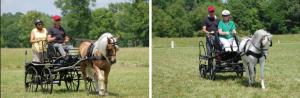
Larry Poulin Driving Clinic
At Bob Martin’s Split Tree Farm in Moscow, TN May 21-23.
Nashoba Carriage Association hosted a driving clinic with Larry Poulin at Bob Martin’s Split Tree Farm in Moscow, TN May 21-23. Drivers came from several states in the mid-south region, e.g., Alabama, Arkansas, Mississippi, Tennessee, to learn from the driving master.
Headquartered in Massachusetts, Larry Poulin is a trainer, teacher, FEI level dressage rider, whip, and many times National Driving Pairs Champion. He won the USET Pairs Championship in 1985, 1986, 1988, 1989, 1995, 1996, 2007, and 2009. He was the highest-placed American driver as a member of the USET pairs squad at the World Championships in 1985, 1987 and 1989. He also competed as an individual in 1993 at the World Pairs Driving Championships in Gladstone, NJ. In 1995, he was selected to anchor the USET World Championship team in Poland, which finished eighth. In 2001, Poulin again competed for the U.S. in the Pairs Driving World Championship, where he drove to a team seventh place finish. He represented the U.S. at the World Championships in France in 2003, and again in Poland in 2005. His 2009 win of the USEF Pair Horse National Championship marked Larry’s 10th World Championship.
With each clinic participant, Larry first checked the harness and equipment for proper fit on the pony or horse. Next he ascertained the driver’s and pony’s driving problems both by watching the participants drive their own ponies, and by driving them himself. Then he formulated a plan to help the driver and pony improve their performance.
With ponies that were stiff to one direction and overly bent in the other direction, he demonstrated exercises to help the horse become “loose and flexible.” Suppling exercises are important to “flex and soften the horse,” he said. On one pony’s stiff side, he recommended, “Flex and soften the horse to the right; bring his haunches to the left.” When driving a 40-meter circle, “Scribe the circle,” he said. “Don’t let it become larger or smaller. It needs equal bend in both directions, on both sides.” He often asked the audience questions about the horse’s movements and position. “Back muscles raise the horse, allowing him to push more,” he explained. So after seeing some quick results with the suppling exercises he had just demonstrated with the horse, he quipped, “Training the human being takes longer.”
With another pony he worked on contact because the pony tended to overflex in the bridle, while at the same time had a pace too quick. “Be careful with the contact. When you pick up the contact, the pony puts his nose to his chest, over-flexing. Then you find the reins flopping, not in contact.” He checked the bit and noted that “the bit gets wrapped around the tongue and the curb chain does nothing, which is a blessing.” He worked with the driver first on slowing the pony’s tempo, counting the desired tempo like a metronome, “1-2, 1-2,” while also helping the driver relax. Then he worked the pony on the desired contact without overflexing. He also used the lateral flexing exercises with this pony, but the bending work was more difficult because of the contact problem.
Poulin had some general advice for safety in and around the cart. “Never train your horses without a halter on. Use the camp halter (that he had explained earlier). Be respectful, but never let your guard down. Don’t ever let the horse get away. There’s a frequent saying around driving when the pony gets away: 'I thought you had him.’”
Poulin had his “Driven Dressage” DVD available for purchase at the clinic. It is available at the Carriage Association of America website, as well as other online outlets.


