

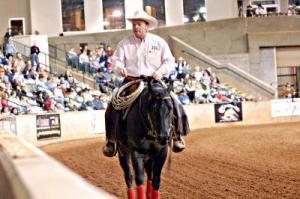
Ken McNabb: No Regrets Horsemanship
“The way a horse works is important to understand"
By Nancy Brannon
Ken McNabb grew up on a traditional ranch in the mountains of Wyoming. From age 16 he knew that horsemanship and teaching was his calling. His mentor was John Lyons, and he was one of the first John Lyons certified trainers. When asked what is the hardest part of competing in Road to the Horse, he said, “You don’t get to explain what you’re doing nearly enough.” So McNabb was glad to have some time to explain and demonstrate to the audience his techniques.
“My philosophy is No Regrets Horsemanship. You don’t want to feel bad about what you do to the horse. The horse doesn’t choose to do things we ask, but is willing to do them.
“Release is what teaches the horse,” McNabb emphasized. Where I release is what’s important to the horse. So ask yourself, what is the horse doing now that I can release? The horse is happiest and in peace when left alone. Ask, how can I give the horse what he wants? Where am I going to leave him alone? If I ask the horse to do something and if I can get closer to the goal of what I want to achieve, I’ll release. If I didn’t get closer to the goal, I’ll ask more. It’s all about training muscle memory and you do it by repetition.
“The way a horse works is important to understand. The horse lives in a herd, but only one horse is in charge of the scenario. That horse tells the others when to run. Horses survive by following a leader and being part of a family, not off on his own.” So the rider must be the leader and in charge of the scenario. “Teach a horse to wait for the rider, and you do this through release and reward. It doesn’t really matter if you pet the horse on the neck. The horse mainly wants to be left alone.”
Teaching the horse lateral movements involves bending the horse slightly while keeping the horse straight. “A horse that you can pick up on is responsive,” McNabb explained. He demonstrated by riding down an arena wall, as if riding along a fence line. “Ride straight down the line. Pick up the horse and slightly bend his nose towards the fence. As you ride down the line, use your inside leg to push your horse’s shoulders away from the fence. Keep you horse fairly straight, soften, and soon you are going sideways, leg yielding.”
McNabb described teaching a horse to stop. “What is one word every person in the world knows how to use to stop a horse? Whoa! Teach your horse to stop on that word alone. You can back it up with reins.” McNabb stressed being clear with your cues. “Cues are not suggestions or requests; they are commands. Whenever you say WHOA, the horse should stop immediately. The horse should stop off the word, even if the rider is in the wrong position. If the word doesn’t mean something, they why say it? You’ve heard people repeat commands lots of times. But don’t repeat commands numerous times; make your words mean something. If the horse doesn’t stop on command, then back up and change directions. When the horse stops where you want him, then leave him alone; let him know he did it right.
“Ask horses to do something and if they try, release! Ask what you can do to reward the horse for what they are doing. The question is did the horse try to do what I asked? If so, release! When all is said and done, have no regrets,” McNabb charged.


