

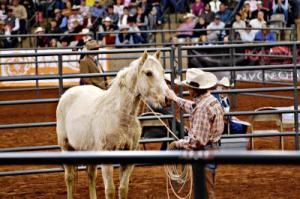
Craig Cameron Complete Horsemanship: Keep It Simple
"Riding is a thinking man’s game"
By Nancy Brannon
“Keep it simple. Both horses and people do better!” Craig Cameron began his training techniques demonstration at Road to the Horse. “I once wrote a book for horse people. I wrote short paragraphs and included big pictures,” he joked. Also, “the more fun you have, the better your horse and you will perform.”
“It takes time to make a good horse. The key to being an effective trainer is to learn to use effective techniques and stick with the fundamentals: flexibility, position and control. Flexibility leads to good position, which leads to better control,” Cameron explained.
It’s one thing to be able to flex your horse, but can you do it when the horse’s feet are moving? Cameron demonstrated how to do that and to teach the horse to yield to pressure. “You yield [meaning the horse], and I’ll yield. You be soft and I’ll be soft. Soon we’re working together,” he explained. “Never stop working for flexibility, position, and control. You want to be able to bend the horse, and control the hindquarters. You must be able to achieve this at the slower gaits before speeding up.”
Cameron also emphasized letting the horse gain confidence. “You have to gain the horse’s trust and respect. Every time you ride the horse, you either gain or lose his respect and confidence.” The key is to “let the horse relax his mind. The best horsemen are casual around their horses, training in a relaxed fashion with an effective process.” Work with the horse, rather than against him, then positive results will come.
Cameron demonstrated leg yielding. “Look to the right, move the horse to the left. Just barely touch the horse’s mouth. Then change direction without changing bend.”
Working on the rider’s skills and position is even more important. “Don’t work so much on the horse as you work on yourself,” Cameron said. “Work on feel, timing, rhythm, tempo, balance and consistency. Awareness is what it’s all about. The ability to sense, hear, and feel what the horse is doing.”
“The most classic mistake is over-bending the horse. To keep the horse straight, the key is the outside rein. Keep the horse straight with the outside rein. Straightness comes through flexibility; keep the horse straight from poll to tail,” Cameron explained. “Don’t pull on the horse’s reins. Keep the horse between your legs and hands, and learn to push with the outside rein. Teach your horse to turn on one rein, on a light rein.”
Cameron demonstrated a bending exercise by circling the horse. “Make your circles smaller and smaller. The horse’s hind legs step further underneath him.” Using this technique, Cameron eventually had the horse spinning.
Cameron taught the basics of stopping. “Learn to sit in the middle of the horse. Sit, stop riding, say WHOA, and pick up on the reins. The way you say WHOA makes a difference. Say w-w-h-h-o-o-o-a-ah. Want to learn a good way to remember how to say WHOA and use good, slow hands? Just sing the song, ‘I want a man with a slow hand. I want a rider with an easy touch.’”
Training is more than just teaching the mechanics of movements. “You’ve got to love horses,” he said. “Give them affection even when they’re not doing so well. Horses have good days and bad days. But it’s their disposition that is important: their willingness to accept training. Accept what the horse gives you and give the horse respect. Horses keep us honest.”
Other sage quotes from Cameron:
“Horsemanship is good for kids, too. It gives them a job to do.”
“Riding is a thinking man’s game.”
“Remember to have fun!”


