

Dressage Training in the German Tradition
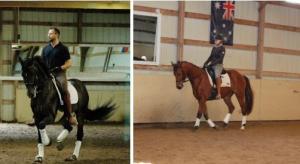
Stephan Kiesewetter at Highgrove Farm
By Nancy Brannon
Stephan Kiesewetter, training and sales manager at Pferdesport Wintermuhle in Germany, came to the U.S. for a clinic tour this February. He stopped at Kim Gentry’s Highgrove Farm in Collierville, TN for a two-day clinic, February 12-13. Stephan has been working with Kim for seven and a half years, and she developed her professional career with Stephan as her trainer and mentor. “He Germanized me,” she said, referring to developing her own dressage riding and training through the tried-and-true German system.
Wintermuhle is one of the biggest sale barns in Germany for Sport and Dressage horses, recognized for high quality horses, with anywhere from 70 to 100 horses for sale at any given time. Kiesewetter also runs another facility near Berlin with about 150 horses, where most of the breeding program is housed. As former Vice Director of the German Reitschule (riding school) at Warendorf for ten years, Stephan has a reputation for quality training and quality education of trainers. This is his tenth year coming to the U.S. to train horses and trainers.
Kiesewetter admits, “Dressage does have its origins in circus riding and we do teach our horses tricks.” But that is only a superficial view of thorough dressage training. Keisewetter and Kim believe in the value of the German system. Dressage training in this method “does it in a way that does not harm the horse’s body or physique or the horse’s mind,” Kiesewetter said. “The horse should enjoy the work,” Gentry added.
Kiesewetter continued: “When you are dealing with another creature’s body, health and mind, riders and trainers have an ethical responsibility [to the horse], and the training system has to fulfill this ethical responsibility. In Germany, there is an attitude of respect toward this occupation [dressage training]. It’s a highly respected profession, respected throughout the whole German culture. The profession is structured, professional, and disciplined.” There, trainers work long hours on a daily basis learning the system and perfecting their skills.
“You can’t train without being a rider and, conversely, you can’t ride without training the horse,” Kiesewetter said. Kiesewetter is skilled at two main aspects of training: “I’m good at educating trainers n teaching them how to teach others and how to train horses. I educate people who train horses for other people.”
“He puts you in a situation with guidance where you learn to figure things out,” Gentry added. “Stephan, by nature, has a very good feel for rhythm.” “But you can’t take for granted that others have it,” Kiesewetter said.
This leads to his second skill: in the saddle as a rider, he is good at guiding horses to reach their peak performance in terms of their abilities. He does it “in a way without over-challenging the horse or over-doing things. In other words, without 'blowing their minds,'" Kiesewetter explained. “I am good at reading horses’ minds and using their strengths to guide them to their performance peak.”
A third point Kiesewetter stressed, “When I’m at the point where the horse is trained the way I want it, then everybody can ride the horse.” “Then, the horse is almost guaranteed a good life from that point,” Gentry added. “He turns out very well trained, well-made horses. He also provides an on-going support system. He doesn’t just sell you a horse and walk away. He gives clinics here; people can travel to Germany n whatever is needed.”
Together, Gentry and Kiesewetter have produced about 10-12 good horses that are still in the program, “either here at Highgrove or somewhere else,” Gentry said. “We also try to keep horses in the network, particularly as riders move on to other horses,” and these horses become available for new riders. Kiesewetter works with other trainers, too, if the client has one.
Pferdesport Wintermuhle GmbH is a family-owned business in the fourth generation, with ideal training conditions. Kiesewetter oversees the entire training operation at Wintermuhle, where there are 17 trainers and five masters on staff. He has a wide range of horses in training and for sale, from youngsters just started to international Grand Prix horses. One of his riders is already qualified for the World Equestrian Games. He runs five shows a year, including one of the biggest shows in Germany. He comes to the U.S. for two-week clinic tours five times a year, with about ten main places he visits on a rotating schedule. He always comes to Gentry’s barn. “That’s my lifetime punishment,” he joked.
For more information, visit: http://www.germanhorses.com/ and http://www.kimgentrydressage.com/.


