

Aussie Horse Trainer Rides Through Town
Joe Guy’s approach is to communicate with horses in their own language
By Nancy Brannon
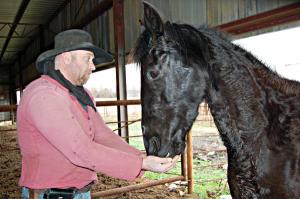
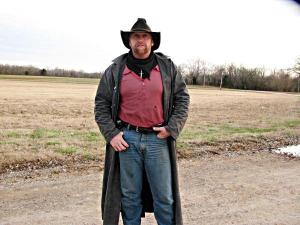
The locals at B & C Trucking called him “Dundee,” referring to the movie character Crocodile Dundee. “Does he carry a big knife?” I asked. “Sure does,” they told me. I met this Aussie horse trainer as he was passing through the Bolivar, Tennessee area on his trek across the country on horseback.
His real name is Joe Guy and he left Leipers Fork, Tennessee December 6th on a ride across the country, headed for Tucson, Arizona. He originally hails from Sydney, Australia, so he has that “G’day mate” Australian accent. He and his wife and family are currently headquartered south of Nashville at Bright Star Stable in College Grove, Tennessee. He's a horse trainer, a singer and guitar player, and has written his autobiography, titled Living a Dream. The book tells about his life, the challenges, the things he has done, and the obstacles he has overcome.
His “dream” got off to a rough start in Australia. Guy related his story: “At age 12 I ran away from home. I didn’t go to school for a year and left school at age 14 unable to read and write. At 15 I was a regular in the local nightclubs. At 16 I drank up my pay at the bars. At 17 I was drinking, doing drugs, and hanging out with the wrong people, doing the wrong things. Later that year I walked into a gym and started training and learning martial arts. That turned my life around. At 19, I settled up, took my rifle and rode horses for the next two years. I’ve shot my food; I drove sheep and cattle. I worked on one of the biggest properties in Australia n a ranch of 500 square miles. At 20 I picked up the guitar and taught myself to play, sing, and write songs. Within three months I was playing on stage and within three years I was singing on TV, on a morning show called 'Ernie & Denise.’ At 23 I was doing street performing, designing my own costumes, make-up, and characters. At 25 I took my street performing to the nightclubs. I eventually became the promotions manager for several nightclubs with my street performing act.”
Through all this time acting, singing and performing, he always yearned to go back to horses. “I’ve got cowboy in my blood,” he said. “So I quit my job and the security of work and rode from the top to the bottom of Australia. About halfway through that trip, I became an actor in a Cabaret: Dracula’s Theater and Restaurant on the Gold Coast. I played six different characters and spend four hours a night performing. Then I quit that job, hopped back on a horse and finished the ride to the bottom of Australia.” He rode somewhere between 3,500 and 4,000 miles on that trip.
“In 2000 I made my first big trip across the pond to the U.S. I was in a band called Fate’s Call and had recorded an album in Australia. We brought it to the U.S. to promote it. We knocked on doors, traveled around the country dropping off demos. Met some big name folks in Nashville, but nothing came of it.” He also wrote a rock opera called “Fate’s Call” to inspire youth and show them the perils of youth that come from peer pressure to do the wrong things. “In 2001, 9/11 happened, so it was not a good time to come back to America.”
Back in Australia, he returned to breaking and training horses at Stratford on Avon, named after the famous bard’s home in England. He worked horses out in the open n no pens, yards, or panels, and in a very short time. “I could lead an unbroken horse down to the river (Avon) on Saturday and could ride the horse back into town on Sunday.” He has done 500 to 1,000 mile rides from Stratford on horses he broke and trained.
In February 2009 he sold his house and business in Australia and came “to America to follow a dream,” Guy said. “I published the book, recorded an album, and rode 1500 miles around the country to get a feel for the horse training here and the problems people are having with their horses. In six months here, I worked with about 100 horses, and completed seven training clinics. I show people how to break in a horse in record time: half an hour to an hour to be on their back. In a 7-day break in, I can have the horse quiet as a mouse and can trust the horse to ride him down a highway through a city.”
For this trip, Guy is riding a 7-year-old Tennessee Walking Horse mare he got in North Carolina. “The owner was going to dig a hole, shoot her, and bury her because they couldn’t break her. I broke her in five days. On day six I rode her over the mountain. On day seven I rode her through Gatlinburg and Pigeon Forge,” Guy recounted.
Guy said he is not about owning horses nor keeping horses for long periods of time. He likes to find new, appropriate homes for the horses he’s trained. “Every horse I get is another horse saved,” he said. He believes that all horses can be fixed and that you also have to fix the owner! “The horse has to learn to understand us. You can read it in the horse’s eyes and behavior whether or not he understands what to give. It’s not 'horse whispering;' it’s horse psychology, reverse psychology, and body language. The ultimate goal is to have the horse accept everything I want to do with him/her.”
Guy’s goal is to also teach as many people along the way as much as he can. He wants people to be able to break and train their own horses and he teaches them every “trick” he knows. “People get hurt or killed every year, but the big name trainers only want to offer their knowledge in increments at high prices. I don’t agree with that.”
Training Techniques
Guy’s approach is to communicate with horses in their own language, on their social terms. He teaches a “greater fear” to the horse, so that whatever else he asks the horse to do will be a piece of cake, easy for them to do. It’s mainly about ranking n showing the horses where they stand in the pecking order and where humans rank in the pecking order.
An hour of chance: “People bring their crazy, problem horses to me; some have been to trainers and come back unsuccessful in their training. In an hour I’ll have a different horse.
Communication: Guy uses two main noises to communicate with the horse: a “chase blow,” a “pfft!” sound used with hands up and direct eye contact to move the horse away from him. He makes a “stallion snort” sound and drops his head to bring the horse back to him. If the horse gets “stuck” and doesn’t want to go forward, Guy says “hup, hup” to move the horse forward.
“There’s no pain, no harm, no sweat. It’s not the horse’s body you want, but his mind. Once you get his mind, he’ll give the body. Too many trainers are about getting only the body. It’s about eye contact, too. You have to know that the horse trusts and respects you, so is not afraid when you step on him.”
Greater Fear, Pressure and Release: “This is the key to everything you’ll ever do with any horse you ever own,” Guy said. Guy works the horses in a “bush bridle” headstall, like a halter and lead rope. The headstall is also designed to hang between two trees to tie the horse, like a crosstie or to a picket line. He uses a flag on a stick, then a tarp along with his two sounds to expose the horse to distraction and to pressure the horse. Then he gives the horse release. “Push the horse past every thing he thought was scary and show him something far greater. I show the horse so much that after the horse has had the flag and tarp all over him for an hour, he things that putting on the saddle or going down the road is no big deal. It’s not about sacking them out; it’s about getting their minds. The horse knows he’s being ranked n put in his place in the pecking order and learns that you are the boss. Then he is calm for whatever he has to do: picking up his feet for the farrier, loading on a trailer, whatever. The horse respects you as the boss, like he would respect the lead horse.”
This is the most important point: Guy establishes himself as the “dominant horse. The technique is so simple but it works!” he said. And people are amazed at his technique. “The horse wants to know where he stands with us, but we often give confusing signals. You have to let him know his rank and where he stands in the pecking order. If you observe horses a pasture, they are calm. When you put in a new horse in the pasture, there is havoc until the herd gets it sorted out and the new horse knows where he stands. Then things return to calm,” he explained. “It’s the smart horses that give us the hardest time. They always question where their ranking is.”
He throws the saddle on the horse every time. “Don’t muck around,” he advised. “Notice the horse’s eye to see how much attention he’s paying to you. You have to give the horse a warning that you about to ask him to do something. But also let the horse know there’s no future in questioning you.”
Guy has 20 years experience breaking horses and riding them down roads, across lands. “I haven’t had a horse yet that I couldn’t fix. The same techniques work on every horse, but the amount of time you spend with the techniques varies according to the horse. Horses are all different and you can’t treat them all the same. You have to be able to break up the time of your techniques to suit the animal.”
To read more about Joe Guy, visit http://www.joeguylongrider.com/. He offers a special deal to Mid-South Horse Review readers: his book, CD, and DVD for $25, including postage and handling. He is also available to do clinics to demonstrate his techniques.


