

Equine Acupuncture Restores the Body's Balance
Dr. Kathy Mitchener, Equine Acupuncture Practitioner and Veterinarian
By Nancy Brannon
“There’s always an improvement in the quality of life,” with acupuncture, said Dr. Kathy Mitchener, DVM a certified Equine Acupuncture Practitioner and Veterinarian. “Even though you may not get specific desired results in terms of measurable variables, 100% of my clients ask me what I can do to improve their animal’s quality of life. And I can always do something,”
“Acupuncture has been around over 2,000 years; it’s tried and true. It is effectively used on people, horses, dogs and cats. The greatest hurdle to overcome with people’s acceptance of acupuncture is the verbiage. Acupuncture is steeped in Chinese metaphysical language, which makes it difficult for Western scientific minds to understand. And I’m one of them! I don’t understand Qi (pronounced Chi), which is the term for the vital force/energy that moves throughout the body. In fact, historically, the Frenchman, Soulie de Morant, who first translated Qi as “energy” actually mistranslated the term. He over-simplified the meaning of the word, as well as the Chinese understanding and appreciation for the body and how it works. It’s much more complicated than that,” Mitchener said.
Qi refers to the myriad phenomena that infuse movement and life into beings. Some say it refers to the “life force,” but that is also narrow and misleading, as in different contexts Qi can mean different things. For example, Chinese medicine identifies specific types of Qi, which refer to very specific phenomenon in the body or the environment. Qi is not simply one thing. What Qi describes is really very ordinary. Everyone “feels” Qi. Have you ever felt happy or sad? Hot or cold? Felt pain or pleasure? This is experiencing the Qi in your body and environment.
Qi contains this general meaning as well as more precise meanings for specific types of Qi. For example, “Qing Qi” refers to the clear air that is inhaled by the lungs and transferred to the blood. This is a reference to oxygen. Shui Gu Zhi Qi, literally “Water and Grain Qi” is the Qi contained in food and drink, the essence of which is extracted by the spleen and stomach, is distributed by the blood, and nourishes the various tissues of the body. “Wei Qi”, translated to “Defensive Qi,” protects the body from external pathogens. This is the Qi of the immune system.
Mitchener was a practicing veterinarian before she learned acupuncture. “I learned acupuncture from a neuro-anatomical approach. If you take every acupuncture point and dissect it to its component in the nervous system, you can trace the route the stimulus takes. The needles stimulate the nervous system either directly by tapping a nerve or indirectly by causing a local reaction that stimulates the nerve. The nerves translate that information to the higher centers n the nerve roots, spinal cord, lower centers of the brain, and higher centers of the brain. The brain and higher centers process the information and send out adaptive signals that restore normality. What we don’t understand is exactly how the brain translates that information to bring about the correction.” Mitchener illustrated her explanation with specific instances. “If you have a colic, for example, where the ileus has stopped [lack of intestinal motility], I can hit [put needles in] points # 21, 22...27 track n any or all points that affect the intestinal tract. That information goes to the brain and the brain sends signals to speed up the intestines. Then you get poop! The converse is also true. If the intestinal tract is moving too fast, you get diarrhea. I can put needles in those same points and the brain transmits information to slow the intestinal tract.”Acupuncture is also effective at relieving pain. “We don’t have much in the way of pain medication for horses,” Mitchener noted. “We expect horses to perform and most horses are agreeable and willing to perform, even to the point of performing under discomfort. Acupuncture is a safe, effective way to alleviate the pain associated with a performing athlete. It is safer for the horse and the rider and should improve the horse’s longevity. It has no [harmful] side effects!”
Michener explained the relationship between muscle physiology and pain relief. “If you have a hurt joint, for example, you will still try to use it as best you can, but you will compensate by putting more weight on the sound joint. Over time, you will over develop the sound joint, under develop the sore joint, and become out of balance as a result. Acupuncture relieves the pain and restores the body’s balance. Acupuncture should preserve the length of the horse’s performance life and make him/her happier.”She continued, “We all use horses for purposes for which they are not built. We ask them to do things they may not be anatomically designed to do. So, as a consequence, we inadvertently facilitate some damage. Acupuncture can overcome some of that damage by improving muscle function, joint flexibility, decreasing pain and facilitating overall better movement.”
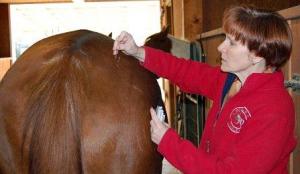
Before inserting the needles, Dr. Mitchener runs a diagnostic check of the horse’s body to see where there are sore or tender areas. “You can use a smooth dowel or a pen. I use a needle case,” Mitchener said. She traces diagnostic lines along the horse that pick up the muscle trigger points and positive acupuncture points.
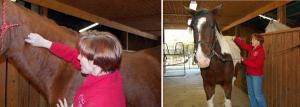
For those squeamish about needles, know that the insertion of acupuncture needles is virtually painless. If you observe the procedure being done on a horse with sore muscles, you will witness a transformation from tenseness and flinching from touch, to a relaxed state of seeming pleasure. “Zen is in the zone,” observed Debra Heaton about her Thoroughbred ex-race horse being treated by Dr. Mitchener. “Zinnie digs it; he relaxes into it,” Mitchener observed. Even before Dr. Mitchener finished inserting all 25 to 40 needles over his body, Zennie relaxed, dropped his neck and just stood as if in a quiet state of meditation.
Dr. Mitchener uses two types of needles, neither of which penetrates the body very far n only 1 to 1 1/2 centimeters. She uses silicon coated needles on the back and stainless needles on other parts of the body. The first three needles are inserted in the “relaxation channel,” which is located on the front of the shoulder. “These are two large intestine and one gall bladder points,” she said. “The pins go in until they 'catch.’ It feels like the body grabs the needle. You stop inserting when you feel the collagen grab the needle. Generally I leave the needles in about 20 to 25 minutes. The Chinese say it takes about 20 minutes for Qi to make one revolution in the body. Some horses don’t accept it so well, so I only leave them in about 10 minutes. Other horses would stand for hours with the needles in.”
Mitchener emphasized that acupuncture is not a replacement therapy for other kinds of medicine, but is an augmenter and works in times when traditional medicine fails. Her ultimate goal is for acupuncture to become recognized as a medical specialty that can be practiced with a consistent approach. She’s been working with cancer patients for 25 years and finds that acupuncture always improves the patient’s quality of life.
For more information about Veterinary Acupuncture, contact Dr. Kathy Mitchener, DVM at Angel Care, 6923 Stage Road, Bartlett, TN; phone (901) 385-9172. Or email her at Kmitchener @aol.com.


