

The Battle of Collierville
October 23 - 25
By Beth Emmons; introduction by Tommy Brannon
On the weekend of October 23 n 25, Confederate and Union re-enactors gathered on the former Twin Hill Ranch east of Collierville, TN to demonstrate how the Civil War Battle of Collierville was fought on Sunday October 11, 1863. A fort had been constructed by federal troops, close to where the Collierville Town Square is today, for the purpose of guarding the Memphis & Charleston Railroad, now known as the Norfolk Southern Railroad. Confederate forces under the command of General James R. Chalmers, with about 2,000 troops, commenced a raid on the fort to damage the tracks and cut the telegraph wires. At the very height of the attack, a train on its way to Corinth MS, carrying Union General William Tecumseh Sherman with an accompanying staff of about of about 250 U.S. Army regulars, arrived. Sherman immediately took charge and reinforcements were requested from Memphis and Germantown before the telegraph wires were cut. The Confederate raiders were able to capture and burn the rear of Sherman’s train, stealing his favorite mare named Dolly. Later in the afternoon after much heated fighting, Union reinforcements arrived and the Confederates disengaged. The real battle took place in one afternoon, but the re-enactment was demonstrated Friday, Saturday and Sunday so that more people in the area would have the opportunity to learn from this education program.
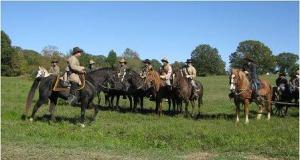
After a rain soaked beginning, the third and final day of the Civil War Re-enactment proved to be the best. The sun shone down and the breeze carried with it the fragrance of the Twin Hill Ranch persimmon trees. The crowd watched in anticipation as the Battle of Collierville began. Cannon and small arms rifles blasted away, throwing smoke rings skyward. Horses were scattered throughout the battlefield scene, bravely playing their roles. Men struggled to position cannons, as the horse drawn cannons moved more quickly and easily.
“Horse artillery units were attached to cavalry units. Those cannons would all be horse-drawn during the real battle,” explained Chris Stewart of Alabama. Chris and his son, Nathan Forrest Stewart were among several Alabama participants in the day’s battle. They all seemed to be authorities on Civil War Horses.
“Gaited horses were popular. Standardbreds were commonly used in the South. Morgans and Thoroughbreds were more often used by Northern troops. Texas and Oklahoma used some Mustangs. There were no Tennessee Walking Horses or Quarter Horses back then. ” When asked which breed works better for reenactments, they all agreed that it didn’t really matter. “A good horse is a good horse, no matter what the breed.
“The tack and equipment used with the horses are meticulously authentic,” affirmed a re-enactor, who rode his Percheron/Walking Horse cross. “Chris made all the saddles and Ed Herring made all the caissons.”
To get a horse used to the noise, they start bringing them to reenactments. “You just keep them further out until they get used to it.” Sometimes they use ear plugs on horses if they are skittish. For driving a pair of horses, putting a green horse beside a seasoned re-enactment horse is a good way to teach them.
The equipment they bring and the roles they play depend upon which unit they’re assigned to for that day’s battle. Sometimes they’re in Confederate Walton’s Battalion. Other days they assume a role in drug company founder Eli Lilly’s Union Artillery battery.


