

The Last Ride Of Meriwether Lewis
Three riders trace path from St. Louis to Washington, D.C.
By Nancy Brannon
Meriwether Lewis was honored October 7th in Hohenwald, Tennessee, the final resting place of the legendary explorer. This year marked the 200th anniversary of Lewis’ mysterious death near Hohenwald, also his burial place. The Montana-based Lewis and Clark Trail Heritage Foundation organized the event, called "Undaunted Courage: The Final Journey,” which was attended by approximately 2,000 people.
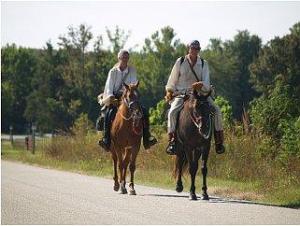
To further mark this 200th anniversary, Scott Mandrell, a school teacher from St. Louis; pipe fitter Jay Rotkin, aka “Bob Frazier,” a historical friend of Lewis; and Steve Wicker, manager at Bob Evans Restaurant, made Lewis’ trek by horseback. They followed the last ride of Meriwether Lewis in 1809 from St. Louis to Washington, D.C. His ride was cut short on the Natchez Trace at Grinder’s Stand, near present-day Hohenwald, Tennessee.
From St. Louis, Lewis took a flatboat down the Mississippi, planning to go all the way to Natchez, where he would complete his journey to Washington by ship. En route, he changed his mind, landed at the Fourth Bluff, at what would become Memphis, TN, and then rode horseback east via the Natchez Trace. “On October 10, 1809 he stopped at an inn on the Natchez Trace called Grinder's Stand, about 70 miles from Nashville, Tennessee. Lewis requested a glass of whiskey almost as soon as he climbed down from his horse. After he excused himself from dinner, he went to his bedroom. In the predawn hours of October 11, the innkeeper heard gunshots. Servants found Lewis badly injured from multiple gunshot wounds. He died shortly after sunrise.”
The play, “Grinder’s Stand: A Tragedy of Blood,” tells the story of Captain Meriwether Lewis' mysterious death, which historians debate was murder or suicide. Chapter Six in The Fate of the Corps: What Became of the Lewis and Clark Explorers After the Expedition, by Larry E. Morris, also tells the story of “The Mysterious Death of Meriwether Lewis.”
Two years ago Mandrell, Rodkin, and Wicker rode the Lewis and Clark National Bicentennial Expedition trail. This year “we are doing the last bit of the trail,” said Scott Mandrell. They took a flatboat from St. Louis and landed in Memphis, where they left their flatboat on display at the Mud Island Museum. Scott joked about the all the rain the mid-South has been getting lately and said “We had two of everything on board“ [the flatboat]. They completed the expedition by riding on horseback Lewis’ trail from Memphis to Hohenwald. “After landing at Ft. Pickering, Lewis then rode overland along the Chocktaw Trails, which became the good roads of today,” Mandrell explained.
The trio rode rescued horses from Adapting Gaits, based near Lynnville, TN, a non-profit Thoroughbred retirement and rescue organization. Carol Molloy provided the horses and met them in Memphis with the horses. Since riding retired racehorses might be quite dangerous through a highly urbanized, automobile-oriented area, the trio started their trip at Shelby Farms. “We didn’t know the horses before we got on them to ride the trail,” Scott said. “We wanted to start from old Fort Pickering, now where the Arkansas-Memphis Bridge crosses the Mississippi, I-55, at the Ornamental Metal Museum. But the horses were very high strung, extremely ready to go, so we thought it would not be a good idea to ride them through downtown Memphis. So they trailered the horses to Shelby Farms and we started at the AgriCenter. We were a bit worried about our time schedule. We had to be in the saddle by September 28, and we are on schedule now. We want to arrive in Hohenwald by October 10. We are trying to get through Tennessee safely with the horses.”
The trio arrived in the Somerville area the first weekend in October and spent the night at a farm just east of the town. The horses had good pasture that night, but carrying all the gear that horses and riders need depends on modern transportation. “We have one truck and a two-horse trailer that hop scotches with us along the trail. We have hay and feed in the trailer for the horses. They’re eating good green grass in Tennessee and are very happy. The horses were very prepared for the trip, and we have lots of sweet feed for them. People along the way have been very helpful and generous. People delivered buckets of water for the horses to Owens Automotive (on Hwy. 64 near Oakland). We got our ride serviced there!” Scott quipped. “People have been great to us! People help out along the way, but we still have to have a broader system of support.”
The cause of Lewis’ death is still a mystery. “The State of Tennessee says it was homicide; the federal government says it was suicide. I’m curious as to which is the correct version and we would like to know what really happened. The family is trying to get him exhumed for DNA testing,” Scott said.
At 3:00 a.m. on October 11, the three got in their truck and drove home. One last expedition accomplished. “We love what we’re doing. We love the history of it. It is an interesting moment both in natural history and in Tennessee history.”
Photos of the historical site of Ft. Pickering can be seen at: http://www.civilwaralbum.com/vicksburg/memphis7.htm. For information about Adapting Gaits, see http://www.adaptinggaits.org/. To read about the National Bicentennial Exhibition see: http://www.lewisandclarkexhibit.org/index_flash.html and the Lewis and Clark expedition history, see http://www.lewisandclarktrail.com/biography.htm. More on Lewis’ mysterious death can be read in The Death of Meriwether Lewis: A Historic Crime Scene Investigation, by Kira Gale and James E Starrs and at their website: http://www.deathofmeriwetherlewis.com.


