

Oh My Aching Back!
The withers is often the site of soreness or misalignment
By Nancy Brannon
You don’t have to have a backache for an examination by the Chiropractor, but if you have one, Chiropractic “adjustment” might just fix the problem. That goes for your horse, too.
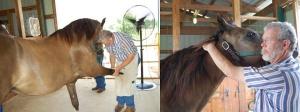
Dr. Troy J. “Ike” Nelson of Athens, Alabama recently made a barn call to Jana Smith’s Windrunner Farms near Moscow, Tennessee. He had appointments with horses at the stable and horses brought in. For most horses, their owners had detected some type of problem with the way they moved; for others, it was a routine check-up to see if everything is aligned and moving properly. As Dr. Nelson moved the horses’ joints from head to tail, some offered resistance at first, but relaxation and the telltale chewing motion soon followed.
Dr. Nelson begins every exam by watching the horse move when jogged or walked. He has a small video camera to film the horse’s movement. Then the horse is brought into the barn for the physical exam. He generally “checks to determine if any joints are stuck,” he explained. He checks the normal, active range of motion; then moves the joint into the passive range of motion. This checking routine indicates whether a joint may be stuck open or stuck closed.
The first horse he examined was Mary Hopkin’s 13-year-old Missouri Fox Trotter, Baron. Then he examined one of Jana’s horses and moved on to others in the barn. Local large animal veterinarian Jennifer Dunlap brought her off-the-track Thoroughbred “Wiseguy” for an exam. He has started hunter training, but was showing several movement “issues.”
Dr. Nelson begins the exam at the horse’s head with the temporomandibular joint (TMJ), aka the jaw joint “because so many nerves come through that area,” he said. “The nerves in this joint move through all the body to the brain, similarly to the way the nerves in your finger influence all the systems of the body, such as the digestive system.” He checks for pain and sensitivity using acupuncture points as well.
From the TMJ he continues down the horse systematically. He checks the vertebrae in the neck, “to see if the second cervical vertebra is moving as it should or is stuck,” he said. Then he examines the front legs, picking them up in a flexed position then stretching them out straight. Next he moves along the back, the pelvis, and to the back legs. “I use a movement called the hula, just like a person doing a hula hoop, moving the hips,” he said. Dr. Nelson noted that the horse he was examining was not as flexible on the right hind, and that right hip was staying a little higher than the left hip. The last part of the examination is pulling the horse’s tail straight out behind. That’s the “typical photo” many people take of the Chiropractic exam, Nelson said, but he emphasized that does not truly represent the exam process.
“A joint that has been injured won’t have a normal range of motion, but I can tell if it needs help,” Nelson said. When he finds a joint that “needs help,” he gives it a short thrust called an “adjustment” to “free the stuckness. The joint will loosen so it moves more as it should move. The most interesting part is that “it doesn’t look like a lot is happening. But you can see a major difference in how a horse moves after the adjustment,” Nelson said.
“The beauty of Chiropractic 'adjustment,’ done correctly, is that you can’t hurt anything. It may not always help, but it can’t hurt. I am working with such short levers that I can’t dislocate the joint with what I am doing. If you ever see a horse’s leg being pulled up with a rope, that’s NOT Chiropractic work,” he clarified. “Chiropractic medicine uses a short lever, high velocity adjustment. It’s the same principle that applies to human Chiropractic work.” Dr. Nelson also explained the difference between an Osteopath and a Chiropractor: “An Osteopath uses a long lever manipulation, which is not a Chiropractic adjustment.
Dr. Nelson has been in veterinary practice for 32 years, with both large and small animals. He works a few days a week at Country Clinic near Athens, Alabama, but stays on the road most of the time making clinical visits to barns all over the country.
Nelson and his wife are endurance riders and his entrance into Chiropractic Medicine began as a result of a misstep his wife’s horse took on an endurance ride. “My wife’s horse stepped in a hole and torqued her pelvis. She didn’t stand level after that and traditional medicine didn’t have a fix for her. So I took her to a Chiropractor in Nashville who worked on her for about 20 minutes. I took her back ten days later for another 20-minute session. After those two sessions, she was back to normal! We took her to an endurance ride a week later and she placed fourth.
“As time went on, I called him back for other horses with other issues. I was calling him to come down so frequently that he advised me to learn how to do it myself. So I decided to go back to school and learn it. I started school last fall and passed the certification exam in February 2009. I love it!”
Dr. Nelson explained some of the common problems he sees and how they are caused. The withers is often the site of soreness or misalignment. “If the withers are stuck to the left, it’s probably a mounting problem. It may be the rider not getting into the saddle correctly” or pulling up with heavy tugging on the horse’s back. “Ropers often have withers problems. When the calf hits the end of the rope, the calf jerks the saddle,” causing strain on the withers. “Ropers also have TMJ problems, especially if they’re being ridden in tie downs. This keeps the head immobile” and coupled with the calf jerking, can bring on multiple problems.
“When a mare gives birth, there is a high likelihood that something in the pelvic area can be harmed and the joint get stuck. There is also a high likelihood the foal has issues.” Dr. Nelson recommended that, just as horse owners call the veterinarian to exam both mare and foal after foaling, it is a good idea to call the Chiropractor within a couple of days of foaling. That way, if the foal has problems, the Chiropractor can adjust the foal.
“There are rider-caused issues of all kinds. Bouncing too much in the saddle is hard on a horse’s back. Ill-fitting saddles can cause problems, as can saddle pads and saddles and pads that sit on the withers.” Every time you saddle your horse, make sure to pull the saddle pad up under the pommel so the pad won’t pull on the horse’s withers. “A horse can injure the withers just by rolling on something hard on the ground. And any kind of trauma can cause joint problems.”
Dr. Nelson recommends adding Chiropractic examinations to your horse’s routine maintenance, just as you do teeth exams, vaccinations, Coggins tests, and deworming. He has plans to return to the Moscow area about once a month “if there is enough interest.” He needs about ten horses to examine to make his trip worthwhile. The basic exam fee is around $75 plus a trip charge.
For more information, call Dr. Troy J. Nelson at 256-431-6538 or email him at dvmchrio10351@hotmail.com.


