

“Jine” the cavalry!
Re-enacting is a family hobby
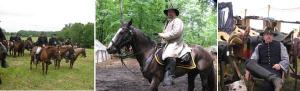
Set the “way back machine” to June 10, 1864, the Civil War battle of Brice’s Crossroads. It is a hot summer day in North Mississippi, where Confederate forces commanded by General Nathan Bedford Forrest defeated Federal troops commanded by General Samuel D. Surges. Then, fast forward to June 12, 2009 for the 145th anniversary and reenactment of the battle on the same ground as the original battle, just east of Baldwyn, MS. Cavalry re-enactors from many parts of the country participated with their riding horses, along with other horses, mules and oxen used to pull caissons and wagons.
It takes 3 or 4 years to train a good cavalry horse, according to Col. Mike Cheaves, a Knox County Sheriff’s Deputy of Knoxville, TN, who is the commander of the First Tennessee Cavalry USV re-enactors. His group depicts an actual regiment of Federal Cavalry that existed from 1862-1865. “Many people do not know that most of the people in the east Tennessee mountains supported the Union. One of the commanders of the real First Tennessee Cavalry was the son of President Andrew Johnson, and the last commander was the son of Parson Brownlow, who became Governor of Tennessee after the war,” Mike said.
Col. Chuck Tarwater of Millington, TN is the division Cavalry commander of Cleburn’s Division of Re-enactors, Inc., the Confederate reenactment group that organized the event. Chuck said, “Training cavalry troopers and horses is a challenge. The only time the whole unit gets together is at reenactments, so I rely on my individual commanders to train in small groups.“
Doug Kid is a saddler, fabricator and trainer. He owns Border States Leatherworks in Springdale, AR. He trains riders and horses for reenacting and makes all of the saddles, tack and weapons, both Union and Confederate. He is a stickler for detail and can tell you all of the little nuances of the equipment: which units used what equipment and where, even to the point of what type of brad was used to attach a particular D ring.
Ken Knopp is a noted author and expert on Civil war tack and accoutrements. He restores and makes all kinds of equipment for civil war reenactments at his Confederate Saddles business. Both Doug and Ken are called Suttlers. They travel to reenactments, setting up booths where the re-enactors can purchase the hard-to-find items they need.
Most of the riders interviewed at the event were riding older horses. Chuck Tarwater was riding a 15-year-old Quarter Horse named Cody. Mike Cheaves said his horse is 26 years old and has been doing this for 18 years. A group depicting Confederate Texas Rangers was bragging that each of their horses is over 20 years old.
Mike Cheaves explained the training that horses need and how many horses do not take to the job. “The hardest part is getting them used to the gunfire,” he said. To practice, horses do drill team-like maneuvers very close together. “The most popular breeds are Quarter Horses, Saddlebreds and Tennessee Walkers mixed,” Mike continued. “Geldings do better than mares; they have a better work ethic.” The color of the horse can be an issue. “To be historically accurate, the horses need to be black, dark bay or brown; a few were gray, but no paints or appaloosas. If anyone is interested in getting into this hobby I suggest you try before you buy. Re-enactors will be happy to loan you a horse, uniform and weapons. After you are hooked, you can acquire the things you need a little at a time,” Mike explained.
Re-enacting is a family hobby. Mike’s daughter Sarah Cheeves rides along with her dad, playing the part of a male trooper. “We go to about 18 reenactments a year, camping out and educating children and families about American History.”
More information about the First Tennessee cavalry can be found at: www.1sttennesseecavalry.com. Information about Cleburne’s Division is at: www.cleburnes-division.com.
Find more information on Doug Kidd’s Border States Leatherworks at: www.borderstates.com. Information about Ken Knopp’s tack is at www.confederatesaddles.com.


