

For This Craftsman, The Hat’s The Thing
“That fraction of an inch can make all the difference in how a hat looks on you.”
If you really want to understand hats, western or dress, you need to spend some time talking with Mike Moore. The manufacturer's representative recently opened Buckaroo Hatters just off the square in Covington, Tennessee, where he plies his second trade in a deep, narrow storefront packed with various forms, blocks, steamers, and machinery used in the custom hat making business. He’s a walking, talking book on hats and their history, and it’s obvious he loves what he does.
Moore says there are only a couple of hundred custom hatters in the country, and the nearest one to the Mid-South is several hundred miles away, in Oklahoma.
The 54-year old Moore, a native of Water Valley, Mississippi, has a long history with hats; leaning against the wall is a large photo of Moore in 1956 astride a pony and sporting a large black cowboy hat. From that early age, he spent a lot years wearing “box hats,” the headwear that’s mass-produced in large factories. But they just didn’t suit him.
“I'm a nut about historical accuracy...because I've done a lot of Old West and Civil War stuff,” said Moore. So he started cutting apart hats, reshaping and resizing the crowns because the ones on modern, factory hats were just too tall. Other folks with a keen interest in authentic style “...just went nuts over them,” he said. Being mechanically inclined, he decided he could go one better and actually begin making his own hats.
“I just started collecting hat blocks, tools and other stuff,” he said, and began expanding his capabilities and his client base. But what he couldn't find were the raw “body blanks” other custom hat makers used to manufacture their products. Until he paid a visit to a hat maker out west. They were chatting nicely about tools and techniques, but when Moore asked about a source for hat blanks the other guy “...zipped up tighter than a hat band.”
His break came thanks to a little industrial espionage. When a delivery driver unloaded a box of blanks while he was standing there in the shop, he spied the shipping label and learned that “...all the custom hat makers get their blanks right here in the great, sovereign state of Tennessee.”
Turns out there's a plant in Winchester, Tennessee that used to supply the blanks to the Stetson factory in Texas. The Winchester plant was eventually sold, and became a supplier to a maker of “highway trooper” hats.
Moore struck up a relationship with the owner, got his hands on a few blanks, and tried his hand at building a complete hat from the blank up. He says some of his early efforts were lacking, but he eventually produced hats worthy of the open market. When someone in Texas, where the cowboy hat is king, requested one of his “Boss Of The Plains” hats “...it was the proudest moment of my life...I felt like I had finally made the big time...when he told me 'this hat is dead on,' I had a grin on my face from ear to ear.”
Now, he's sold hats in most of the western states, which he considers a real honor since the legends of custom hat making are all located out there.
Moore said that up until the 1940's every town had it's own custom hatter, and he can tell you why they went the way of the buffalo. When the soldiers started returning from World War II, they were tired of wearing helmets and hats as part of their everyday attire, and chose the freedom of not wearing headgear on a regular basis. “Also, the automobiles had changed from mostly open models to closed sedans, and the hats were hitting (the ceiling)....What was keeping the hat industry alive was the western hats...Fedoras, or dress hats, just plummeted.” To show just how dramatic the decline was, he notes that in 1905, Stetson was located in Philadelphia, Pennsylvania, occupied 102 square city blocks, and employed some 7500 people to make 120 million dozen hats. Yep, 12 times 120 million.
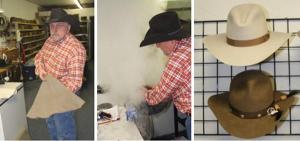
Moore can pass along a lot of hat history while he's engaged in his craft. I was fortunate enough to get scaled-down demonstration of the whole process, from a comparison of raw 100X and 10X body blanks to the finishing touches, all the way down to brim trimming to the proper width and bevel-edging. If he's really busy, you may not get access to the total wealth of his knowledge, but it's hard to imagine anyone could visit his shop and not come away having learned something new about hats.
He says the Fedoras are coming back, and he's making quite a few of them for people who need a hat for dress occasions. One of the racks in his shop sports a bright yellow “Dick Tracy” hat, among a big selection of more modest styles.
Moore has been almost twenty years learning the business, basically teaching himself and picking up pointers where he could. It was about four years ago that he got really serious and started up business in his garage. His success has outgrown the garage, and allowed him to open the shop in Covington, where he's currently open on weekends.
Pressure machinery, clouds of steam, strategically-placed nylon twine, and a lot of elbow grease help achieve a crisp, 90-degree brim break, which Moore notes is critical to a proper hat. Other tools spin the hat while the crown and brim are sanded to silky smoothness. “A good hat will be smooth like velvet, it will be lightweight, and it won't be coarse and heavy,” he said. “True working horsemen, guys and ladies, want a hat they can wear everyday that can stand up to the rigors.” Small custom-made tools gradually transform a flat brim into the well-known “pencil roll” variety.
It's worth noting that most of the tools used in the custom hat business are remnants from the heyday of hat making Moore said there really haven't been any new tools invented for the process since the 1940's, and it can be a real problem when you need someone who knows how repair a sewing machine from that era.
From there, he carefully stitches in custom-stamped sweat bands, and then selects finishing touches from rack of ribbons that ranges from the ultra-new to some authentic, vintage-style hat banding. For the ladies, he has a selection of Montana-made turquoise banding and locally-produced gemstone banding which double as a necklace.
Moore sells three grades of western hats: a 100X, a 50X and a 10X, and he can explain in great detail what that means, why it's important, and how the “X factor” is frequently misused in advertising hats. And he can also give some good advice on the proper proportions of any given hat style for an individual's head size and face shape. “That fraction of an inch (in crown height or brim width) can make all the difference in how a hat looks on you,” he said.
If a picture is worth a thousand words, a visit to Buckaroo Hatters is probably worth a page full of pictures. Moore's shop is located 122 W. Pleasant Ave., just off the square in Covington. He's officially open Saturday and Sunday from 10:00 until 6:00, but says he might be open as late as 10:00 in the evening on Saturday if he's working on a special hat. You can get in touch with Mike Moore at 901-907-7436 or through his web site at www.buckaroohatters.com.


