

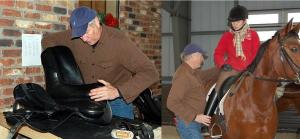
Gullikson Helps Riders Achieve Best Fit
Saddle fitter has done a lot of research on the biomechanics of riding
By Nancy Brannon
If your saddle does not sit level and in the proper place on your horse’s back, the rider will have a difficult time getting the best performance from the horse, and the horse will not be able to move feely and correctly. Equally important is the saddle fitting the rider’s physique and putting the rider in the correct position. “My goal is to make a horse move with the least amount of resistance that a saddle and rider often present to that horse,” said George Gullikson, saddle maker and saddle fitter. Gullikson recently came to Mid-South Dressage Academy in Hernando, Mississippi to evaluate dressage riders’ positions and fit their saddles accordingly.
With a mechanical engineering background, Gullikson takes a physiological and technological approach to fit saddles to suit the particular needs of riders and horses. He applies human and horse anatomy to his saddle-fitting techniques. “I am concerned about the horse’s freedom of movement and the position of the rider: the saddle should give the rider the position to sit a horse in their aerobic frame,” he said. “What I’m looking for in the horse is freedom of motion in the shoulders. The horse is able to articulate in the pelvis a natural stepping motion, with stifle and hock action to be able to step underneath himself. The horse should work off the abdominal muscles, lifting into the back. The key muscles to develop in the dressage or event horse are the latissimus dorsi (the major back muscles).
Gulllikson has done a lot of research on the biomechanics of riding. “For horses, the saddle should sit between the 8th and 18th thoracic vertebrae n at T13 is where the center of the saddle should sit on the horse’s back.” And the rider should be centered in the saddle. A rider’s centered, balanced position in the saddle is crucial to allow the horse to perform optimally.
For the rider, Gullikson first considers the gender because “there are differences in the pelvis in males and females, which determine how a rider sits in the saddle,” he explained. “Because of the anatomical structure of a man’s pelvis, a man naturally sits on two small, narrowly-spaced seat bones, which provide a small base in the saddle. A man merely has to pivot slightly forward, and can usually balance himself quite easily. Men seldom use the lumbar area.”
Gullikson explained the genetic differences in women’s structure. “Women have a wider pelvis and sit from the ischium to the pubic bone. Genetically, women from Northern Europe have a shorter, more closed pelvis and are better riders because of this. They ride more like men because of the way they are built. Women from Southern Europe, for example Italy and Spain, have a more open pelvis and inward curvature of the spine.” He compared the look to female gymnasts. “Because of their anatomy, they have to struggle to keep forward in the saddle to maintain balance. They will usually be forced to lean forward; their knees will try to move over the thigh rolls of the saddle; and their lower leg will move back of the irons.” He describes this as the “compensating frame” whereby the rider struggles to maintain balance, and is less able to be in the “aerobic frame and less able to use their abdominal muscles. They try to get in a more vertical frame and absorb the shock through a supple lower back. Use the abdominals to absorb all the energy.”
“The rider’s seat reflects the position of the ischium. You want to sit on your seat bones n V seat. If you sit on the pubic bone, you will hit the pommel every stride.” Placement of the stirrup bars of the saddle is important for the rider’s position. Gullikson said he often “has to bring the stirrup bars back to put the rider in the correct position.” “For the rider, if the stirrup bars are too far forward, the rider sits on the cantle, will not be in the aerobic frame, is more likely to stiffen the back, and the horse stiffens his back, too.”
Gulllikson compared the dressage seat to the saddle seat. “Dressage riders use the abdominal muscles. Saddle seat and Tennessee Walking Horse riders sit the opposite: they all sit back in the saddle on the lumbar; you’ve seen that hunched- over pose. This causes a sore lumbar for the rider and sore backs for horses, too.”
Gullikson has a keen eye for observing riders, analyzing how their anatomy and skeletal structure determine their riding position, and what he can do to correct their position through proper saddle fitting. “There are alterations that can be made to a saddle that will give the rider a sense of security, a frame in which communicating their aids becomes a lot easier, and, most important, placing the rider in their aerobic frame n that is when sitting in a saddle, the abdominal, back, and oblique muscles are in their neutral, relaxed position.”
For more detailed information on male and female skeletal differences and how they affect saddle fitting, see http://equationsaddlery.com/wp-content/uploads/2008/10/female-anatomy.pdf.
Also see George Gullkison’s web site at http://equationsaddlery.com and click onto “Saddle Fitting Guide.”


