

Advances In Equine Veterinary Care Seminar
April 26, 2008
by Nancy Brannon
Four veterinary experts shared their knowledge about some new equine health care techniques at Collierville Methodist Church on April 26, 2008. The Advances in Equine Veterinary Care Seminar was hosted and organized by Dr. Stephen Galloway’s Animal Care Hospital of Oakland, TN. Presenters included Dr. Charles Mercer of Akin Veterinary Clinic; Dr. Stephen Galloway, equine dentist; Dr. Kathy Mitchner, acupuncturist; and Dr. Hoyt Cheramie of Merial, a company that produces pharmaceuticals and vaccines for livestock and pets.
Dr. Galloway spoke of how “patient dental care” for horses has changed with advances in dentistry equipment and surgery, although the “events,” like floating teeth and tooth extraction, have not changed. While some of the procedures still used today were developed in the early 1900s, there have been surgical advancements and improved equipment, which have led to faster healing in horses. Even with these modern improvements, it is important to “diagnose problems early!” he said.
Equine dentists perform many of the same procedures on horses that dentists do on humans, even root canals. The canine teeth in the horse are similar to those in humans, but the incisors and cheek teeth are different.
Like humans, horses are susceptible to periodontal disease. The periodontium is the supporting structure of the tooth and acts as the shock absorber for the tooth. Horses have at least ten times greater crushing forces in chewing than humans, making care of the peridontium very important in horses. Galloway said, “Periodontal disease is the number one source of infection and cause of tooth loss in horses, humans n mammals, in general. …Periodontal disease can affect all ages, but it typically occurs in older horses. …It is important to balance the mouth; the teeth need to fit tightly together. If they don’t, grass can pack in the gaps between teeth and can lead to periodontal disease. Another cause of periodontal disease is tarter, which can build up around canine teeth.”
Galloway talked about two kinds of orthodontic procedures used in horses: interceptive and functional; the latter involves putting braces on horses’ teeth to get them in correct alignment. He pointed out the difference between “overjet,” which is normal, and “overbite” in horses’ front teeth. If a young horse shows a potential for overbite, sometimes just floating the teeth can fix the problem.
Another dental problem occurs when extra teeth grow in a horse’s mouth, sometimes from an adult tooth not totally pushing out a baby tooth. “Extra teeth are not a bonus in horses!” he said. “Extra teeth can cause problems, especially periodontal disease.”
There are cases of horses having dental problems which are difficult to diagnose. Galloway warned that TMJ, temporomandibular joint disease, is sometimes a catchall mis-diagnosis for jaw, mouth, and chewing problems when there is not an accurate diagnosis of the real problem. “TMJ is fairly rare,” said Galloway.
“There is more than just the teeth involved in the care of the horse’s mouth,” Galloway continued. “Care of the soft tissue is important.” Melanomas are common in grey horses, but most are not malignant. However, some can occur in the mouth, called oral tumors. “It is important to biopsy these tumors,” he said.
Also important is care of the hard tissue, the bones in the jaws. To diagnose problems here, X-rays are very important. “Horses’ hard tissues are very reactive,” Galloway explained. “They also have a lot of precursor cells, maybe more than any other species, which are undifferentiated cells that can become specific types of cells.”
Galloway sees the future of equine dentistry moving toward credentialing of Equine Diplomates by the American Veterinary Dental College (AVDC), so that veterinarians will be board certified by specific colleges for their specialities.
How can horse owners prevent dental disease? Galloway recommends, “Let horses graze whenever possible. Feed them on the ground, not in elevated bunks, and have routine dental care.” Nutrition is also important and he recommends that horse owners rely on feeds developed by nutritional experts. “If you don’t have a Ph.D. in equine nutrition, you shouldn’t be formulating rations.” When deciding on a feeding regimen, ask yourself, “Why do you feed what you feed? You need to get nutritional advice from experts so your horse can eat correctly,” Galloway emphasized.
Dr. Kathy Mitchner introduced the audience to acupuncture, an ancient Chinese medical treatment that has been shown to be very effective in treating a variety of horse ailments. She explained how “the Chinese connected the dots through nerve channels as they observed the beneficial effects. Needling imparts a signal to the spinal cord, which then signals back to the periphery. This creates a loop to the visceral neural networks.” When the neural network loops are established, there is an “endogenous opioid release which produces profound changes in the central nervous system.” The loop links to the brainstem and cerebrum. “The Chinese have 2,000 years of experience” in researching and observing “changes in the way the nervous system responds. You can change everything happening in the body by modulating the nervous system, a process called neuromodulation.” All acupuncture “points are right above a nerve. When you affect the nerve, you affect everything in the system because you are talking to the Boss.”
Acupuncture is primarily used in horses to treat pain and lameness. “The number one use is back pain,” Mitchner said. It is also effective for “sore muscles, nerve paralysis, reproductive problems, and colic (acute and chronic) if it’s a non-surgical.”
Mitchner has found that because of lack of acceptance by Western medicine or lack of knowledge or understanding of acupuncture, “many patients only turn to it as a last resort after they have tried all kinds of therapies and nothing worked. It is so steeped in traditional Chinese verbiage that is sounds foreign to Western medicine practitioners and is hard to understand. But those who use it are pleased to see how well acupuncture works!” Asked by an audience member if Barbero had this kind of treatment, Mitchner said, “Yes, Barbero had an acupuncturist, although it was not widely publicized.” Addressing any risks or contraindications of the practice, Mitchner said it should never be used during pregnancy or when there is infection present. However, the risks are minimal, mainly non response to treatment. She said there are no “true” medical risks and that generally “horses are fabulous responders.”
Mitchner gave some case study examples to show how the practice works for horses. In one of her case studies, a 20-year-old gelding trained to at least 4th level dressage, Mitchner said the results after acupuncture were “better front to back engagement and the horse had more energy!” One of her favorite case studies is “Bug,” a dressage horse who had “severe anxiety about entering the arena. He would blow up and bolt in the arena,” not very impressive to the judges. She did an acupuncture exam and treatment for the horse. “Acupuncture raises serotonin levels,” she said. As a result of the treatment, the horse has been performing well in the dressage arena.
The exam begins with the acupuncturist moving her hands along the horse’s body looking for “positive points, places where the body is tender, sore, or tight. Then you treat the points,” she explained. There are several “master points on the body, such as ST 36 (stomach 36), spleen 6, large intestine 4, liver 3, and gall bladder 39.” These are some of the places where needles are inserted, according to how the animal reacts to the initial touches. She also uses an “electrical impulse which stimulates beta endorphin release and facilitates treatment.”
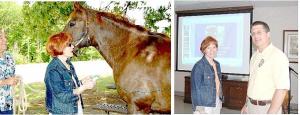
Mitchner demonstrated the exam, where and how the needles are placed on Abadi, an 11-year-old Anglo-Arab dressage horse who has had some serious previous injuries. He had a torn muscle in his shoulder and had laminitis in both front feet last year. He has since recovered from both, but still has some pain, soreness, and discomfort issues. Mitchner examined the horse and identified numerous places where the horse flinched when she touched them, indicating soreness or pain. After identifying all the critical points, she then inserted the needles. “Point placement is based on anatomy,” she explained, and she buries the needles in a muscle until “they catch.” Mitchner uses both Japanese needles, which have a coating, and Chinese needles, which are steel. After all the needles were inserted, she hooked up an electrical device to some of the needles, which then sent a low electrical impulse to the muscles. Observers could see the needles move slightly. Mitchner explained that she does this instead of spinning the needles, as some acupuncturists do. As she worked her therapy on the horse, the transformation from a nervous, unsettled animal to a serene fellow who was licking his lips in pleasure was obvious to all.
Recently acupuncture “has been getting lots of attention from both humans and equine owners; it is also used on dogs and cats,” Mitchner said. In general, “acupuncture uses the nervous system (related to the master points)” to treat various ailments. “All mechanisms [for why it works] are still not established; it is not known why placing needles at particular points produces bodily changes. It is a powerful treatment that works best with a medical diagnosis, but it also works with problems that cannot be accurately diagnosed by a veterinarian. Acupuncture points in a direction, but doesn’t give specific diagnoses. It is also used as a maintenance treatment. Horses work hard for us and if they have pain, their body compensates for it so they can still work. Acupuncture treats the whole body, so acupuncture helps re-balance the body.”
Dr. Hoyt Cheramie of Merial, spoke about several equine diseases and the products his company has developed to treat them: equine gastric ulcer syndrome; osteoarthritis n its diagnosis and treatment; and inflammation and how non-steroidal anti-inflammatory drugs, like Phenylbutazone, AKA “bute,” Equivoxx, and Banamine, work. Cheramie said “Equioxx” is a new product developed by Merial, a non-steroidal anti-inflammatory drug for the control of pain and inflammation associated with osteoarthritis in horses. “GastroGard” was developed by Merial to treat and prevent the recurrence of gastric ulcers in horses.
Dr. Charles Mercer described extracorporeal shockwave therapy (ESWT). It was developed in Europe in the early 1990s for the treatment of musculoskeletal disorders. Extracorporeal shockwaves are high-pressure, low frequency sound waves generated by a device outside the body and applied to the affected tissue in a site-specific manner. When the shockwaves meet tissue interfaces of different densities, the energy contained in the shockwaves is released and interacts with the tissue. The shockwaves appear to relieve pain and accelerate healing within the injured tissue, although the mechanism for these effects is unclear. This type of therapy was originally used to treat human beings with kidney stones by the use of sound waves rather than invasive surgery. ESWT is used to treat a range of orthopedic conditions in both human beings and animals. Conditions for which ESWT can be used in horses include suspensory ligament injury, tissue calcification, fractures or joint ankyloses (immobility), fatigue injury to bone, back pain, navicular disease, and bone exostosis, the formation of new bone on the surface of a bone, which can cause chronic pain.


