

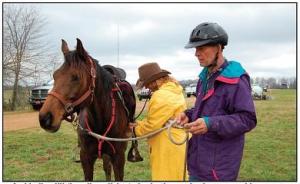
Rain Slickers Definitely Needed
At City Slickers Endurance Ride
by Nancy Brannon
This year’s Shelby Farms City Slicker Endurance Ride on the Ides of March hosted thirty-four 50-mile riders, fifty 25-mile riders, and seven 14-mile run riders who endured the rain, the mud, and sloppy footing which claimed many horseshoes throughout the day. “How’s the endurance ride going?” I asked official timer Samm Bartee at the 25-mile vet check. She replied, “It’s cold and wet; we’ve had hail; our tent collapsed. Other than that, it’s going swimmingly well!” The thunderstorms and rain moved into the area in the wee hours of Saturday morning, pummeling the area with heavy showers, hail, and wind that delayed the start of the ride for an hour. But by 8: 15 a.m. the first hardy riders and horses began either the 25-mile ride or the 50-mile ride. By mid-day, the rains had eased and patches of blue sky let the sun shine through for half an hour or so. But the heavy grey clouds soon returned and again threatened rain at any time.Bartee came from Birmingham, Alabama to do her timing duty. Estimating the amount of time riders would be on the trail she said, “The 25-mile loop takes approximately three hours and 40 minutes, with 40-minute mandatory holds at the vet checks. The 50-milers do the trail twice and that usually takes a little over six hours. Front runners do it quicker than that.”Angie Fura timed riders at the third vet check stop along the trail. This was her first time being a timer and she thought things were going relatively well. “I still have all my hair and nobody died,” she jokingly assessed.
Chris Frame and his daughter Teresa, from Rosemark, Tennessee, were on hand to mentor the new and junior riders. They have been doing endurance rides for quite a while, so their experiences were helpful to the newcomers.Two long-time veterans of the Shelby Farms Endurance Ride were back to volunteer their services. The “original vet” Dr. Otis Schmitt from Ten Mile, Tennessee and the “original ride manager” Rudy Watkins from Rossville, Tennessee were checking out riders at the third vet check area. “He started this back in 1896,” quipped Schmitt, referring to Watkins. “Seriously, we’ve been doing this about 13 years,“ corrected Watkins. “I was riding in endurance rides and I wanted to give something back to the sport. Otis helped me quite a bit and I asked him to be the official veterinarian. We had 65 horses the first year and from the proceeds from the ride, I was able to make a large donation to the Shelby Farms Equestrian Alliance (SFEA).”
The Ride Manager has a daunting job Watkins explained. “You have to get volunteers, hire veterinarians, set up the course, get the ride sanctioned by the American Endurance Ride Conference (AERC)” along with a lot of other jobs. “That first year I had a lot of help. Peggy Hart was my biggest helper.” In addition to all that is generally involved in putting on endurance rides, “We had to go before the Shelby Farms Board to get approval. That was a chore in itself! But it was a big success and has been every year since.” Watkins is no longer the Ride Manager; “I turned it over to SFEA three years ago,” but he still volunteers his services every year.
Schmitt chimed in, “He spent a lot of money getting it going and I spent a lot of time trying to make things go. Vets [who volunteer] only get a place to sleep and their meals.” But they play an important role in trying to keep the horses safe and healthy. At the vet stations, they check horses’ heart rates and respiration rates; check for lameness, muscle soreness, dehydration, and any wounds they may have sustained along the trail. Schmitt said, “It’s not strange to see a major problem with the horses, like colic. But most horses usually go through the vet check in good shape. Shelby Farms gets a lot of first time, inexperienced riders. The inexperienced riders may not be able to handle the horses well or make the horses do what they want. But everywhere there are endurance rides, the circumstances are different.” Schmitt sported a “Fun in the Sun Endurance Festival” hat from his previous weekend’s adventure at Gainesville, Florida. “The horses generally are in good condition. The main job of the veterinarian is to make sure nothing happens to the horse that we could have done something about.”
Both emphasized the fact that the veterinarians protect the horses. “At most endurance rides, the horse comes first,” Schmitt explained, “The riders believe what you tell them [about their horses].” Watkins continued, “There is no money involved and no impetus to cheat. I’ve seen a 50-mile rider help a 25-mile rider get back on after
having fallen off. The experienced riders help the others with their tack, with getting the horse ready, and advising them what to expect on the trail and at the vet checks. The level of equipment required to start is very low,” so it’s a good place for amateurs.Watkins added, “There are lots of people watching different aspects of the rides. It may look like confusion, but the job [of supervising horses and riders] gets done. Endurance rides are a good place for single men because they are dominated by women.” Both Watkins and Schmitt had stories to tell from past endurance ride experiences, especially stories from the days of sitting around the campfire after the ride. “But it’s all different now because of trailers with living quarters, “ Schmitt said. “Now people go to their trailers instead of gathering around the campfire.” Both guys were nostalgic for those days of fun and camaraderie around the campfire.
Jackie Caudill and her daughter Kate regularly attend endurance rides. Jackie said, “Endurance riding is good for teenagers. It teaches them responsibility and to not put themselves first all the time.” This is Jackie’s fifth year doing endurance rides and this year she’s volunteering to help time the rides. “I think it is important to volunteer to help work the rides, as well as to participate as a rider.”
Ed Kidd and Roger Barrett were both competing in the 50-mile ride. The horses they were riding “are brothers,” Ed said. “Both horses are by the stallion sable.” Ed was riding MERLIN and Roger was riding his older brother FARLOW. Ed commented on the riding conditions: “Boy, it’s nasty out there!”
Farrier Guy Buck of Selmer, Tennessee felt the effects of the weather, too. “It’s been a miserable day today,” he said. He worked all morning in the pouring rain and got wet “all the way down to my underwear. The Gore-Tex wasn’t helping either.” He went through several pairs of shoes because they got wet or the mud kept pulling them off. Buck is used to varying conditions, thought, because every weekend he’s at some endurance ride. “All my customers are endurance riders. During the week I take care of them and during the rides I take care of them again.” He has been shoeing for 24 years so his quickness and precision in repairing hoof damage or replacing shoes is an asset to the riders.
Buck just returned last October from an 18-month tour in Afghanistan as a security contractor with the U.S. State Department. There he escorted U.S. diplomats as they checked out various infrastructure projects. Over the 18 months he was there, “I saw the infrastructure get considerably better - the roads, electrical supply especially. I saw the security situation get worse.” He studied the horses in Afghanistan and has a folder full of pictures of the horses and their owners and families. He has written an article about them for the American Farriers Journal. More information about Guy Buck can be found at his web site: http://buckfarrierservice.com. The Journal can be read on-line at: www.lesspub.com/cgi-bin/site.pl?afj/index.
One of the horses Buck worked on was Rain Man Gadaf, appropriately named, and ridden by Tamara Schoech. The horse is owned by Troy Nelson, the head veterinarian for this event. Schoech had interesting stories to tell about RAIN MAN, an 11-year old Arab gelding. “The first endurance ride I did with him was at South Point Plantation near Atlanta, where the weather was rainy and cold, 32 degrees. The third ride I did on him, we had two days of rain and lots of water.” This was her fourth ride on him, and another rainy day. Schoech has thousands of miles of endurance riding experience since she has been doing the sport for 15 years. She complimented the horse as being “a really good mudder.” She competed on the 50-mile endurance ride with her husband Joe Schoech.
For general information about endurance rides, see the AERC web site: http://www.aerc.org/. For information about the local endurance ride at Shelby Farms, visit the SFEA web site: http://www.sfeaonline.org/ Click the left-hand link to “City Slickers.”


