

Herbal Remedies For Equine Health
American Mercantile “imports herbs from all over the world”
by Nancy Brannon
Many horse owners are turning to herbal products as a substitute for prescribed drugs for their horses’ ailments. For those looking for alternative medicines, Equine Science markets a variety of products for a broad gamut of horse-related health problems and nutritional needs. The seven-year-old company is a subsidiary of American Mercantile, which has been marketing herbal products for people for over 20 years.
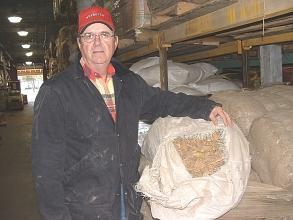
The company “imports herbs from all over the world,” said Manager Don Silver. The herbs come in dried form in huge sacks and are warehoused in Memphis before being ground and mixed in a particular product combination. There are several mills at the manufacturing facility that grind the dried herbs into a fine, dust-like powder. American Mercantile sells the powder to various wholesale companies who put the herbs in capsule form for humans. Equine Science takes the same powders, blends them into formulas for horses, and pelletizes them. The products are sold in 3, 5, and 10-pound containers. Equine Science also has some products for small pets.
A tour of the warehouse facility showed a variety of herbs in huge sacks: slippery elm bark, lavender, barberry, Echinacea, periwinkle, witch hazel, rose hips, yarrow, hawthorn, milk thistle, nettle, dandelion. “We have every herb you can think of,” said Silver. “We use the leaf and root of most herbs. The root has a higher concentration than the leaf.” Silver talked about the fact that a lot of plants that people consider weeds in their yards and pastures are really useful plants, like dandelions for example. He said kelp is a versatile, all-natural vitamin-mineral supplement. In addition to using the dried herbs, Silver said they also grind up deer antlers, which is known to be an aphrodisiac. “American Mercantile markets that; not Equine Science.”
Equine Science markets a full line of products, such as vitamin and mineral supplements, joint supplements. “There are about 30+ products that we handle. We try to match the product with the problem the customer wants to solve,” said Silver. “All our products are natural n from plants with no synthetic chemicals. There are also no fillers and no binders. To meet American Mercantile’s standards, the powder has to be ground very fine. We can put that powder in the pelletizer and it sticks together well and is easy for the horse to digest. Generally, you mix one to two ounces (of the pelleted product) with the horse’s feed and the horse just thinks it’s part of their regular feed.”
Silver described some of the conditions or ailments and the products they have developed to treat those conditions. A popular product is a treatment “for navicular disease called Cipex, which includes pain relieving herbs,” Silver said. “It increases the blood flow which helps speed the healing process. We have Herbal Bute, a combination of herbs with anti-inflammatory and pain relieving qualities. We have an ulcer blend for horses. We also have PMS products for mares who don’t cycle right or are cranky in estrous.” It’s called “painful mare soother.” Silver compared their product to Regumate, but noted that Regumate is difficult to use and can have harmful effects on people who are exposed to it. “Our product works on the same problem and is easier and cheaper to use.”
Silver recommended the use of garlic in spring and summer to “repel flies, insects, and ticks. Garlic is high in sulfur and stays in the blood” so has lasting repellent qualities, he said.
“We make an AR cream, an ointment for arthritis. You rub it on the joints to relieve the pain. We have a moisturizing cream that is like Bag Balm. People like it, too, because it makes their skin so soft.” Silver described their Special Joint Blend, which includes Glucosamine, Chrondroitin, and MSM and some other herbs. He noted the importance of including all three because “Glucosamine increases the fluid in joints; the Chrondroitin builds up cartilage, and MSM builds up the ligaments and tendons around the joint. All three help to increase the strength of the entire joint.”
Their Senior Blend is formulated to improve energy, strengthen the immune system, and improve digestion in older horses. “We tested it on a 38-year-old horse in Arkansas,” Silver said and “it increased his stamina, appetite, and helped with his joints.”
Equine Science even has a product for COPD called Mo Lung. “It is made from Chinese herbs which dilate the bronchial tubes to increase air flow,” Silver said. “It works for the heaves. We have a testimonial from a person in Holly Springs who said it completely cleared up the horses breathing problems.”
Barn Dust is an environmentally safe insect repellent, Silver said. “It’s a white powder that you sprinkle in your barn, like it lightly snowed. Any insects that crawl over the powder, it cuts their exoskeleton and kills them. It also works on fire ant hills and we have a formula for dogs to get rid of fleas,” Silver said. The main ingredients in it are diatomaceous earth, lemon balm, lavender, and eucalyptus.
Silver refers readers to the testimonials page of their web site: http://www.herbs4horses.com. “We post what people write in about the conditions of their horses and how the products worked. These are unsolicited, and we use them as a sales tool.”
Silver is a strong believer in herbal products and the importance of holistic medicine. “Herbal products keep chemicals out of the horse’s system. When you give the horse chemicals, you can create other problems. Herbs treat problems naturally and holistic medicine treats the causes, not just the symptoms.” He thinks much of conventional medicine gives only symptomatic relief, whereas holistic medicine looks for the causes of problems and seeks to treat them. Holistic medicine also emphasizes prevention, he says. For example, “Our immune booster helps strengthen horses’ immune systems to help them fight off communicable diseases. The horse will be healthier if you keep chemicals out of his body. Holistic medicine is becoming more accepted and popular. Its goal is to keep the horse healthier, which is also a lot cheaper. We get ideas for new products from various sources. We have a librarian who does lots of research to find the particular herbs we need to take care of the problem.”
Silver is the main researcher and developer of new products. For developing new products, “we have a chemist on staff and we work with local veterinarians on developing products.” Among the new products now being developed is a natural wormer. They are also testing Sarcoid-X, a product to treat equine sarcoids, or tumors caused by a virus. Many grey horses get sarcoids, said Silver. “What is currently available from veterinarians will get rid of the tumors, but they come back. We are developing anti-tumor herbs” that hopefully with prevent the recurrence. The approach with this condition, as with others, is a holistic approach to prevent the cause of the problem.
Equine Science is a member of the National Animal Supplement Council (NASC), which regulates the herbal industry. Equine Science stays away from the human side of herbal remedies, which is the niche of American Mercantile. American Mercantile has to satisfy all the requirements of the FDA and has a pharmaceutical license. At Equine Science “We go by their standards (FDA) and those of NASC. American Mercantile is the supplier to the human herbal industry and Equine Science is just for horses,” said Silver.
Silver told stories of a variety of people who use and sell the products. “We have chiropractors, farriers, and veterinarians who handle our products. There is a holistic veterinarian in Bristo, OK who uses our products and formulates his own herbal remedies as well.” He did not know of a holistic veterinarian per se in this area, but did know of veterinarians who are interested in it and incorporate it somewhat into their conventional practice. “Some veterinarians are open-minded enough to consider holistic medicine as an addition to their conventional practice. Herbs are becoming more popular every year. We’re seeing steady growth in our sales and products.”
An important facet of the business that Silver stressed is that “we have control over the herbs from the time they are picked until they are blended. We know where all the herbs come from, which is very important these days. That way, we can produce cheaper and keep our quality higher. We are also a no waste manufacturer. If the powder is not ground fine enough to be capsulated for American Mercantile products, we can pelletize it and use it in a horse product.”
Silver uses the products on horses he and his wife Terri own. He believes they are stronger and healthier as a result. He is a team roper and Terri is an endurance and competitive trail rider. “Since endurance horses are ridden 25, 50 and 100 miles, they have to be in good condition,” he said. Silver has been into roping practically all his life and goes to team roping events all over the U.S. In fact, at a recent weekend he was roping at the Shelby Show Place arena. He started out working on a ranch, managed a ranch in Texas, and got his degree in Animal Science at Oklahoma State. In 1993 he won the US TRC World Championship.
Silver takes Equine Science products on the road to five shows every year. He goes to Springfield, Massachusetts, to Sacramento, California, to Columbus, Ohio, and to Albany, Georgia. His next stop will be at the “Road to the Horse” at the Miller Coliseum in Murfreesboro, Tennessee February 29 through March 1 and 2. He sells products at their booths at shows as well as on-line from their web site. They sell both retail and to local dealers. Customers can buy through local dealers, which are listed on their web site, or place their order on-line at http://www.herbs4horses.com .


