

Why is Equine Dentistry so Important?
by Lindsey Calton
Equine Dentistry is an area of equine maintenance that is often neglected. Having dentistry performed regularly on a horse can actually add years tothe horse’s life.
It will also help improve the horse’s performance, health, well being, digestion and attitude. It is recommended that a horse be checked twice a year.
Horses’s teeth are called hypsodont teeth. Hypsodont teeth are teeth with a generous amount of reserve crown beneath the gum line. Horses have about 2 inches or more of teeth below the gum line. All of the teeth in a horse’s mouth erupt at the rate at which they are being used. The eruption process takes place until the horse reaches the age of twenty to thirty years, then the reserve crowns of the teeth are mostly used.
Horses chew in a down-out-up-in pattern. They do not really chew grain and forage, they grind it. A horse’s lower jaw or mandible is mobile. It moves down-out-up-in and also forward and backward (anterior-posterior
movement). When a horse lowers its head to nip grass, the mandible comes forward. When a horse raises its head to grind, the mandible goes backward. If a horse is in a stall most of the time and eats out of hay racks and buckets that are up off of the ground, the mandible does not get the chance to slide forward. In a case like this, the horse will usually have hooks on the upper premolars and hooks or ramps on the lower molars, causing the horse to be locked up. This causes discomfort when the horse has a bit in its mouth and also causes discomfort in the TMJ.
Most horses have 44 teeth. Twelve of the 44 are the incisors or front teeth used for nipping. Four of the 44 are the canines, or fighting teeth. Stallion’s and gelding’s canines are usually considerably larger than a mare’s canines, if she even has any that are above the gum line. Another four of the 44 can be the wolf teeth. These teeth serve no purpose in today’s horses. A long time ago they did serve a purpose, they used to be the first premolar.
The wolf teeth are small teeth that come in just before the first premolar. If wolf teeth are not taken out, the bit will hit them and it will cause the horse pain. There are usually only two wolf teeth in horses on the upper arcades, but it is not uncommon if two more are found on the lower arcades and removed. Another twelve of the 44 are the premolars. These are the first three grinding teeth. The last twelve of the 44 are the molars. These teeth are just behind the premolars. The premolars and the molars are the same type of teeth, they are just called two different names because the premolars in a horse’s mouth shed caps, and they are deciduous teeth.
The teeth that shed caps are the incisors and the premolars. Equine dentists can tell the age of a horse, if it is under the age of five, just by the baby teeth that it has or has shed. Equine dentists know when the deciduous teeth shed and know if there is or will be any complications. If there are any complications, the equine dentist will be able to correct it by taking the baby teeth out and breaking the skin so that the permanent teeth can come through.
It is important for a young horse to have its teeth checked twice a year. This is the time that is most important because many complications can take place with the shedding of baby teeth and the eruption of permanent teeth. For instance, a retained cap may become infected (abscessed) and cause the youngster pain.
If regular dentistry is performed on a horse from a young age, the equine dentist can help shape the mouth for the rest of its life. That means that the horse will not need to have dentistry performed twice a year, probably just once a year. If a horse is floated it does cost money, but the dentistry performed will pay for itself. It will pay for itself because the horse will grind its feed and forage better and get more nutrients out of it, thus less feed will be needed.
Performance will also be improved and as a result, training and riding will go a lot smoother. If regular dentistry is performed it can also fix any problems before they become problems. When an equine dentist performs dentistry, he/she will first look the horse over to see if there are any indications of extreme problems. He/she will also check the incisors to see if a wedge, smile or frown is present. (These are just abnormal angles and wearing of the incisors.) Then he/she will take off the sharp edges (buccals and linguals) of the cheek teeth and smooth the arcades off.
Extra teeth, abscesses, and many other abnormalities will also be checked for. Bit seats will also be inserted. Bit seats are important because they allow forage and grain to enter the arcades more easily and also allow a place for the bit to sit. After the cheek teeth are floated, the equine dentist will check the incisors to make sure that they are not too long in which the cheek do not touch or too short in which the cheek teeth are too long. When the equine dentist is finished, the premolars and molars will be smoothed out with the the correct angles, bit seats will be present, the canines willl be at the correct height, the incisors will be even with a straight line in between the uppers and lowers, wolf teeth will have been removed (if needed), and any other abnormalities or complications will have been noted and corrected, if possible.
The goals of equine dentists are 1) Equal clinical crown height; 2) Correct molar table angles; 3) Correct incisor table angles; 4) Three point balance of the TMJ, cheek teeth and incisors; 5) Full lateral excursion of the mandible; 6) Maximum occlusion of the available incisors and cheek teeth; 7) Maintain maximum anteriorposterior movement of the mandible; 8) Overall comfort for the horse during all activities.
The overall goal of equine dentists is to make the horse happier and healthier, thus the owner will be happier.
Most equine dentists like for the owners to be present when dentistry is performed so that they can explain everything to them. For example, when I go to people’s houses to perform equine dentistry, I like to tell the owner everything that is going on in the horse’s mouth. I also like for the owners to feel or see before and after results. Every time they are impressed and interested. I try to explain everything to them that I can. Most of the calls that I get are from owners who are experiencing problems with their horses. It is important to have an equine dentist come out before problems are present. If that is done, then the horses will not correlate the pain with the type of training, exercise, or task that was performed. Needless to say, the horses will not resent their trainers and/or owners if pain is not present.
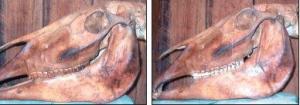
Included in this article are some pictures of an equine’s skull. I took some pictures of the skull before I performed dentistry and then after the dentistry was performed. The wolf teeth are also present in the before pictures. They are the small teeth in front of the first premolars. In the before pictures a person can see how sharp and uneven the molars and premolars are. He/she can also see that the incisors had a slight wedge (an uneven line between the uppers and lowers). The wedge in this horse’s incisors told me that it was mainly grinding on one side of its mouth. The before pictures is a typical horse’s mouth. The after pictures are how all horses’ mouths should look after equine dentistry is performed.
I hope that everyone who read this article enjoyed it and learned from it. I also hope that it informed readers of how important dentistry is. When dentistry needs to be performed on yourhorse/horses please give me a call, I will perform the best job to my ability and also inform you of everything that is going on in your horse/horses mouths. Please call me at 931-724-2273/931-629-9305 or e-mail me at ljcbarrelracing@hotmail.com if you have any questions or if you want to make an appointment.
As they say on RFD-TV—”Happy Trails to You!”


