

Richard Watson Bits Promise Control With Lighter Touch
by Nancy Brannon
Do you have a problem with your horse running away, or running through the bit, or not being as responsive and round as you would like? Then Richard Watson may have an answer for your problem.
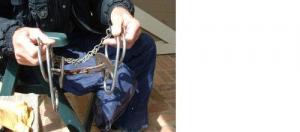
Watson has invented several bits that he says are designed to be comfortable in the horse’s mouth, stimulate a quick response, and provide more control without harshness. All have the same mouth piece, which is the key to their effectiveness.
Richard Watson is well-known among long time hunter-jumper riders in the Memphis area. He was a top trainer of both horses and riders in the Germantown, Tennessee area for “about 18 to 20 years,” he remembered. Now he resides in Alachua, Florida where he still rides, trains, and sells horses at his private stable. He also travels around the country to conduct riding clinics, coming back to the Memphis area on occasion. He was giving a clinic at Wildlife Manor, south of Collierville, in April where he talked about developing his specialty bits.
Watson told how a problem horse and an available workshop led him to create a new type of bit. “I had a mare I was riding and I wanted a hackamore with a bit for her. I was in the shop, and had a piece of 3” pipe. I put it in the vice and wrapped a piece of copper wire around it and thought, hmm, ‘that might make a bit’.” So he took a piece of stainless steel and worked with it until he got it the shape he wanted. “The mouthpiece is what makes the bit,” he said. “It’s called Sweet Iron. It’s a cold-rolled steel. Then the design is what makes it work, what makes the mouthpiece work well. The link-style mouthpiece is shaped to fit the horse’s mouth. It curves about the mouth and when you pull back on the rein, it acts somewhat like a gag bridle. The mouthpiece elevates in the mouth a bit, in a new spot. It also puts pressure on the poll, but with a different feel from a gag. You ride with the chain real loose; after a while the chain comes into play. After you’ve used the bit a while, the chain doesn’t do anything because the horse learns to react to a slight touch so quickly.”
Watson had a testimonial of how he used the bit on a horse that was out of control, running away with one of his students. “Within minutes the horse relaxed, was quiet, and he jumped and never ran off with her.
From the first prototype, Watson has now developed four types of bits, all with the same mouthpiece, but with different action: the two-ring, the three ring, and the gagavator. The latest is a snaffle, the “Watson snaffle.” If you’re interested in trying one, “It’s in the Dover Catalog,” he said.
That led to the question of how he got into the commercial business, marketing his bits to the public. “I had a friend in California; she liked the bit a lot. She called me one day to ask permission to show it to the owner of Mikmar Bit Company. I said, ‘Sure!’ They liked it and made me an offer I couldn’t refuse.” So now Mikmar manufactures and distributes the bits. Watson is pleased with the way the company makes the bits. “They are professionally made; they look good and are made well. They use good steel and all customers seem satisfied with them.”
Speaking of satisfied customers, Watson told another story of a customer happy with his bit. “I was teaching a dressage lady whose horse had a problem running through the bit. She put one of my bits on him and within three minutes the horse was soft and round and did all the things she’d been trying to accomplish for six months.”
Debra Heaton, a friend of Watson’s and user of the Watson bit, testified to its effectiveness, too. “It does make them quiet. It goes straight to their brain. Other people have looked at it and assumed it’s a severe bit.”
But Watson qualified, “It’s not a severe bit. You can make any bit severe, even a simple snaffle. It’s the hands of the rider that determine if a bit is severe or not. Horses just accept it [Watson’s bit] and like it. You just barely touch their mouths.”
Heaton added, “My mare understood what I wanted immediately.”
Watson continued, “With this bit, the horse won’t run through he bit. They accept it. Then you can teach them to respond to your leg. They stay light in your hands, and when that happens, the horse responds better and moves over to your leg.”
Watson does have a story about a rider who claimed that the horse can become too light in the bridle. “A really good jumper rider came to look at a horse I had for sale. I won’t mention a name, but he is a well known Grand Prix jumper rider. I got on the horse first and rode her over a whole course of fences in one of my bits. The jumper rider got on and right away said he couldn’t ride the horse in that bit. ‘She’s too light,’ he told me.” To cut to the end of the story, the Grand Prix jumper rider came to see the benefit of Watson’s bits and now has four horses showing in Watson’s bits. “All his horses are going lighter now and he wouldn’t go back to bits he used before mine.”
Explaining how some of the designs work, Watson showed the two-ring bit. “The little ring inside the big one keeps the bit from moving too far. The big ring allows the mouthpiece to move and gives a kind of gag effect. I’ve now developed an S-shank bit. We were trying to figure out what to call it and we thought, it isn’t a gag; it isn’t an elevator. Oh, let’s call it the gagavater.” So that’s how it got the name.
Diane Newton, who hosted the riding clinic at Wildlife Manor, uses and likes Watson’s bits, too. “I foxhunted a horse in it last season. I had brakes! This horse hated gags, but liked Watson’s bit.”
Heaton added, “When you’re riding in a high stress, high excitement situation [like foxhunting], the bit allows the rider to have more control without being harsh on the horse’s mouth. Another thing I like about the bit is that it gets horses to carry their heads in the correct position. It’s a great communication tool. The horse seems to understand quickly and they also like the sweet iron mouthpiece.”
Richard Watson now resides in Alachua, Florida, a small town in central Florida near Gainesville. Alachua is a Seminole word meaning “green pasture.” He’s been in Florida for about 20 years riding and training horses, giving riding lessons and clinics, and occasionally showing some young horses in low jumper classes. Florida was his home for all his young life, but he moved to the Memphis area in his early 20s. He operated public training stables at several locations. “I started out on the old Joe Schaffer place off Hacks Cross Road,” said Watson. “At time it had a huge lake; now it’s all houses. In the very beginning I worked for Ned Cook, riding polo ponies. I had worked with Monte Forman doing cutting horses, and then I started doing the polo ponies. Among the polo ponies, they had a horse that jumped n FANCY, a black mare. I got on her and jumped her and the rest is history. The first horse show I rode in was at Blackberry Hill, Mrs. [Imogene] Erb’s place.”
Information about the “Watson Snaffle” and other styles of Watson’s bits can be found at the Mikmar Bit Company web site: http://www.mikmar.com/products-elevator.html.


