

Mid-South Horsewomen Bring Rare Breeds To The Limelight
When most people think of draft horses, they also tend to picture beer wagons, carriages, and horse-drawn farm implements at the same time. But a pair of area horsewomen are working to change that image of these versatile horses by introducing the relatively rare Friesian and Shire breeds in the show ring.
Dana Shah Bishop and Jessica “Jessi” Waldrop became fast friends some seven years ago, when Jessi came to Dana’s Blues City Warmbloods facility near Memphis to look at a Percheron Shah Bishop was selling. “She fell in love with the horse (which she wound up buying), and we’ve been friends ever since,” said Shah Bishop.
On a balmy September afternoon, the pair watches Shah Bishop’s majestic Damascus EQ7 being put through his paces in the regulation-size dressage arena at her Blues City Warmbloods facility just east of Memphis, Tennessee. A whopping 17.1 hands high, the glossy black steed works his way through a series of exercises under the control of Nick Handy, a friend of Shah Bishop and her husband, farrier Daniel Bishop. The horse’s long mane, tail, and “feathers” flow elegantly in the light breeze.
Waldrop said she’s been riding since childhood, and Shah Bishop began at age four and says she started showing at age six, starting with hunter-jumpers and transitioning to jumpers. “Horses are a huge passion with me, they always have been.” said Shah Bishop. “I got my love of horses from my mother...This is a passion that will never die.”
Both women speak frequently about the docile nature and friendliness of the draft horses, but also note they are more than capable of competing in English riding, eventing, jumping, and dressage. They are also popular as police mounts, and Shah Bishop says she has sold several horses to southern police departments. She also contends the horses’ size is a real benefit when it comes to certain events. “I think size is a personal preference,” she said. “I like height, and I breed for that. You want height for jumping.”
Jessi and her husband, Joe Waldrop, have established Thunder Valley Shires ranch in Brighton, Tennessee, where their goal is “...to introduce and expand the Shire Horse Breed throughout the midsouth area.”
According to Waldrop’s web site, the breed was first imported to America in the mid-1800’s. Numbers peaked at around 7,000 by the turn of the century, and there were only 25 registered Shires in the country during the 1950’s. However, the breed’s popularity is again on the rise, and there are currently about 550 registered horses in the country. However, Waldrop said most of those are located in the west, and there are “...maybe 20 on this side of the Mississippi River, from New York all the way down.” Among horse breeds, the Shire is typically the largest, even though the current world record is held by a Percheron.
Jessi, a veterinary technician, bought her first Shire a little over a year ago, and the horse is now 15 months old. Knighthaven’s Captain Crunch will be standing at stud beginning next year, and in the meantime is proving himself on the show circuit. He has competed in two halter shows, earning second place in Louisville, Kentucky and placing fourth at the Shire National Championship in Columbus, Ohio. Jessi also plans to enter him, at some point, in dressage and harness events.
He will only breed by artificial insemination, and only to approved, registered mares. Thunder Valley is planning to purchase a mare in the near future and, when nature has taken its course, live foals will be available. Shah Bishop says Thunder Valley’s program will give breeders considering crossing with a Shire a “local” connection, rather than having semen shipped from somewhere out west.
Captain Crunch looks to have a “big” future; his sire is 19 hands tall, and his dam stands 18.2. Jessie said she expects him to mature at around 19 hands. While Shires are typically gray at birth, they will eventually turn completely white.
Shire competitions, at least for Mid-South owners, aren’t for those who like to stay close to home, though. Jessi noted that the nearest Shire show is in Columbus, Ohio, while most of the others take place in Colorado, California, New York and Pennsylvania. Of course, contests aren’t the only point to having a horse, and these “gentle giants” would certainly provide endless hours of enjoyment for those who just want a calm, stable riding companion.
While the Shires tend to be uniformly gray in color, Friesians are always marked by their ebony coats. Some have a white star, but Shah Bishop says that is generally considered an undesirable trait. There is a recessive gene in the breed which produces a red coloring, but those horses are not eligible for registration. Friesians were nearly extinct worldwide just prior to World War 1, and pure stock became non-existent in America until they were re-introduced in the 1970’s.
Dana’s current arena partner is Damascus EQ7, who was imported from Holland at four months old and just recently turned five. She has been riding him in first-level dressage events, racking up scores in the 60’s and 70’s.
Damascus is registered with the Friesian Horse Association of North America and Shah Bishop said his DNA pattern was recorded at birth and, like all horses in the registry, he was implanted with an ID chip. He was also named before she bought him, according to procedures established by FHANA. Foals are given names that begin with one of three letters from a set that designates the year of birth. “That year it was D-E-F, and the people named him Damascus because it was a Biblical name, EQ meaning equine, and 7 being the number of God,” she said. “That’s how it was explained to me.” The horse is exceptionally large for his line; most Friesians stand 15-16 hands.
“He and I have a terrific bond,” she said, and with a little laugh confided that “...I have pictures of him in my house. Now that I’m married, that’s probably not going to happen again.”
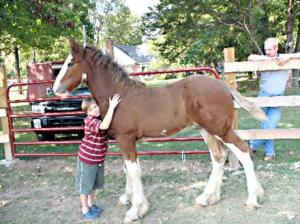
Shah Bishop said she and Damascus are limiting competition riding to dressage, but notes that they participate in a number of other activities, as well. Friesians were a favorite steed of the knights of England, and she and Damascus have full medieval costumes they often wear while taking part in numerous charity events, parades, and re-enactments. The pair also made a recent appearance at a local farm equipment store as part of a “Horseman’s Day” celebration, along with a Shire colt who is the newest addition to the stable at Blues City Warmbloods.
Shah Bishop admits both she and Damascus have some lessons to learn in the field of dressage. “He’s very young, still, and I’m very new to this, I always rode hunter-jumper so I still have a lot to learn.” To that end, she has begun training with Kentucky-based dressage trainer Francois Lemaire de Reffieu.
While Damascus is a gelding, Blues City Warmbloods does have a registered Friesian stallion in the pipeline; Onassis just turned two in June, and Shah Bishop plans to stand him at stud in 2007. She remains undecided whether she will cross-breed him, which would require changing his registry. She commented that both breeds have been “preserved” well and thinks the breeds should be maintained responsibly, but believes that can be done by selective crossbreeding. “People look to breed to Friesians,” she said, “because there are not that many people that would do crossbreeding. There are only, I’m going to say maybe eight in the state that are advertised to crossbreed.” Onassis will only be available for artificial insemination.
Onassis is described as a “beautiful mover,” and his father, Lukas 324, is renowned as a “dancing stallion. Friesians are the ‘dancing horses’ and I have great expectations for him as a dressage horse,” she said.
She also has a new Shire colt she just got from Wisconsin, who shows amazing potential for height. Cadet, also known as “Flash Gordon” for a pair of lightning bolt markings on his cheeks, is already 14.3 hands at a little over three months old. “He’s going to be big...His daddy is 17.3 and his mom is 18.1.” Both of the parents show in halter classes, and the sire competes in English walk-trot canter and is “...doing very well.”
Dana married farrier Daniel Bishop in April of this year, and the union has allowed the two to combine their talents and vocations at the Blues City facility. In addition to full boarding services, there’s now “full time” horseshoeing available on site, and Daniel Bishop is offering training and breaking of young horses, with each animal getting a workout five times a week. Shah Bishop said each horse has its own nutritional schedule, and that all animals are fed Vaughn’s Bermuda Hay and wormed every month. Horses must be current on all vaccinations, including Coggins, West Nile, and strangles. The facility includes 12 x 12 stalls, the regulation dressage arena, and enough jumps for a full jump course.
Blues City Warmbloods can also provide a hunter-jumper training. Nick Handy, a graduate of Meredith Manor International Equestrian Center who has ridden with Cavalier Lippizaner Stallions and currently teaches at Magnolia Hill Stables in Brighton, can meet students for dressage training at the facility.
For more information on Thunder Valley Shires, visit their web site at www.thundervalleyshires.com or give them a call at 901-833-6635.
To find out more about breeding, boarding, and training at Blues City Warmbloods, visit their web site at www.blues city-warmbloods.com or call 901-371-8890.


