

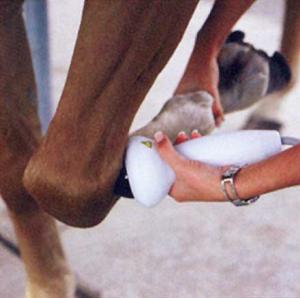
The Latest Vibes On Shock Wave Therapy
by Nancy Brannon
If your horse has a tendon or suspensory ligament injury, stress fractures or a sore back, your veterinarian may recommend a treatment called shock wave therapy.
Extracorporeal Shock Wave Therapy (ESWT) uses shock waves, or “rapidly expanding sound waves, in variable intensity and frequency, to pound on the injured tissues to stimulate healing.” That is how Dr. Kim Garner at Big Creek Animal Hospital in Millington, Tennessee described it. “It’s an interesting concept, but I don’t know exactly how it works. It can penetrate to a specific depth, depending on the setting, and sends a specific number of waves to the site. It is used in human medicine to break up kidney stones, and in this use, they found that people with arthritis in the general area of the stones had improvement,” she added.
The therapy was originally used in human patients to break up kidney and gallstones and in other orthopedic conditions. The treatment is now used in dogs as well as horses. Dr. Garner related, “when they used the treatment to break up kidney stones, the patients with arthritis in the general area of the stones showed improvement in their arthritis.”
At a seminar Dr. Garner attended about the therapy last year, the instructor revealed he “had experienced two years of back pain. He decided to take the therapy and confessed it was so uncomfortable that it brought tears to his eyes. But it relieved his pain.” She explained that the treatment has come into fairly common usage, but the downside it that it anesthetizes the area. She had a machine on trial for a while and “saw some improvement in some animals. We even used it in small animals.
Mississippi veterinarian Dr. Mark Akin uses the therapy “a lot because I see a lot of soft tissue injuries. It has proved to be a good treatment, especially for tendon and ligament injuries, but it doesn’t work as well on bones.” Akin explained that there are two types of units, focused and unfocused units. He uses the focused unit and finds that it works better than the unfocused unit. “It stimulates healing, but also has an analgesic effect—it numbs the area.” He said Dr. Scott McClure was “the world authority on the treatment. He is at Iowa State University. Dr. McClure’s smarter than I am about this. I’m just a country vet,” he quipped.
Interviewed in the Grayson-Jockey Club Research Today newsletter, Dr. McClure explained the treatment in lay terms. “Extracorporeal means outside the body. A shock wave is a pressure wave that goes from atmospheric pressure up to 1000 times that pressure in seconds.” Essentially a shock wave is a pressure wave, like those that occur when jets penetrate the sound barrier.
The way the treatment works, according to Dr. McClure, “it can stimulate the body to do things when used at the correct energy and number of pulses.” It can stimulate healing, but it can also destroy cells at high energy and high number of shocks. In this case, “it can kill tumor cells. It is non-invasive and when compared to surgery and lay up time, relatively inexpensive.”
Research by Dr. Ana Liz G. Alves and other veterinarians at Sao Paulo State University found ESWT an effective treatment for injured equine tendons, or superficial digital flexor tendonitis in horses. It promoted better healing, relieved pain, and improved tissue regeneration and repair. The main beneficial effects were EWST stimulated the alignment of collagen fibers during the course of the repair process. This gave significant improvement in the quality of tendon repair.
The drawback to the treatment is its analgesia effect. Drs. Akin Garner, and McClure cautioned that animals need to be watched carefully as this anesthesia effect can “deny a horse a warning from his own pain when asked to do something he is not sound enough to do,” said McClure. It is important not to misuse the treatment.
Two manufacturers of the ESWT are Versatron, distributed by SanuWave Services LLC in Marietta, Georgia and Focus-It, LLC in Roswell, Georgia. Dr. Akin uses the Focus machine.


