

By Leigh Ballard
The legendary Natural Horsemanship clinician and cowboy, Buck Brannaman, held two clinics at Harvest Farm in Harvest, AL near Huntsville October 12-15. The clinics were Horsemanship 1, the basics of groundwork and what Buck calls “a soft feel,” and Horsemanship 2, more advanced continuation of the principles of softness and cooperation from the horse.
Regardless of which clinic they attended, all students rode a half day on each of the four days, and then were required to watch the other class the rest of the day. Each student had the benefit of both levels of teaching. Auditors were welcome, and since half of Buck’s clinic students were always in the auditing audience, this section received a good deal of direct conversation and instruction from Buck. He quoted Ray Hunt often, and offered valuable nuggets of wisdom on many topics.
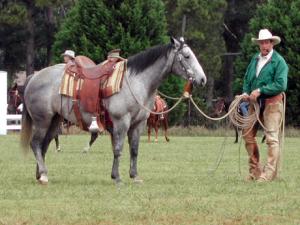
He described how a horse learns “to follow a feel” on a line in groundwork. He said, “If you get a horse decent on a lead rope, they’ll do whatever you want.” This is due to the sensitivity they develop to pressure and to the respect they develop for the person. Buck’s philosophy is that manners and maneuverability can become well developed on a lead rope, where the horse should be always responsive and respectful. He explained “fulfilling his obligation to the horse.” He said, “You can check out a lot of things about a horse you’ve never been on, just while he’s on a lead rope. If I take a horse on a lead rope and then I get on him, if I miss something, and I get that horse in trouble and he bucks with me, I’m disappointed. I failed that horse. I want to succeed and I want him to succeed. You pay attention to what he does on a lead rope.”
The clinic was held in a large open field, so Buck elaborated a lot about horses being comfortable on a loose rein. Buck said “I know a lot of you are a little ‘puckered up’ coming out here in this big meadow, no fence, no boundary. But until a horse is totally comfortable at a walk, trot, lope, and even, yes, a gallop, on a loose rein, collection is inappropriate. Many people start on collection too soon because there are trust issues. They are afraid if they ever give the horse freedom to move, things will fall apart.”
He explained how to teach a horse to pick up “a soft feel” by the rider putting a little pressure on one rein so the horse will give to the bit. He said, “First he’s not bending. He’s looking, exploring, but pretty soon flexion will come. He’s not sure; remember, he’s exploring, so be very careful to give him the ‘high sign’ when he does it right.” In other words, be sure to give the horse release when he gives to pressure.
Buck worked at length on concepts, such as what he calls “working off of a feel.” Brannaman’s entire concept of horse training and riding is that the trainer or rider should do as little as it takes to get the job done. The trainer (rider) has to instill trust and confidence in the horse, for the horse to want to cooperate with the trainer. He says you can force training, but you only have a relationship of intimidation, not respect and responsiveness.
In Horsemanship 1, students were asked to do riding exercises which laid a foundation for “a soft feel.” The first exercise was trotting short serpentines. The riders rode their horses around the field on a loose rein, turning them back and forth with their leg, and then stopping with one rein. Regarding whether or not the horse would surge forward or go too fast on the loose rein, Buck said, “Trot a few strides, then stop before you get into trouble; don’t ride into trouble and then try to get out of it.”
Then the students built on that exercise, doing one rein turns of 180° to free the hindquarters, followed by a 180° turn to move the forequarters around to complete the circle, and keep going forward. They learned the difference between using a leading rein and a supporting rein, depending on which part of the horse they were trying to move.
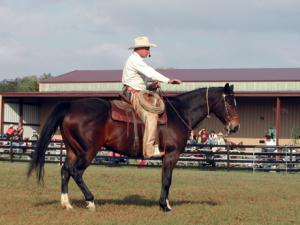
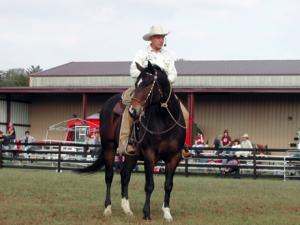
Buck used his horse to demonstrate how the exercise should look when done properly. He said, “It would be a lot easier to fly in and not drive 3,000 miles, but you need to see your teacher on horseback. I’ll take the time to show you so you can see.” As he demonstrated he explained, “Look, my reins are attached to my horse’s feet. It may look like they’re attached to his mouth, but they’re not. I can pick that foot up and take it anywhere I want.”
When the students had trouble with their horses not flexing or being heavy he said, “Look, right now this has nothing to do with the artistry of horsemanship. This is pure mechanics, fundamentals. But, we are looking for quality movements.”
In working on another fundamental maneuver, the stop, he instructed the students, “Stop; then there’s a little ‘dwell’ there, then pick up and teeter back, bend your hocks. Make it a matter of habit to teeter back.”
For teaching the horse to back well, he said, “Work on timing with release, in harmony with the horse. Feel the feet hit the ground. There is a perfect position of balance where you steal no energy from the horse.”
He closed the morning session with a groundwork exercise that he called the “half-circle exercise.” The student walks forward with the horse, changing directions out in front like a figure eight, crossing the front end and hind end back and forth “like a nice dance. This puts a little more pressure on them mentally,” Buck said.
In the afternoon session for Horsemanship 2, Buck directed the students to back circles, paying special attention to the arc of their horse’s bend. Buck said, “Ray (Hunt) was pretty subtle, he said ‘that looks all right—it’d be pretty hard to do too much of that.’” Buck said that exercise has helped him a lot over the years with his horses learning to get balance.
The students worked on walk transitions: fast, slow, back to fast. He wanted the horses very slow, very straight, very soft. When he saw someone doing it correctly, he would say, “There! That’s what you need to hunt for!”
The afternoon class also worked on leg yields and the elements of proper flexion. Buck said, “There are three correct ways to do a leg yield, relative to where you put your leg. You can have front quarters leading, hind quarters leading, or be even. Weight distribution is so important. And don’t dump the poll.”
In trot work, the instruction was “get a soft feel and then release. Carry it a few steps and then let go while they are still light to you. Don’t carry it until he gets heavy. Then, when they are carrying that pretty well, add some leg yielding.”
In the lope, Buck said to make sure the legs are used only for transitions. “Don’t be kicking every stride. Take the spur out of him. Put him to the lope and he should stay there. It’s supposed to be effortless to ride a horse; it’s not supposed to be work.”
A challenging exercise at the lope was “all about the horse learning to work straight up and down.” This meant the horse had to stay balanced, on the correct lead, bending properly. The rider had to, as Buck put it, “concentrate on something else, but ride your horse with accuracy.” This helps when working cattle, for example. Buck said, “I always ride my horse like I’m working a cow. I’ve got my imaginary friends all around me all the time (he joked), so everything I do, I do with purpose.” The riders had to rope a barrel and then lope circles around it, riding one-handed and all the while playing out the rope to wrap circles in a neat stack around the barrel. At the end of the rope, they had to turn around and do the same thing in the other direction while coiling the rope back up. Buck said, “Some of you might have to trot these circles. That’d be all right, but loping would be better.” The audience on the sidelines chuckled, and Buck laughed and said, “Yeah, I know you’re just glad you’re not in here!”
Buck quoted his mentor Ray Hunt often, and one thing he spoke much about was “the troubled horse.” Students asked questions about things such as head-tossing, opening the mouth, tie downs and dropped nosebands. He said, “The mouth, the eyes, the ears, tail, even the way they wear their hide – these things are symptoms; they are not the problem. Something is internally wrong; you’ve got a troubled horse. If the oil light comes on in your dashboard, do you stop the car and add some oil or do you smash the dashboard to make it go away? Do you tie a horse’s mouth shut to make it stop having problems with the bit? Do you smash the indicator or find out what the problem is?”
On misbehavior Buck advised, “Master your hands and your legs to create a rectangle of support around and for the horse. He will learn you can be a resource for his safety. Sometimes a horse spooks or acts up; doesn’t listen. A horse looks for a way out of trouble. He has all these open doors, front, sides, but you have the ability to close these doors with your hands and legs. He not only respects that, but craves it.”
The legendary Natural Horsemanship clinician and cowboy, Buck Brannaman, held two clinics at Harvest Farm in Harvest, AL near Huntsville October 12-15. The clinics were Horsemanship 1, the basics of groundwork and what Buck calls “a soft feel,” and Horsemanship 2, more advanced continuation of the principles of softness and cooperation from the horse.
Regardless of which clinic they attended, all students rode a half day on each of the four days, and then were required to watch the other class the rest of the day. Each student had the benefit of both levels of teaching. Auditors were welcome, and since half of Buck’s clinic students were always in the auditing audience, this section received a good deal of direct conversation and instruction from Buck. He quoted Ray Hunt often, and offered valuable nuggets of wisdom on many topics.
He described how a horse learns “to follow a feel” on a line in groundwork. He said, “If you get a horse decent on a lead rope, they’ll do whatever you want.” This is due to the sensitivity they develop to pressure and to the respect they develop for the person. Buck’s philosophy is that manners and maneuverability can become well developed on a lead rope, where the horse should be always responsive and respectful. He explained “fulfilling his obligation to the horse.” He said, “You can check out a lot of things about a horse you’ve never been on, just while he’s on a lead rope. If I take a horse on a lead rope and then I get on him, if I miss something, and I get that horse in trouble and he bucks with me, I’m disappointed. I failed that horse. I want to succeed and I want him to succeed. You pay attention to what he does on a lead rope.”
The clinic was held in a large open field, so Buck elaborated a lot about horses being comfortable on a loose rein. Buck said “I know a lot of you are a little ‘puckered up’ coming out here in this big meadow, no fence, no boundary. But until a horse is totally comfortable at a walk, trot, lope, and even, yes, a gallop, on a loose rein, collection is inappropriate. Many people start on collection too soon because there are trust issues. They are afraid if they ever give the horse freedom to move, things will fall apart.”
He explained how to teach a horse to pick up “a soft feel” by the rider putting a little pressure on one rein so the horse will give to the bit. He said, “First he’s not bending. He’s looking, exploring, but pretty soon flexion will come. He’s not sure; remember, he’s exploring, so be very careful to give him the ‘high sign’ when he does it right.” In other words, be sure to give the horse release when he gives to pressure.
Buck worked at length on concepts, such as what he calls “working off of a feel.” Brannaman’s entire concept of horse training and riding is that the trainer or rider should do as little as it takes to get the job done. The trainer (rider) has to instill trust and confidence in the horse, for the horse to want to cooperate with the trainer. He says you can force training, but you only have a relationship of intimidation, not respect and responsiveness.
In Horsemanship 1, students were asked to do riding exercises which laid a foundation for “a soft feel.” The first exercise was trotting short serpentines. The riders rode their horses around the field on a loose rein, turning them back and forth with their leg, and then stopping with one rein. Regarding whether or not the horse would surge forward or go too fast on the loose rein, Buck said, “Trot a few strides, then stop before you get into trouble; don’t ride into trouble and then try to get out of it.”
Then the students built on that exercise, doing one rein turns of 180° to free the hindquarters, followed by a 180° turn to move the forequarters around to complete the circle, and keep going forward. They learned the difference between using a leading rein and a supporting rein, depending on which part of the horse they were trying to move.
Buck used his horse to demonstrate how the exercise should look when done properly. He said, “It would be a lot easier to fly in and not drive 3,000 miles, but you need to see your teacher on horseback. I’ll take the time to show you so you can see.” As he demonstrated he explained, “Look, my reins are attached to my horse’s feet. It may look like they’re attached to his mouth, but they’re not. I can pick that foot up and take it anywhere I want.”
When the students had trouble with their horses not flexing or being heavy he said, “Look, right now this has nothing to do with the artistry of horsemanship. This is pure mechanics, fundamentals. But, we are looking for quality movements.”
In working on another fundamental maneuver, the stop, he instructed the students, “Stop; then there’s a little ‘dwell’ there, then pick up and teeter back, bend your hocks. Make it a matter of habit to teeter back.”
For teaching the horse to back well, he said, “Work on timing with release, in harmony with the horse. Feel the feet hit the ground. There is a perfect position of balance where you steal no energy from the horse.”
He closed the morning session with a groundwork exercise that he called the “half-circle exercise.” The student walks forward with the horse, changing directions out in front like a figure eight, crossing the front end and hind end back and forth “like a nice dance. This puts a little more pressure on them mentally,” Buck said.
In the afternoon session for Horsemanship 2, Buck directed the students to back circles, paying special attention to the arc of their horse’s bend. Buck said, “Ray (Hunt) was pretty subtle, he said ‘that looks all right—it’d be pretty hard to do too much of that.’” Buck said that exercise has helped him a lot over the years with his horses learning to get balance.
The students worked on walk transitions: fast, slow, back to fast. He wanted the horses very slow, very straight, very soft. When he saw someone doing it correctly, he would say, “There! That’s what you need to hunt for!”
The afternoon class also worked on leg yields and the elements of proper flexion. Buck said, “There are three correct ways to do a leg yield, relative to where you put your leg. You can have front quarters leading, hind quarters leading, or be even. Weight distribution is so important. And don’t dump the poll.”
In trot work, the instruction was “get a soft feel and then release. Carry it a few steps and then let go while they are still light to you. Don’t carry it until he gets heavy. Then, when they are carrying that pretty well, add some leg yielding.”
In the lope, Buck said to make sure the legs are used only for transitions. “Don’t be kicking every stride. Take the spur out of him. Put him to the lope and he should stay there. It’s supposed to be effortless to ride a horse; it’s not supposed to be work.”
A challenging exercise at the lope was “all about the horse learning to work straight up and down.” This meant the horse had to stay balanced, on the correct lead, bending properly. The rider had to, as Buck put it, “concentrate on something else, but ride your horse with accuracy.” This helps when working cattle, for example. Buck said, “I always ride my horse like I’m working a cow. I’ve got my imaginary friends all around me all the time (he joked), so everything I do, I do with purpose.” The riders had to rope a barrel and then lope circles around it, riding one-handed and all the while playing out the rope to wrap circles in a neat stack around the barrel. At the end of the rope, they had to turn around and do the same thing in the other direction while coiling the rope back up. Buck said, “Some of you might have to trot these circles. That’d be all right, but loping would be better.” The audience on the sidelines chuckled, and Buck laughed and said, “Yeah, I know you’re just glad you’re not in here!”
Buck quoted his mentor Ray Hunt often, and one thing he spoke much about was “the troubled horse.” Students asked questions about things such as head-tossing, opening the mouth, tie downs and dropped nosebands. He said, “The mouth, the eyes, the ears, tail, even the way they wear their hide – these things are symptoms; they are not the problem. Something is internally wrong; you’ve got a troubled horse. If the oil light comes on in your dashboard, do you stop the car and add some oil or do you smash the dashboard to make it go away? Do you tie a horse’s mouth shut to make it stop having problems with the bit? Do you smash the indicator or find out what the problem is?”
On misbehavior Buck advised, “Master your hands and your legs to create a rectangle of support around and for the horse. He will learn you can be a resource for his safety. Sometimes a horse spooks or acts up; doesn’t listen. A horse looks for a way out of trouble. He has all these open doors, front, sides, but you have the ability to close these doors with your hands and legs. He not only respects that, but craves it.”


