

Article & photos by Nancy Brannon
Warner Speakman and his wife Linda moved to their farm in Fayette County, Tennessee after tiring of the daily commute down a crowded 2-lane highway to work every day. Now sort-of retired, Speakman and his wife devote much of their time to making hay, although Speakman still does consulting work.
For 30 years he was president and owner of ESI, a high-tech electronics supplier. He has done water projects on Saudi Arabia and Africa. In his early years, he developed water controls, irrigation designs, and more. As a co-developer in electronics, he holds three patents. So researching and installing the latest, most efficient irrigation system on his hay fields is apropos.
“This micro irrigation technology is very active in California and on vegetable farms,” he said. The irrigation is done through a tape buried a few inches underground. “It’s more effective than the above ground, center-pivot systems,” he added. “It’s now being used in Fayette County mainly for row crops, soybeans, cotton. This is the first application for hay here.”
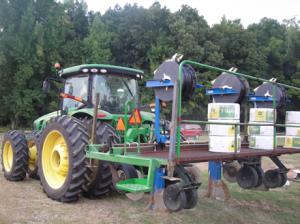
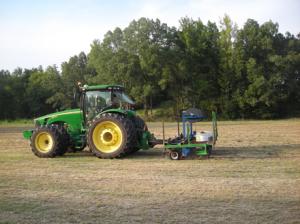
The tape is “plowed in” similar to how fiber optic cable is laid. The tape is buried about the same depth as with row crop, about 12,” and has a slit every 12 inches, where the water is emitted. PVC pipes carrying water to the tapes gradually decrease in size from 4” to 3” to 2”. The system is designed to maintain equal pressure on all laterals. Speakman recently installed 48 thousand-foot tapes, five feet apart, in one of his hay fields.
It’s a closed loop system with maintenance points where it can be flushed. Every 12 tapes have a cap on the line where you can blow out any trash. It has a combination of pressure and release vents to keep the pressure even in the tape. “You don’t want to allow it to be pressured up or pulled down (suction). In the winter, this allows the system to expand without freezing.”
Speakman is looking for even “greener” ways to keep his hay fields green. “Are there points where I could use solar or wind energy” to run it?” he wondered. “Could I inject liquid fertilizer? Or maybe it’s best to stay with surface applied fertilizer.”
“Once the grass feels the water, it responds big time!” he emphasized. “With this irrigation, I could possibly get five cuttings a year. I should also be able to maintain high yields, getting 100 bales per acre with irrigation. I should be able to get the maximum yields every cutting.”
This system works best on flat land. It takes a very skilled irrigation expert to install it on rolling because it is more difficult on that terrain to keep the pressure equal. Ideal pressure in the system should be around 8 to 15 pounds, “but it will work on as low as four,” Speakman explained. “It’s mainly wetting the grass from the subsoil up; water migrates up.”
Next year he plans to run the irrigation system six hours per week, regularly checking the moisture content. “That should keep the grass ‘happy,’” he hopes. He expects the cost of running the pump will be minimal, but hasn’t “run the numbers” yet to get a cost-benefit analysis. He expects his return on investment will be rather quick, in about two to three years.
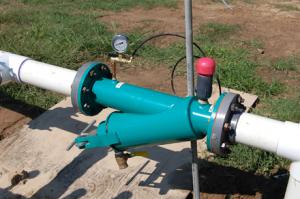
“One thing that’s very important is to have a sand filter on the system,” he said. His has Janis filter, and regularly checking the water pH is helpful, since Fayette County’s water tends to be somewhat on the acidic side.
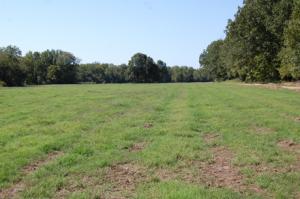
Looking at the height of Bermuda grass in his hay fields, one would think he’s growing a hybrid, but Speaking is growing common Bermuda grass for his hay. It’s hardy and grows to heights of 8 to 10 inches or more. The day I visited, Linda was out on the John Deere “flipping hay,” as Speakman calls tedding. They were getting ready to bale their fall cutting.
The Speakmans have horses on the farm, too, mostly flat shod Tennessee Walking Horses. His black horse, Power’s On,is retired from padded showing. He has a breeding stallion, Swamp Cat, that is ¾ bred to Armed and Dangerous. He’s been decorated in both the racking horse and walking horse worlds. He has a Powered by Generator sorrel mare and some other fine mares, too.
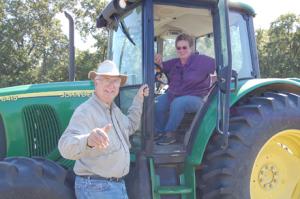
Both the Speakmans thoroughly enjoy raising and baling hay. Linda is as much, or more, at home in the tractor as Warner. She cuts, teds, rakes, and bales, while Warner mainly handles the pick up and storage.
Warner Speakman and his wife Linda moved to their farm in Fayette County, Tennessee after tiring of the daily commute down a crowded 2-lane highway to work every day. Now sort-of retired, Speakman and his wife devote much of their time to making hay, although Speakman still does consulting work.
For 30 years he was president and owner of ESI, a high-tech electronics supplier. He has done water projects on Saudi Arabia and Africa. In his early years, he developed water controls, irrigation designs, and more. As a co-developer in electronics, he holds three patents. So researching and installing the latest, most efficient irrigation system on his hay fields is apropos.
“This micro irrigation technology is very active in California and on vegetable farms,” he said. The irrigation is done through a tape buried a few inches underground. “It’s more effective than the above ground, center-pivot systems,” he added. “It’s now being used in Fayette County mainly for row crops, soybeans, cotton. This is the first application for hay here.”
The tape is “plowed in” similar to how fiber optic cable is laid. The tape is buried about the same depth as with row crop, about 12,” and has a slit every 12 inches, where the water is emitted. PVC pipes carrying water to the tapes gradually decrease in size from 4” to 3” to 2”. The system is designed to maintain equal pressure on all laterals. Speakman recently installed 48 thousand-foot tapes, five feet apart, in one of his hay fields.
It’s a closed loop system with maintenance points where it can be flushed. Every 12 tapes have a cap on the line where you can blow out any trash. It has a combination of pressure and release vents to keep the pressure even in the tape. “You don’t want to allow it to be pressured up or pulled down (suction). In the winter, this allows the system to expand without freezing.”
Speakman is looking for even “greener” ways to keep his hay fields green. “Are there points where I could use solar or wind energy” to run it?” he wondered. “Could I inject liquid fertilizer? Or maybe it’s best to stay with surface applied fertilizer.”
“Once the grass feels the water, it responds big time!” he emphasized. “With this irrigation, I could possibly get five cuttings a year. I should also be able to maintain high yields, getting 100 bales per acre with irrigation. I should be able to get the maximum yields every cutting.”
This system works best on flat land. It takes a very skilled irrigation expert to install it on rolling because it is more difficult on that terrain to keep the pressure equal. Ideal pressure in the system should be around 8 to 15 pounds, “but it will work on as low as four,” Speakman explained. “It’s mainly wetting the grass from the subsoil up; water migrates up.”
Next year he plans to run the irrigation system six hours per week, regularly checking the moisture content. “That should keep the grass ‘happy,’” he hopes. He expects the cost of running the pump will be minimal, but hasn’t “run the numbers” yet to get a cost-benefit analysis. He expects his return on investment will be rather quick, in about two to three years.
“One thing that’s very important is to have a sand filter on the system,” he said. His has Janis filter, and regularly checking the water pH is helpful, since Fayette County’s water tends to be somewhat on the acidic side.
Looking at the height of Bermuda grass in his hay fields, one would think he’s growing a hybrid, but Speaking is growing common Bermuda grass for his hay. It’s hardy and grows to heights of 8 to 10 inches or more. The day I visited, Linda was out on the John Deere “flipping hay,” as Speakman calls tedding. They were getting ready to bale their fall cutting.
The Speakmans have horses on the farm, too, mostly flat shod Tennessee Walking Horses. His black horse, Power’s On,is retired from padded showing. He has a breeding stallion, Swamp Cat, that is ¾ bred to Armed and Dangerous. He’s been decorated in both the racking horse and walking horse worlds. He has a Powered by Generator sorrel mare and some other fine mares, too.
Both the Speakmans thoroughly enjoy raising and baling hay. Linda is as much, or more, at home in the tractor as Warner. She cuts, teds, rakes, and bales, while Warner mainly handles the pick up and storage.


