

Article & photos by Nancy Brannon
On September 15-16, Delta Dressage sponsored a clinic with Balanced Riding Trainer Allison Faso at Sara Matz’ Fair Meadow Farm on Forest Hill-Irene Road south of Germantown, TN. Riders of all disciplines were invited, but Delta Dressage members received a discount for the clinic costs.
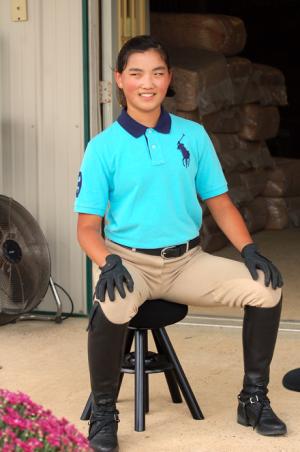
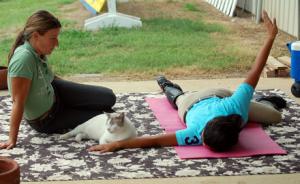
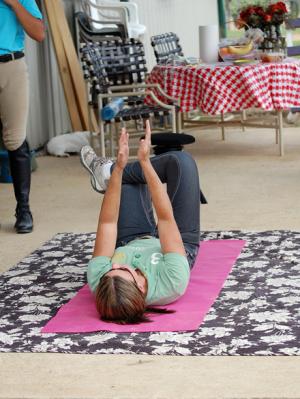
Allison is certified with Eckart Meyner's Balimo Equestrian Training Program, which utilizes simple exercises which help riders achieve balance by stretching, relaxing, and strengthening muscles in order to achieve a correct, comfortable seat. In addition to mounted instruction, Allison had riders work on improving and strengthening their weaknesses by using a yoga mat and a special stool, the Balimo Chair, which tilts in 3 directions and teaches the rider to follow a horse's movement and remain in balance.
Allison is a classically trained dressage competitor, instructor and trainer with a strong record of achievement: she is a USDF Silver Medalist and successful FEI competitor. She has worked with some of the most respected professionals in dressage including Betsy Steiner and Lynda Alicki.
Her philosophy is that Dressage, and riding in general, is all about connections. Building a top performing dressage horse involves much more than 20 meter circles and 30 minute lessons. It involves an approach that treats the horse as a connected system of mind and muscle.
Allison is a Graduate Core Instructor for the Eckart Meyners Instructor Training Program (EMITP), which offers riding instructors of all levels and disciplines vital tools to enhance their effectiveness. Based on established educational and teaching theories, the EMITP adds a dynamic focus on the physiology and movement of the rider, integrating instruction through a mind/body approach.
Mr. Meyners’ program offers very practical, easy to implement methods to create an effective seat. These methods involve more than simply having the “correct” position; the focus is on the rider’s ability for balance in motion, which Mr. Meyners considers to be the most important ingredient in successful riding. Second is his belief that the roles of mind and body must be connected and balanced together in order for a dialogue with the horse to occur. This belief is evident in many of his practical exercises for the rider. Third, he has developed a teaching methodology that includes how to teach motion and feel. Using this methodology results in the development of the correct muscle memory necessary for riding.
Allison’s focus in the clinic was working with a variety of riders on balance, straightening, not interfering with the horse, and assessing the riders’ weak points. From this she created exercises for the riders to help strengthen, or loosen, these weak areas, and produce a more balanced rider.
She watched the riders mounted, asked them what they needed to work on, and then made a plan to help the riders improve. After a few minutes of mounted instruction, she brought them to the Balimo Chair, where riders rotate their hips sideways, back and forth, then come to a balanced position. After a few minutes’ work here, riders remounted to find that same balanced position on horseback. Riders were then brought to the exercise mat, where Allison showed them additional exercises to stretch and strengthen particular muscle groups, as needed by the individual rider.
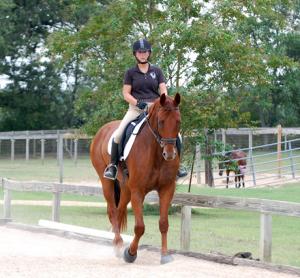
At one point, Allison was working with rider Emma Miller, riding Trip, on trot-canter transitions and stretch down. She encouraged her to keep contact even in the stretch down. If your horse over-flexes, kick him forward a bit. “A horse must get rounder, not longer and flatter,” she said, explaining the stretch down. As a general comment, she said, “Brakes and gas – they come in handy!”
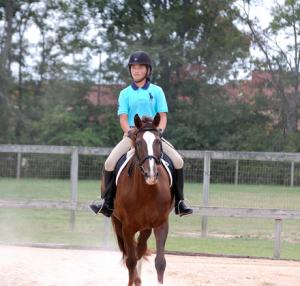
Danielle Gallo, on Dinera, worked on improving her sitting trot. After watching her ride both directions at trot, posting and sitting, she had Danielle dismount and try out the Balimo Chair. Then after a few minutes of rocking forward and back, “3 o’clock and 9 o’clock,” then circling, Danielle remounted to feel on horseback what she had accomplished on the stool. Allison first lengthened her stirrups, then encouraged her to “stay in your center spot” and “feel like your ankle can be a better spring. Just allow yourself to sit there and be looser in your body, not stiff.” One way to be more supple while riding is to “wiggle” whenever you feel a part of your body becoming stiff.
Again Danielle dismounted and came to try some additional exercises on the exercise mat. Then she remounted to implement the exercise results on horseback.
Sara Matz said, “All the riders had a great time, learned a lot, were really positive and looking forward to a return on Sunday. Although her specialty is dressage, her methods work for any riding discipline. We had quite a few hunter/jumper riders in the morning. Her emphasis is balance, finding weaknesses, and developing a remedy for them.” Sara was very appreciative of all the volunteer efforts from Delta members in making the clinic a success.
On September 15-16, Delta Dressage sponsored a clinic with Balanced Riding Trainer Allison Faso at Sara Matz’ Fair Meadow Farm on Forest Hill-Irene Road south of Germantown, TN. Riders of all disciplines were invited, but Delta Dressage members received a discount for the clinic costs.
Allison is certified with Eckart Meyner's Balimo Equestrian Training Program, which utilizes simple exercises which help riders achieve balance by stretching, relaxing, and strengthening muscles in order to achieve a correct, comfortable seat. In addition to mounted instruction, Allison had riders work on improving and strengthening their weaknesses by using a yoga mat and a special stool, the Balimo Chair, which tilts in 3 directions and teaches the rider to follow a horse's movement and remain in balance.
Allison is a classically trained dressage competitor, instructor and trainer with a strong record of achievement: she is a USDF Silver Medalist and successful FEI competitor. She has worked with some of the most respected professionals in dressage including Betsy Steiner and Lynda Alicki.
Her philosophy is that Dressage, and riding in general, is all about connections. Building a top performing dressage horse involves much more than 20 meter circles and 30 minute lessons. It involves an approach that treats the horse as a connected system of mind and muscle.
Allison is a Graduate Core Instructor for the Eckart Meyners Instructor Training Program (EMITP), which offers riding instructors of all levels and disciplines vital tools to enhance their effectiveness. Based on established educational and teaching theories, the EMITP adds a dynamic focus on the physiology and movement of the rider, integrating instruction through a mind/body approach.
Mr. Meyners’ program offers very practical, easy to implement methods to create an effective seat. These methods involve more than simply having the “correct” position; the focus is on the rider’s ability for balance in motion, which Mr. Meyners considers to be the most important ingredient in successful riding. Second is his belief that the roles of mind and body must be connected and balanced together in order for a dialogue with the horse to occur. This belief is evident in many of his practical exercises for the rider. Third, he has developed a teaching methodology that includes how to teach motion and feel. Using this methodology results in the development of the correct muscle memory necessary for riding.
Allison’s focus in the clinic was working with a variety of riders on balance, straightening, not interfering with the horse, and assessing the riders’ weak points. From this she created exercises for the riders to help strengthen, or loosen, these weak areas, and produce a more balanced rider.
She watched the riders mounted, asked them what they needed to work on, and then made a plan to help the riders improve. After a few minutes of mounted instruction, she brought them to the Balimo Chair, where riders rotate their hips sideways, back and forth, then come to a balanced position. After a few minutes’ work here, riders remounted to find that same balanced position on horseback. Riders were then brought to the exercise mat, where Allison showed them additional exercises to stretch and strengthen particular muscle groups, as needed by the individual rider.
At one point, Allison was working with rider Emma Miller, riding Trip, on trot-canter transitions and stretch down. She encouraged her to keep contact even in the stretch down. If your horse over-flexes, kick him forward a bit. “A horse must get rounder, not longer and flatter,” she said, explaining the stretch down. As a general comment, she said, “Brakes and gas – they come in handy!”
Danielle Gallo, on Dinera, worked on improving her sitting trot. After watching her ride both directions at trot, posting and sitting, she had Danielle dismount and try out the Balimo Chair. Then after a few minutes of rocking forward and back, “3 o’clock and 9 o’clock,” then circling, Danielle remounted to feel on horseback what she had accomplished on the stool. Allison first lengthened her stirrups, then encouraged her to “stay in your center spot” and “feel like your ankle can be a better spring. Just allow yourself to sit there and be looser in your body, not stiff.” One way to be more supple while riding is to “wiggle” whenever you feel a part of your body becoming stiff.
Again Danielle dismounted and came to try some additional exercises on the exercise mat. Then she remounted to implement the exercise results on horseback.
Sara Matz said, “All the riders had a great time, learned a lot, were really positive and looking forward to a return on Sunday. Although her specialty is dressage, her methods work for any riding discipline. We had quite a few hunter/jumper riders in the morning. Her emphasis is balance, finding weaknesses, and developing a remedy for them.” Sara was very appreciative of all the volunteer efforts from Delta members in making the clinic a success.


