

By Leigh Ballard
Butterfly weed, Asclepias tuberosa, is common pasture and field native perennial, which is highly prized by native plant enthusiasts. It also enjoys popularity with “regular” perennial gardeners as a drought tolerant and tough ornamental plant that is not only colorful, but also brings butterflies to the garden.
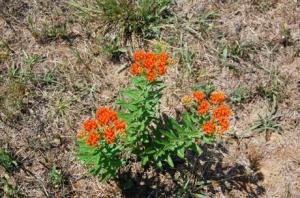
Butterfly weed has large clusters of bright orange flowers full of nectar, which is extremely attractive to butterflies – one almost never sees a butterfly weed in its natural environment without butterflies fluttering around, especially larger butterflies, like swallowtails, monarchs, viceroys and queens. Occasionally you might find a plant in the wild with yellow or red clusters, rather than the typical orange. These are especially prized, and some selections have been deliberately cultivated by growers. In the wild, the plant is typically about two feet tall. The plant is sometimes called Pleurisy Root, because the root was chewed by Native Americans and early settlers to cure lung problems.
Butterfly weed is the larval food plant for Monarch (and a few other) butterflies. Translated: the caterpillars that will eventually become these butterflies eat the plant. Do not kill the caterpillars you see on the plant; it will re-grow when the caterpillars finish eating and go into the chrysalis stage. Aphids are also often found on butterfly weed, but if you introduce ladybugs to eat the aphids, they will eat the butterfly larvae, too. It’s best to just leave nature alone; the plant is adapted to handle it.
Butterfly weed likes open spaces in full sun and a fairly dry location. It blooms profusely in the early summer. It will continue to bloom through the summer if left alone.
For those who want to enjoy the plant in the field or pasture, just mow around it and leave it as a little oasis for the butterflies. Horses generally do not bother it, although deer have been known to nip off the tender flower buds.
For those who want to enjoy it closer to the garden, be advised: it is a well-adapted plant for its native situation. It does not like rich garden soil or too much moisture. Digging one up to move to your preferred location will often kill it because it has a long taproot. Seeds can be collected when the long seedpods dry and mature, but growing butterfly weed from seed is also difficult. Butterfly weed seeds require stratification, a process which mimics the alternating temperatures and moisture conditions that a seed would encounter in nature as it waits to germinate. If you can dig a young plant or dig very deeply for an older plant, or if you have an appropriate place to scatter seed that won’t wash away, you might be successful cultivating Asclepias tuberosa. Otherwise, enjoy it where it grows!
Butterfly weed, Asclepias tuberosa, is common pasture and field native perennial, which is highly prized by native plant enthusiasts. It also enjoys popularity with “regular” perennial gardeners as a drought tolerant and tough ornamental plant that is not only colorful, but also brings butterflies to the garden.
Butterfly weed has large clusters of bright orange flowers full of nectar, which is extremely attractive to butterflies – one almost never sees a butterfly weed in its natural environment without butterflies fluttering around, especially larger butterflies, like swallowtails, monarchs, viceroys and queens. Occasionally you might find a plant in the wild with yellow or red clusters, rather than the typical orange. These are especially prized, and some selections have been deliberately cultivated by growers. In the wild, the plant is typically about two feet tall. The plant is sometimes called Pleurisy Root, because the root was chewed by Native Americans and early settlers to cure lung problems.
Butterfly weed is the larval food plant for Monarch (and a few other) butterflies. Translated: the caterpillars that will eventually become these butterflies eat the plant. Do not kill the caterpillars you see on the plant; it will re-grow when the caterpillars finish eating and go into the chrysalis stage. Aphids are also often found on butterfly weed, but if you introduce ladybugs to eat the aphids, they will eat the butterfly larvae, too. It’s best to just leave nature alone; the plant is adapted to handle it.
Butterfly weed likes open spaces in full sun and a fairly dry location. It blooms profusely in the early summer. It will continue to bloom through the summer if left alone.
For those who want to enjoy the plant in the field or pasture, just mow around it and leave it as a little oasis for the butterflies. Horses generally do not bother it, although deer have been known to nip off the tender flower buds.
For those who want to enjoy it closer to the garden, be advised: it is a well-adapted plant for its native situation. It does not like rich garden soil or too much moisture. Digging one up to move to your preferred location will often kill it because it has a long taproot. Seeds can be collected when the long seedpods dry and mature, but growing butterfly weed from seed is also difficult. Butterfly weed seeds require stratification, a process which mimics the alternating temperatures and moisture conditions that a seed would encounter in nature as it waits to germinate. If you can dig a young plant or dig very deeply for an older plant, or if you have an appropriate place to scatter seed that won’t wash away, you might be successful cultivating Asclepias tuberosa. Otherwise, enjoy it where it grows!


