

By Nancy Brannon, Ph.D.
The Mid-South Horse Review recently received an advisory from the UT Agricultural Extension Service, “Armyworms Are All Around Us.” The report says: “Fall armyworms are most numerous in late summer or early fall. Usually, reports of fall armyworm damage begin to come in during late July or early August. There are three or more generations of fall armyworms each year. Fall armyworms are susceptible to cold, and are unable to survive our winters.
“Fall armyworm damage may vary in appearance and severity according to the type of grass and management practices. In closely grazed fields, the grass may seem to thin out and develop brown spots similar to those sometimes seen on golf courses. These spots look burned or browned out. This appearance is the result of grass plants rapidly dehydrating after fall armyworm larvae have chewed off the tender foliage. For this reason, fall armyworm damage often resembles drought damage.
“Established, healthy, Bermuda grass is rarely killed by fall armyworms, but the complete defoliation caused by a severe infestation weakens plants and deprives livestock of pasture or a hay producer of a hay cutting.
“Fall armyworm damage is most likely to occur from August through October when populations are at seasonal highs. During periods of drought, it is not uncommon to receive the first reports of damage in July. Natural enemies of the armyworm are less effective during drought years.”
The report describes how to check Bermuda grass pastures for Armyworms and then, if necessary, to treat for Armyworms using insecticides such as Sevin XLR and Tracer SC, which are available without a private applicator’s license. “Mustang Max is another choice, but a restricted pesticide.”
However, several pieces of information are missing from this advisory. First, what is an Armyworm? Second, what are the “natural enemies” of Armyworms, referred to in the report? Third, what conditions bring on Armyworm infestation? Research from some other sources revealed the answers to these questions.
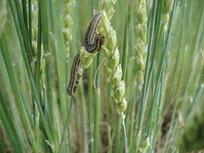
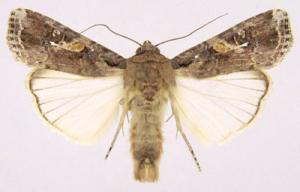
What are Armyworms? The fall Armyworm (Spodoptera frugiperda) is part of the order of Lepidoptera and is the caterpillar life stage of a moth. The Armyworm has four stages: egg, larva, pupa; the fully developed parent is a brownish-gray moth.
Their eggs masses are deposited on or near plant foods. Each female may deposit several of these egg clusters. The caterpillar that hatches from the egg is only about one-eighth inch long, but when fully grown, it reaches a length of about two inches.
The Armyworm's diet consists mainly of grasses and small grain crops. Their common name is derived from their feeding habits. They will eat everything in an area and once the food supply is exhausted the entire “army” will move to the next available food source. The caterpillars usually feed at night and hide in plant litter just above the soil surface during the day. These moth larvae chew off the grass blades above the soil surface. When there is a major infestation, the grass is eaten to the soil level.
A hard frost may kill the larvae off. Although the moths do no damage to plants, they will continue their life cycle and reproduce.
Predators: Predators that readily consume armyworm larvaeinclude: Ground beetles (Coleoptera: Carabidae) are especially effective, as are various predatory bugs (Hemiptera: various families), ants (Hymenoptera: Formicidae), and spiders (Araneae: Lycosidae and Phalangiidae) feed on armyworm. Green lacewings, pirate bugs, and egg wasps are somewhat effective in the control of armyworms and caterpillars.
Avian predators on Armyworms include: the bobolink, Dolichonyx oryzivorus (Linnaeus), sometimes called the “armyworm bird” in North America. Other birds of note include the crow, Corvus brachyrhynchos Brehm, and starling, Sturnus vulgaris Linnaeus. “According to the records of the United States Biological Survey, more than 40 species of native wild birds are known to eat the armyworm in its various stages. Among the most important of these are the following: Crow blackbird or grackle, yellow-headed blackbird, chipping sparrow, bluebird, prairie hen, and European starling. Domestic fowls of all kinds will greedily devour the caterpillars and pupa, if allowed to roam over infested fields. [free range chickens] Skunks and toads also undoubtedly eat thousands of the army worms, both caterpillars and pupa. These birds and other animals should therefore be encouraged and protected by the farmer by all possible means.”
Diseases commonly infect Armyworms, especially during periods of high density. Bacteria and fungi, particularly the fungus Metarhizium anisopliae, are reported in the literature.
Conditions Conducive to Armyworm Infestation:
No-till and minimum tillage fields experience greater problems with armyworm, relative to conventional tillage fields.
A 1996 report from the Organic Cotton Monitor, produced by the Institute for Agricultural and Trade Policy reported that farmers in the Texas Rio Grande Valley voted overwhelmingly to terminate a $10 million Boll Weevil Eradication Program. The farmers had adopted the program in 1994, which involves periodic application of Malathion at critical stages of the boll weevil's breeding cycle. While other states like Georgia and the Carolinas had seen impressive results from the eradication program, unintended consequences soon appeared. The report stated:
“Disaster struck in Texas during the first year of the eradication program when the Malathion killed off spiders, wasps and other beneficial insects, which usually feed on pests like aphids and beet army worms, and allowed the pests to ravage crops. More than 80 percent of the crop was reported lost to pests, totaling over $140 million in crop losses and a $300 million hit to the Texas state economy.” So the boll weevil eradication program actually contributed to increased crop damage by killing off beneficial insects that keep crop “pests” in control.
The example with Malathion shows how human efforts directed at controlling one particular pest without considering the holistic picture and relationships among a variety of plants and animals can often have unintended consequences which are counter to the original goals. The efforts to destroy one “pest” or “weed” often destroy a variety of other plants and animals, upsetting the natural balance, allowing the “pest” species to overpopulate.
Another factor contributing to the wholesale destruction of crops by crop predators is the monocrop system practiced in agriculture. A predator that feeds on one particular plant in its lifecycle will have an enormous feast when hundreds or thousands of acres are planted exclusively in its favorite food. Planting a variety of companion crops and maintaining diversity of plant and animal life will establish an ecological balance that keeps “pests” in check.
Resources:
True Armyworms Showing Up In MS Wheat, http://www.mississippi-crops.com/2012/03/29/true-armyworms-showing-up-in-ms-wheat-ahead-of-schedule/
How To Control Armyworms and Caterpillars, http://www.thegardenhelper.com/armyworm.html
Texas Eradication Program Terminated, http://www.ibiblio.org/london/orgfarm/crops/Organic.Cotton.Monitor
Damage to Turf from the Armyworm, http://gsr.lib.msu.edu/1920s/1924/2407166.pdf
Univ. of Florida, Dept. of Agriculture, Featured Creatures: Armyworm, http://entnemdept.ufl.edu/creatures/field/true_armyworm.htm
The Mid-South Horse Review recently received an advisory from the UT Agricultural Extension Service, “Armyworms Are All Around Us.” The report says: “Fall armyworms are most numerous in late summer or early fall. Usually, reports of fall armyworm damage begin to come in during late July or early August. There are three or more generations of fall armyworms each year. Fall armyworms are susceptible to cold, and are unable to survive our winters.
“Fall armyworm damage may vary in appearance and severity according to the type of grass and management practices. In closely grazed fields, the grass may seem to thin out and develop brown spots similar to those sometimes seen on golf courses. These spots look burned or browned out. This appearance is the result of grass plants rapidly dehydrating after fall armyworm larvae have chewed off the tender foliage. For this reason, fall armyworm damage often resembles drought damage.
“Established, healthy, Bermuda grass is rarely killed by fall armyworms, but the complete defoliation caused by a severe infestation weakens plants and deprives livestock of pasture or a hay producer of a hay cutting.
“Fall armyworm damage is most likely to occur from August through October when populations are at seasonal highs. During periods of drought, it is not uncommon to receive the first reports of damage in July. Natural enemies of the armyworm are less effective during drought years.”
The report describes how to check Bermuda grass pastures for Armyworms and then, if necessary, to treat for Armyworms using insecticides such as Sevin XLR and Tracer SC, which are available without a private applicator’s license. “Mustang Max is another choice, but a restricted pesticide.”
However, several pieces of information are missing from this advisory. First, what is an Armyworm? Second, what are the “natural enemies” of Armyworms, referred to in the report? Third, what conditions bring on Armyworm infestation? Research from some other sources revealed the answers to these questions.
What are Armyworms? The fall Armyworm (Spodoptera frugiperda) is part of the order of Lepidoptera and is the caterpillar life stage of a moth. The Armyworm has four stages: egg, larva, pupa; the fully developed parent is a brownish-gray moth.
Their eggs masses are deposited on or near plant foods. Each female may deposit several of these egg clusters. The caterpillar that hatches from the egg is only about one-eighth inch long, but when fully grown, it reaches a length of about two inches.
The Armyworm's diet consists mainly of grasses and small grain crops. Their common name is derived from their feeding habits. They will eat everything in an area and once the food supply is exhausted the entire “army” will move to the next available food source. The caterpillars usually feed at night and hide in plant litter just above the soil surface during the day. These moth larvae chew off the grass blades above the soil surface. When there is a major infestation, the grass is eaten to the soil level.
A hard frost may kill the larvae off. Although the moths do no damage to plants, they will continue their life cycle and reproduce.
Predators: Predators that readily consume armyworm larvaeinclude: Ground beetles (Coleoptera: Carabidae) are especially effective, as are various predatory bugs (Hemiptera: various families), ants (Hymenoptera: Formicidae), and spiders (Araneae: Lycosidae and Phalangiidae) feed on armyworm. Green lacewings, pirate bugs, and egg wasps are somewhat effective in the control of armyworms and caterpillars.
Avian predators on Armyworms include: the bobolink, Dolichonyx oryzivorus (Linnaeus), sometimes called the “armyworm bird” in North America. Other birds of note include the crow, Corvus brachyrhynchos Brehm, and starling, Sturnus vulgaris Linnaeus. “According to the records of the United States Biological Survey, more than 40 species of native wild birds are known to eat the armyworm in its various stages. Among the most important of these are the following: Crow blackbird or grackle, yellow-headed blackbird, chipping sparrow, bluebird, prairie hen, and European starling. Domestic fowls of all kinds will greedily devour the caterpillars and pupa, if allowed to roam over infested fields. [free range chickens] Skunks and toads also undoubtedly eat thousands of the army worms, both caterpillars and pupa. These birds and other animals should therefore be encouraged and protected by the farmer by all possible means.”
Diseases commonly infect Armyworms, especially during periods of high density. Bacteria and fungi, particularly the fungus Metarhizium anisopliae, are reported in the literature.
Conditions Conducive to Armyworm Infestation:
No-till and minimum tillage fields experience greater problems with armyworm, relative to conventional tillage fields.
A 1996 report from the Organic Cotton Monitor, produced by the Institute for Agricultural and Trade Policy reported that farmers in the Texas Rio Grande Valley voted overwhelmingly to terminate a $10 million Boll Weevil Eradication Program. The farmers had adopted the program in 1994, which involves periodic application of Malathion at critical stages of the boll weevil's breeding cycle. While other states like Georgia and the Carolinas had seen impressive results from the eradication program, unintended consequences soon appeared. The report stated:
“Disaster struck in Texas during the first year of the eradication program when the Malathion killed off spiders, wasps and other beneficial insects, which usually feed on pests like aphids and beet army worms, and allowed the pests to ravage crops. More than 80 percent of the crop was reported lost to pests, totaling over $140 million in crop losses and a $300 million hit to the Texas state economy.” So the boll weevil eradication program actually contributed to increased crop damage by killing off beneficial insects that keep crop “pests” in control.
The example with Malathion shows how human efforts directed at controlling one particular pest without considering the holistic picture and relationships among a variety of plants and animals can often have unintended consequences which are counter to the original goals. The efforts to destroy one “pest” or “weed” often destroy a variety of other plants and animals, upsetting the natural balance, allowing the “pest” species to overpopulate.
Another factor contributing to the wholesale destruction of crops by crop predators is the monocrop system practiced in agriculture. A predator that feeds on one particular plant in its lifecycle will have an enormous feast when hundreds or thousands of acres are planted exclusively in its favorite food. Planting a variety of companion crops and maintaining diversity of plant and animal life will establish an ecological balance that keeps “pests” in check.
Resources:
True Armyworms Showing Up In MS Wheat, http://www.mississippi-crops.com/2012/03/29/true-armyworms-showing-up-in-ms-wheat-ahead-of-schedule/
How To Control Armyworms and Caterpillars, http://www.thegardenhelper.com/armyworm.html
Texas Eradication Program Terminated, http://www.ibiblio.org/london/orgfarm/crops/Organic.Cotton.Monitor
Damage to Turf from the Armyworm, http://gsr.lib.msu.edu/1920s/1924/2407166.pdf
Univ. of Florida, Dept. of Agriculture, Featured Creatures: Armyworm, http://entnemdept.ufl.edu/creatures/field/true_armyworm.htm


