


By Nancy Brannon
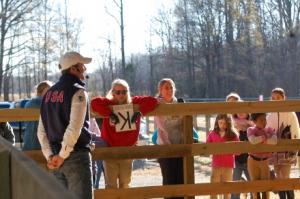
Usually, when one attends a riding clinic with a professional coach, one wants to be as attentive as possible, following instructions and doing as closely as possible what the expert asks. So it’s a rare occasion when the professional clinician tells riders to ignore him! “Ignore me today because I’m distracting you!” said Daniel Stewart, sports psychologist. “Riders should have one confident voice in your mind. The goal is finding clarity through all the distractions and difficulty, while still enjoying it.”
Daniel Stewart was invited to Showcase Equestrian Center for a 2-day sports psychology clinic and seminar. He was for ten years Coach at the U.S. Equestrian Team, and has been a successful international trainer and instructor for over 20 years. As the author of Ride Right, he’s considered one of the world’s leading experts on rider psychology, biomechanics, and performance.
Daniel told riders in the clinic, “You work all week developing a good leg, good seat, and good position. Then you go to a horse show, and things fall apart. You don’t ride well.” Why is that? “To create success, your brain has to work hard, too. Keep on working on your body, but this weekend, you will work on your brain. Who are you, how do you ride under pressure? When the pressure goes up, does your potential [for success] go down? What happens when you’re rushed? These things take away success. Even if you have everything physically required, these other things can take success away. The goal is to learn to ride above distractions. Don’t focus on the distractions.”
Daniel then illustrated his points with a story about a top-notch event rider who was riding the cross country course at an event. Things were going well, when suddenly seemingly out of nowhere, she was hit in the chest by a duck! She was so disturbed by this surprise event that things began to fall apart and she eventually withdrew from the competition.
What does this tell us about distractions? “It’s your brain that keeps the body together. We tend to focus on physical elements, but today I will show you the tools to use to work on your brains. Distractions, pressure, show jitters, rushing – all these factors rob us of our potential.”
The evening’s activity was his Sports Psychology seminar. “But before we do the seminar, we are going to do a series of ‘psycho- clinics’ wherein we work on the psychology of riding.”
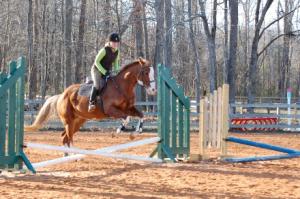
He set up a series of 8 cross-rail fences in a zig-zag pattern, and labeled each fence with a number, 1 to 8. He gave the riders a series of rules they must follow when jumping the fences. First, to get from one side of the arena to the other, they had to jump to get there. Then could not cross their path and could not make U-turns. Then he gave the riders a “course” to ride, but from the approach the riders could not see the numbers on the fences.
First assignment: jump even, odd, even, odd. Riders began their approaches, all the while Daniel talked to them, distracting them from their assigned task. “Your job is to shut me out today,” he told them, urging them to focus solely on their task at hand. When they finished their course, he asked each rider if they had ridden the course correctly, following with an “Are you sure?” to place a seed of doubt in their confidence.
In the next challenge Daniel gave a set of numbers, e.g., 3-18, meaning the riders were to ride three fences and their value had to add up to 18. So now the riders had to plan a course to jump the fences according to the original rules, now they had to incorporate math! “Math is involved,” he told them. “Math is power! Stay in School!”
Then, challenging them further, “Jump 4-19 with no repeats,” he said, waiting until the absolute last minute to give instructions. The riders all quickly learned to tune out Daniel’s incessant talking and questioning and were successful in carrying out his challenges.
“You have both external and internal distractions.” The external distractions include what’s going on around you as you work to accomplish your task. The internal distractions include calculating the math and planning a course as your are riding. “The goal is finding clarity through distraction and difficulty while still enjoying it.” Daniel summarized. The riders learned to be confident in their decisions and their smiles indicated their enjoyment.
Usually, when one attends a riding clinic with a professional coach, one wants to be as attentive as possible, following instructions and doing as closely as possible what the expert asks. So it’s a rare occasion when the professional clinician tells riders to ignore him! “Ignore me today because I’m distracting you!” said Daniel Stewart, sports psychologist. “Riders should have one confident voice in your mind. The goal is finding clarity through all the distractions and difficulty, while still enjoying it.”
Daniel Stewart was invited to Showcase Equestrian Center for a 2-day sports psychology clinic and seminar. He was for ten years Coach at the U.S. Equestrian Team, and has been a successful international trainer and instructor for over 20 years. As the author of Ride Right, he’s considered one of the world’s leading experts on rider psychology, biomechanics, and performance.
Daniel told riders in the clinic, “You work all week developing a good leg, good seat, and good position. Then you go to a horse show, and things fall apart. You don’t ride well.” Why is that? “To create success, your brain has to work hard, too. Keep on working on your body, but this weekend, you will work on your brain. Who are you, how do you ride under pressure? When the pressure goes up, does your potential [for success] go down? What happens when you’re rushed? These things take away success. Even if you have everything physically required, these other things can take success away. The goal is to learn to ride above distractions. Don’t focus on the distractions.”
Daniel then illustrated his points with a story about a top-notch event rider who was riding the cross country course at an event. Things were going well, when suddenly seemingly out of nowhere, she was hit in the chest by a duck! She was so disturbed by this surprise event that things began to fall apart and she eventually withdrew from the competition.
What does this tell us about distractions? “It’s your brain that keeps the body together. We tend to focus on physical elements, but today I will show you the tools to use to work on your brains. Distractions, pressure, show jitters, rushing – all these factors rob us of our potential.”
The evening’s activity was his Sports Psychology seminar. “But before we do the seminar, we are going to do a series of ‘psycho- clinics’ wherein we work on the psychology of riding.”
He set up a series of 8 cross-rail fences in a zig-zag pattern, and labeled each fence with a number, 1 to 8. He gave the riders a series of rules they must follow when jumping the fences. First, to get from one side of the arena to the other, they had to jump to get there. Then could not cross their path and could not make U-turns. Then he gave the riders a “course” to ride, but from the approach the riders could not see the numbers on the fences.
First assignment: jump even, odd, even, odd. Riders began their approaches, all the while Daniel talked to them, distracting them from their assigned task. “Your job is to shut me out today,” he told them, urging them to focus solely on their task at hand. When they finished their course, he asked each rider if they had ridden the course correctly, following with an “Are you sure?” to place a seed of doubt in their confidence.
In the next challenge Daniel gave a set of numbers, e.g., 3-18, meaning the riders were to ride three fences and their value had to add up to 18. So now the riders had to plan a course to jump the fences according to the original rules, now they had to incorporate math! “Math is involved,” he told them. “Math is power! Stay in School!”
Then, challenging them further, “Jump 4-19 with no repeats,” he said, waiting until the absolute last minute to give instructions. The riders all quickly learned to tune out Daniel’s incessant talking and questioning and were successful in carrying out his challenges.
“You have both external and internal distractions.” The external distractions include what’s going on around you as you work to accomplish your task. The internal distractions include calculating the math and planning a course as your are riding. “The goal is finding clarity through distraction and difficulty while still enjoying it.” Daniel summarized. The riders learned to be confident in their decisions and their smiles indicated their enjoyment.


