

By Leigh Ballard
Sometimes feeding our horses seems like a real financial drain, and the weather hasn’t helped either. Pastures are decimated from drought, and many are down to dirt lots, offering nothing in the way of grazing nutrition. Feed prices seem to rise every time we pick up a few bags. In this down economy, we need a solution to keep our horses in good health without breaking the bank! For many horse owners who care for their horses at home and are not under a managed feeding program at a boarding barn, the following information may offer some economical solutions.
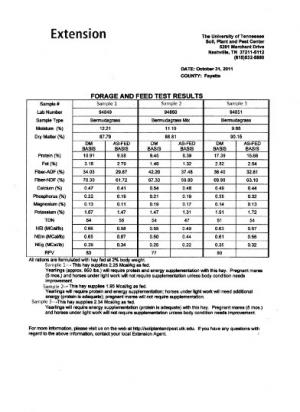
For the purposes of this article, three hay samples were collected from local hay suppliers in Hardeman and Fayette counties in west Tennessee. They are representative of hay that is currently available in this area. Sample 1 is a clean-looking Bermuda with a very small amount of “other” grasses. Sample 2 is a Bermuda and “other” grass mix and includes weeds. Visually, it looks coarse. Sample 3 is a “clean” Bermuda and is more expensive than the others. A sample of each was sent to the TN Agricultural Extension Service for evaluation. All of these hays tested similarly and may be representative of an average “horse hay” purchase in the mid-south area.
Information for how to read these analyses, and feeding recommendations for supplementing these hays, were gathered from the UT Forage Testing Lab in Nashville, TN a company specializing in equine feed, and from the UT Extension Equine Specialist. IMPORTANT* All recommendations assume that the horses are fed free choice hay at a rate of at least 20 lbs per day or a MINIMUM of one half bale per day for an average sized horse.
The notes at the bottom of the lab report show that the only type of horse needing supplemental feed is a growing yearling. Other horses need feed supplements only if their work increases or if their body condition starts to decline as weather becomes colder.
Bridgett McIntosh, Ph.D., UT Extension Equine Specialist and Nutritionist, was consulted to interpret these analyses, and offered the following information about digestible energy:
“Digestible energy (DE) is the amount of energy, or calories a feed or forage provides. Energy is the most important component of the equine diet. If energy requirements are not met, the horse will not maintain its weight and performance will be poor. The amount of energy in a feed or forage is predicted by mathematical equations based on other nutrients. Energy requirements are expressed as megacalories (Mcal). On hay analysis reports, DE is reported as Megacalories per kilogram (Mcal/kg) or pound (Mcal/lb). The average DE of Bermuda grass hay is 2.0 Mcal/kg, but it can range from 1.2 to 3.2 Mcal/kg. DE requirements for horses are based on activity level, type of exercise, and physiological state (lactation, gestation, breeding stallion, etc). To calculate the amount of Mcals a horse is fed per day, simply multiply the DE of the hay (Mcal/kg) by the amount of hay fed (kg). It is recommended that horses need 2% of their bodyweight (BW) in forage each day, so a 500 kg (1,100 lb) horse should be fed 10 kg (22 lb) of hay per day (if hay is the only source of forage).
The three hay samples exceed the DE requirements for horses at maintenance and light work when fed at 2% BW. For horses with increased energy requirements due to exercise, reproduction, lactation or weight gain, either more hay can be offered or a commercial concentrate can be added to the diet. When selecting commercial concentrates it is important the feed is labeled by the manufacturer for horses and properly balanced and fortified to meet the energy and nutrient requirements for the particular class of horse. For example, for a yearling, a feed should be selected that is designed to meet the needs of a young growing horse. Although feed tags do not include the DE value, manufacturer’s recommendations for feeding rates are based on DE and nutrient requirements for different classes of hoses, so feeding directions should be followed closely. Horse owners often select a feed based on protein content, but protein is a poor energy source and feeds high in fat and fiber should be selected for providing additional energy. “
Regarding the mineral content of the samples, McIntosh said, “The three hay samples exceed the requirements for Ca, P, Mg and K for horses at maintenance and light work. This particular hay test did not include Cu and Zn, but since our soils, and therefore hays, are often deficient in these, it is safe to assume they were below the minimum requirements for all classes of horses, and additional supplementation is likely necessary. For hays like the three analyzed here, where they meet or exceed the energy requirements, but may not provide all of the necessary vitamins and minerals, a “forage balancer” feed should be selected. Most horse feed manufacturers offer these types of products and the feeding rate is typically a mere 1 lb per day (or less). Forage balancer supplements are an economical way to ensure your horse’s vitamin and mineral requirements are being met while avoiding unnecessary calories.”
A leading feed company representative also made this recommendation. Because the hay quality is known, he recommended feeding what his company calls a “ration balancer” at ½ the label rate to ensure meeting vitamin and mineral needs. While the cost of a bag seems high, it is fed at a very low rate, often no more than a coffee cup sized ration, so cost per serving is low compared to other feeds.
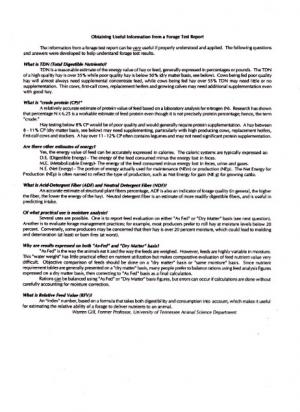
McIntosh explained further: “Acid Detergent Fiber (ADF) and Neutral Detergent Fiber (NDF) are also essential components of the hay analysis because they represent the amount of fiber in the diet. ADF and NDF are measurements of the structural carbohydrates, which are important energy sources in the equine diet. Generally, the lower the ADF and NDF values, the better the quality of the hay. High quality forages are considered to have an ADF of 25 to 45% and NDF of 35 to 55% (as fed). Lower quality forages are considered to have an ADF of 35 to 45% and NDF of 55 to 70% (as fed). In comparing hays, the hay with the lower ADF for comparable NDF is the better quality hay. In this case, sample 1 is the better quality hay. When feeding hay that is over 65% NDF, the risk for impaction colic may increase, especially if the horse isn’t drinking enough water. Senior horses often have reduced digestive function of the hindgut, so it is recommended the ADF be less than 40% and NDF less than 53%. It is also common for senior horses to have dental problems, which may interfere with their ability to chew and properly digest forages. Senior horses may require a complete feed that is high in fiber yet highly digestible.
“Hay analysis reports also list Total Digestible Nutrients (TDN) and Relative Feed Value (RFV). TDN is an estimate of energy value of the feed and is typically expressed as a percentage. As a general rule, TDN of less than 50% is considered to be poor quality hay. Relative feed value (RFV) is an index number based on a formula that takes digestibility and intake into consideration. However, both TDN and RFV are estimates and should not be the primary basis for selecting forages. It is much more important to select hays based on DE and nutrient requirements of a particular horse.”
Armed with a hay analysis, horse owners who are feeding their horse at home may be pleasantly surprised to find that their hay is supplying almost everything their horse needs. By offering ample, good quality hay, supplementing with “balancers” or other feeds can be held to a minimum, and cost per day to feed is slightly more than the cost of hay. That’s a great thing for the pocketbook!
NOTE: Although not addressed in the forage analysis here, analysis of nonstructural carbohydrate (NSC) is essential for horses prone to digestive and metabolic diseases like laminitis and insulin resistance. NSC includes sugars, starches and fructans. Equi-analytical Laboratories is the primary lab recommended for NSC analysis http://www.equi-analytical.com/default.htm. They offer the most comprehensive analyses of NSC components including: ethanol soluble carbohydrates (ESC) (sugars), water soluble carbohydrates (WSC) (sugars + fructans) and starch.
The “Basic Forage Analysis” from the UT Extension Forage Laboratory includes the minerals Calcium (Ca), Phosphorous (P), Magnesium (Mg), and potassium (K) for $10.00. The laboratory also offers a “Basic Forage Plus Mineral Analysis” which includes the additional minerals Copper (Cu) ,Zinc (Zn) , sulfur (S) and Manganese (Mn) for a cost of $20. For forage and grain analysis and soil testing, visit: http://soilplantandpest.utk.edu/.
Sometimes feeding our horses seems like a real financial drain, and the weather hasn’t helped either. Pastures are decimated from drought, and many are down to dirt lots, offering nothing in the way of grazing nutrition. Feed prices seem to rise every time we pick up a few bags. In this down economy, we need a solution to keep our horses in good health without breaking the bank! For many horse owners who care for their horses at home and are not under a managed feeding program at a boarding barn, the following information may offer some economical solutions.
For the purposes of this article, three hay samples were collected from local hay suppliers in Hardeman and Fayette counties in west Tennessee. They are representative of hay that is currently available in this area. Sample 1 is a clean-looking Bermuda with a very small amount of “other” grasses. Sample 2 is a Bermuda and “other” grass mix and includes weeds. Visually, it looks coarse. Sample 3 is a “clean” Bermuda and is more expensive than the others. A sample of each was sent to the TN Agricultural Extension Service for evaluation. All of these hays tested similarly and may be representative of an average “horse hay” purchase in the mid-south area.
Information for how to read these analyses, and feeding recommendations for supplementing these hays, were gathered from the UT Forage Testing Lab in Nashville, TN a company specializing in equine feed, and from the UT Extension Equine Specialist. IMPORTANT* All recommendations assume that the horses are fed free choice hay at a rate of at least 20 lbs per day or a MINIMUM of one half bale per day for an average sized horse.
The notes at the bottom of the lab report show that the only type of horse needing supplemental feed is a growing yearling. Other horses need feed supplements only if their work increases or if their body condition starts to decline as weather becomes colder.
Bridgett McIntosh, Ph.D., UT Extension Equine Specialist and Nutritionist, was consulted to interpret these analyses, and offered the following information about digestible energy:
“Digestible energy (DE) is the amount of energy, or calories a feed or forage provides. Energy is the most important component of the equine diet. If energy requirements are not met, the horse will not maintain its weight and performance will be poor. The amount of energy in a feed or forage is predicted by mathematical equations based on other nutrients. Energy requirements are expressed as megacalories (Mcal). On hay analysis reports, DE is reported as Megacalories per kilogram (Mcal/kg) or pound (Mcal/lb). The average DE of Bermuda grass hay is 2.0 Mcal/kg, but it can range from 1.2 to 3.2 Mcal/kg. DE requirements for horses are based on activity level, type of exercise, and physiological state (lactation, gestation, breeding stallion, etc). To calculate the amount of Mcals a horse is fed per day, simply multiply the DE of the hay (Mcal/kg) by the amount of hay fed (kg). It is recommended that horses need 2% of their bodyweight (BW) in forage each day, so a 500 kg (1,100 lb) horse should be fed 10 kg (22 lb) of hay per day (if hay is the only source of forage).
The three hay samples exceed the DE requirements for horses at maintenance and light work when fed at 2% BW. For horses with increased energy requirements due to exercise, reproduction, lactation or weight gain, either more hay can be offered or a commercial concentrate can be added to the diet. When selecting commercial concentrates it is important the feed is labeled by the manufacturer for horses and properly balanced and fortified to meet the energy and nutrient requirements for the particular class of horse. For example, for a yearling, a feed should be selected that is designed to meet the needs of a young growing horse. Although feed tags do not include the DE value, manufacturer’s recommendations for feeding rates are based on DE and nutrient requirements for different classes of hoses, so feeding directions should be followed closely. Horse owners often select a feed based on protein content, but protein is a poor energy source and feeds high in fat and fiber should be selected for providing additional energy. “
Regarding the mineral content of the samples, McIntosh said, “The three hay samples exceed the requirements for Ca, P, Mg and K for horses at maintenance and light work. This particular hay test did not include Cu and Zn, but since our soils, and therefore hays, are often deficient in these, it is safe to assume they were below the minimum requirements for all classes of horses, and additional supplementation is likely necessary. For hays like the three analyzed here, where they meet or exceed the energy requirements, but may not provide all of the necessary vitamins and minerals, a “forage balancer” feed should be selected. Most horse feed manufacturers offer these types of products and the feeding rate is typically a mere 1 lb per day (or less). Forage balancer supplements are an economical way to ensure your horse’s vitamin and mineral requirements are being met while avoiding unnecessary calories.”
A leading feed company representative also made this recommendation. Because the hay quality is known, he recommended feeding what his company calls a “ration balancer” at ½ the label rate to ensure meeting vitamin and mineral needs. While the cost of a bag seems high, it is fed at a very low rate, often no more than a coffee cup sized ration, so cost per serving is low compared to other feeds.
McIntosh explained further: “Acid Detergent Fiber (ADF) and Neutral Detergent Fiber (NDF) are also essential components of the hay analysis because they represent the amount of fiber in the diet. ADF and NDF are measurements of the structural carbohydrates, which are important energy sources in the equine diet. Generally, the lower the ADF and NDF values, the better the quality of the hay. High quality forages are considered to have an ADF of 25 to 45% and NDF of 35 to 55% (as fed). Lower quality forages are considered to have an ADF of 35 to 45% and NDF of 55 to 70% (as fed). In comparing hays, the hay with the lower ADF for comparable NDF is the better quality hay. In this case, sample 1 is the better quality hay. When feeding hay that is over 65% NDF, the risk for impaction colic may increase, especially if the horse isn’t drinking enough water. Senior horses often have reduced digestive function of the hindgut, so it is recommended the ADF be less than 40% and NDF less than 53%. It is also common for senior horses to have dental problems, which may interfere with their ability to chew and properly digest forages. Senior horses may require a complete feed that is high in fiber yet highly digestible.
“Hay analysis reports also list Total Digestible Nutrients (TDN) and Relative Feed Value (RFV). TDN is an estimate of energy value of the feed and is typically expressed as a percentage. As a general rule, TDN of less than 50% is considered to be poor quality hay. Relative feed value (RFV) is an index number based on a formula that takes digestibility and intake into consideration. However, both TDN and RFV are estimates and should not be the primary basis for selecting forages. It is much more important to select hays based on DE and nutrient requirements of a particular horse.”
Armed with a hay analysis, horse owners who are feeding their horse at home may be pleasantly surprised to find that their hay is supplying almost everything their horse needs. By offering ample, good quality hay, supplementing with “balancers” or other feeds can be held to a minimum, and cost per day to feed is slightly more than the cost of hay. That’s a great thing for the pocketbook!
NOTE: Although not addressed in the forage analysis here, analysis of nonstructural carbohydrate (NSC) is essential for horses prone to digestive and metabolic diseases like laminitis and insulin resistance. NSC includes sugars, starches and fructans. Equi-analytical Laboratories is the primary lab recommended for NSC analysis http://www.equi-analytical.com/default.htm. They offer the most comprehensive analyses of NSC components including: ethanol soluble carbohydrates (ESC) (sugars), water soluble carbohydrates (WSC) (sugars + fructans) and starch.
The “Basic Forage Analysis” from the UT Extension Forage Laboratory includes the minerals Calcium (Ca), Phosphorous (P), Magnesium (Mg), and potassium (K) for $10.00. The laboratory also offers a “Basic Forage Plus Mineral Analysis” which includes the additional minerals Copper (Cu) ,Zinc (Zn) , sulfur (S) and Manganese (Mn) for a cost of $20. For forage and grain analysis and soil testing, visit: http://soilplantandpest.utk.edu/.


