

By Dr. Michael Betz
Introduction by Dr. Nancy Brannon
A University of Tennessee Professor Emeritus friend of mine was recently in Thailand where he helped edit the English translation of ancient Buddhist scriptures from Sanskrit. He wrote: “I learned more about both the content of Buddhist beliefs and much more about the structure of different languages and the difficulty of faithfully transferring ideas/concepts from one language into another. Each language has its own structure which constitutes a ‘mold’ or form that we might think of as ‘pouring’ words from one language into another language where the forms and size of ideas are very different.” Sanskrit language from India is one of the oldest languages in the world and is very analytical.
Following is an excerpts from a presentation on language and Buddhist thought, “Learning Buddha’s Way,” by Michael Betz, Ph.D. Professor Emeritus, University of Tennessee.
The story of the Kurukshetra War as told in the MahÄbhÄrata preceded the Buddha by at least 500 years. This story greatly influenced Buddha as he focused on training the mind and senses to live in peace and happiness. The Kurukshetra War was over a dynastic succession struggle for the throne between two groups of cousins of an Indo-Aryan kingdom located in the modern state of Haryana in India. Vast armies from all over the Indian Subcontinent joined alongside the two rivals and Arjuna realised that he would have to kill his dear great-granduncle and his respected teacher who were on the opposing side. Arjuna felt weak and sickened at this prospect so he asked for divine guidance from Krishna. Krishna, who Arjuna chose as his charioteer, advised him of his duty and helped “guide” Arjuna through the battle. This conversation forms the Bhagavad Gita, one of the most respected religious and philosophical texts in the Hindu religion. (The story of Moses in conversation with God in leading the children of Isreal out of Egypt is a parallel in our western tradition.)
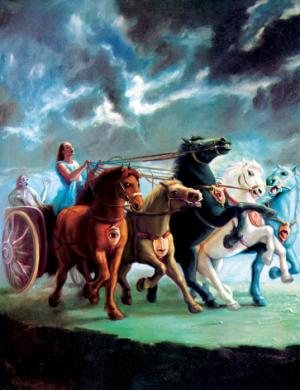
The artistic depiction below [MindDrivingFiveSensesSoulPassenger] was inspired by this story and came much later. The picture is symbolic and full of meaning for our own journey as we seek to awaken to our Source for guidance, peace and enlightenment. The Meaning of the Symbols might be:
• The chariot represents the body.
• The passenger Arjuna is the embodied individual soul.
• The driver/charioteer is the mind (choice-maker), guiding the chariot through life's challenges.
• The horses are the senses—eyes, ears, nose, tongue and skin.
• The road is life that we are exposed to and from which impressions and perceptions arise.
Sai Baba's interpretation is below and can be found at: www.indianweekender.co.nz/Pages/ArticleDetails/47/350/Heritage/The-Significance-of-the-Chariot-with-Krishna-and-Arjunat
Learn how to drive your chariot
1. Chariot: physical body, the instrument through which the Self, intellect, mind, and senses operate.
2. Charioteer: Self or Higher Intellect, is supposed to be the wise giver of instructions to the mind.
3. Passenger: Individual Soul, the pure center of consciousness, is always the neutral witness.
4. Horses: Senses- eyes-vision, ears-hearing, nose-smell, tongue-taste, skin-touch, through which we relate to the external world by perception and action.
5. Reins: Mind, through which the senses receive their instructions to act and perceive.
6. Roads: The countless objects of senses and desires in the world and our memory
7. Destination: “Perfection” or “Self Realization”
8. Kurukshetra Battlefield: It’s the inner battlefield, the only place where one can confront, do battle with, and vanquish the inner demons.
9. Two Armies: Demonic nature and divine nature
Mindfulness is Central to Buddhist Spiritual practice
• Vipassana meditation cultivates a mindful state of focus (alpha and/or theta brainwaves)
• Meditation is the art of relinquishing thoughts
• Meditation helps sharpen the mind & awareness
• To be mindful is to “hold” an intention
• A mind that is “open” is capable of being “empty” and teachable
• Going below the thinking mind allows one to see through appearances and gain wisdom
Wisdom from the Buddha
• Hate never dispels hate. Only love dispels hate.
• What you think you become.
• With our thoughts, we create our world.
• You will not be punished for your anger, but by your anger.
• Better than a thousand hollow words is one word that brings peace.
• All living beings have the Buddha nature and can become a Buddha-Christ-consciousness in the West.
• One who experiences the unity of life sees one’s own self in all beings.
• We are the same as plants, as trees, as other people, as the rain that falls. We consist of that which is around us; we are the same as everything.
• There are only two mistakes one can make along the road to truth: not going all the way and not starting.
• It is better to conquer yourself than to win a thousand battles
• Peace comes from within. Do not seek it outside.
• Thought manifests as word; word manifests as deed; deed develops into habit; and habit hardens into character.
• Holding onto anger is like grasping a hot coal with the intent of throwing it at someone else; you are the one getting burned.
Thoughtful conclusion: the Body is a Receptacle for Emotional and Mental Energies.
Read more about the Kurukshetra War at http://en.wikipedia.org/wiki/Kurukshetra_War.
Introduction by Dr. Nancy Brannon
A University of Tennessee Professor Emeritus friend of mine was recently in Thailand where he helped edit the English translation of ancient Buddhist scriptures from Sanskrit. He wrote: “I learned more about both the content of Buddhist beliefs and much more about the structure of different languages and the difficulty of faithfully transferring ideas/concepts from one language into another. Each language has its own structure which constitutes a ‘mold’ or form that we might think of as ‘pouring’ words from one language into another language where the forms and size of ideas are very different.” Sanskrit language from India is one of the oldest languages in the world and is very analytical.
Following is an excerpts from a presentation on language and Buddhist thought, “Learning Buddha’s Way,” by Michael Betz, Ph.D. Professor Emeritus, University of Tennessee.
The story of the Kurukshetra War as told in the MahÄbhÄrata preceded the Buddha by at least 500 years. This story greatly influenced Buddha as he focused on training the mind and senses to live in peace and happiness. The Kurukshetra War was over a dynastic succession struggle for the throne between two groups of cousins of an Indo-Aryan kingdom located in the modern state of Haryana in India. Vast armies from all over the Indian Subcontinent joined alongside the two rivals and Arjuna realised that he would have to kill his dear great-granduncle and his respected teacher who were on the opposing side. Arjuna felt weak and sickened at this prospect so he asked for divine guidance from Krishna. Krishna, who Arjuna chose as his charioteer, advised him of his duty and helped “guide” Arjuna through the battle. This conversation forms the Bhagavad Gita, one of the most respected religious and philosophical texts in the Hindu religion. (The story of Moses in conversation with God in leading the children of Isreal out of Egypt is a parallel in our western tradition.)
The artistic depiction below [MindDrivingFiveSensesSoulPassenger] was inspired by this story and came much later. The picture is symbolic and full of meaning for our own journey as we seek to awaken to our Source for guidance, peace and enlightenment. The Meaning of the Symbols might be:
• The chariot represents the body.
• The passenger Arjuna is the embodied individual soul.
• The driver/charioteer is the mind (choice-maker), guiding the chariot through life's challenges.
• The horses are the senses—eyes, ears, nose, tongue and skin.
• The road is life that we are exposed to and from which impressions and perceptions arise.
Sai Baba's interpretation is below and can be found at: www.indianweekender.co.nz/Pages/ArticleDetails/47/350/Heritage/The-Significance-of-the-Chariot-with-Krishna-and-Arjunat
Learn how to drive your chariot
1. Chariot: physical body, the instrument through which the Self, intellect, mind, and senses operate.
2. Charioteer: Self or Higher Intellect, is supposed to be the wise giver of instructions to the mind.
3. Passenger: Individual Soul, the pure center of consciousness, is always the neutral witness.
4. Horses: Senses- eyes-vision, ears-hearing, nose-smell, tongue-taste, skin-touch, through which we relate to the external world by perception and action.
5. Reins: Mind, through which the senses receive their instructions to act and perceive.
6. Roads: The countless objects of senses and desires in the world and our memory
7. Destination: “Perfection” or “Self Realization”
8. Kurukshetra Battlefield: It’s the inner battlefield, the only place where one can confront, do battle with, and vanquish the inner demons.
9. Two Armies: Demonic nature and divine nature
Mindfulness is Central to Buddhist Spiritual practice
• Vipassana meditation cultivates a mindful state of focus (alpha and/or theta brainwaves)
• Meditation is the art of relinquishing thoughts
• Meditation helps sharpen the mind & awareness
• To be mindful is to “hold” an intention
• A mind that is “open” is capable of being “empty” and teachable
• Going below the thinking mind allows one to see through appearances and gain wisdom
Wisdom from the Buddha
• Hate never dispels hate. Only love dispels hate.
• What you think you become.
• With our thoughts, we create our world.
• You will not be punished for your anger, but by your anger.
• Better than a thousand hollow words is one word that brings peace.
• All living beings have the Buddha nature and can become a Buddha-Christ-consciousness in the West.
• One who experiences the unity of life sees one’s own self in all beings.
• We are the same as plants, as trees, as other people, as the rain that falls. We consist of that which is around us; we are the same as everything.
• There are only two mistakes one can make along the road to truth: not going all the way and not starting.
• It is better to conquer yourself than to win a thousand battles
• Peace comes from within. Do not seek it outside.
• Thought manifests as word; word manifests as deed; deed develops into habit; and habit hardens into character.
• Holding onto anger is like grasping a hot coal with the intent of throwing it at someone else; you are the one getting burned.
Thoughtful conclusion: the Body is a Receptacle for Emotional and Mental Energies.
Read more about the Kurukshetra War at http://en.wikipedia.org/wiki/Kurukshetra_War.


