

By Leigh Ballard
Susan Rowley and her husband Rodney have created a training ground for horses who are being prepared for obstacle competitions. It is located near Byhalia, MS at their Chubby Acres Ranch. They call it the Chubby Acres Challenge, and it looks like a playground similar to a child’s playground at a park. Scattered across two acres are horse versions of teeter totters and merry go rounds. Rodney, who is handy with a hammer and is the official obstacle construction engineer, has helped Susan create obstacles that are often seen at American Competitive Trail Horse Association competitions or events like Craig Cameron’s Extreme Cowboy Challenge. The course is used for practice sessions for upcoming competitions, and occasionally Chubby Acres hosts training clinics on the course. Mike Wolfe of MW Ranch in Abbeville, MS has conducted clinics there.
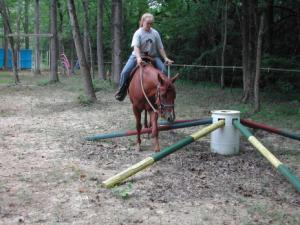
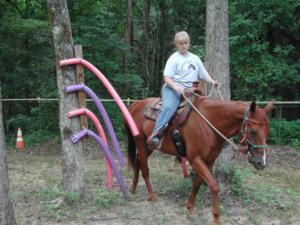
The training ground provides general desensitization to strange objects and situations. One exercise is to walk through a structure with Styrofoam swimming pool “noodles” attached to it. The horse experiences an unusual touching along the sides of his body, as well as some raspy sounds from the “noodles.” In addition to looking strange, it also feels and sounds strange, but the horse soon becomes used to it. Another obstacle, the Cowboy Curtain, also addresses the issue of unnatural things touching the body.
Negotiating the obstacles is a test of a horse’s confidence in himself and trust in his rider. The horse is required to go through or into obstacles that he would normally avoid in a natural setting. For example, the Tarp Tunnel puts a horse in a situation that goes against his nature as a prey animal. A horse doesn’t want to be closed in. On the contrary, he wants to be in the open, scanning his environment. In the Tarp Tunnel he is required to go into a situation where he can’t see around him for a period of time before he comes out to see his environment again.
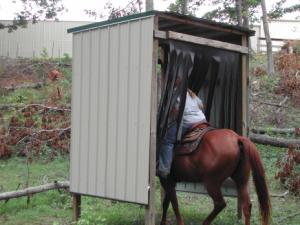
The Cowboy Carwash combines an advanced test of a horse’s tolerance for claustrophobia with the touch factor of the Curtain. Not only does he have to walk through an enclosed area, but curtains of material drag over the horse’s body, both upon entering and exiting! Mother Nature made Susan’s Carwash even more of an obstacle when a recent storm felled a tree at one end of it. Now the horse has the additional challenge of negotiating the tree at the end.
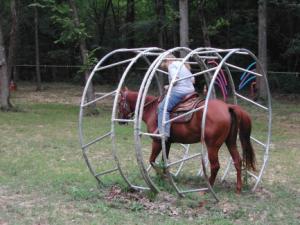
Another obstacle addressing the claustrophobia issue is the Hay Rings. The horse can see through the rings, but normally would not seek to be surrounded by them on all sides and above his head.
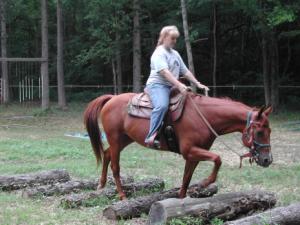
Some of the obstacles are designed to help the horse with placement of his feet as well as simple body control. They require that the horse line up his body squarely and have shoulder control and correct forward movement. The Log Crossing is a good test of these things. Logs are in a line on the ground like trot poles, but are too close together to be trotted. The horse must walk through them, being careful with his feet and maintaining forward motion, even when he can’t see exactly where he is putting his feet. The rider must have control of the shoulders, because the natural inclination of the horse is to sidestep the logs and avoid them.
The Star is another challenge for control of the feet. Because the poles radiate off a hub that is high in the middle, one side of the horse has to step higher than the other. Again, the horse’s inclination is to exit sideways, so it is also an excellent exercise for the rider to keep the horse directed and the shoulders controlled.
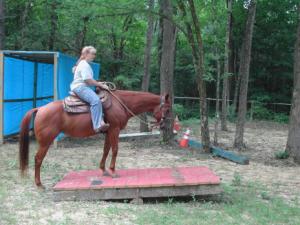
The Teeter Totter is a wooden bridge that makes a hollow sound as the horse walks across it. This sound can be intimidating to some horses. As the horse reaches the center of the bridge, the balance tips and the footing “teeters” downward. Many horses don’t like the sound or the movement under their feet, but with practice, they become comfortable crossing it.
“Our obstacles help the horses get past what their instincts are telling them, so they can be a safe ride for us. They learn not to be afraid of every little thing that looks funny or makes a sound. Nature tells them “don’t get closed in, don’t get your feet in a mess.” Putting them through these obstacles helps them develop a trust that we won’t put them in harm’s way, and if we ask them to do it, it will be okay for them. Not only do they trust their rider as leader, but their own confidence level rises as well,” Susan explained.
However, most horses don’t hold this confidence at their first exposure to the course! Susan encourages groundwork with the course at first, and once the horse has achieved a comfort level with the unfamiliar situations, then the obstacles can be attempted with a rider. Horses may behave differently with a rider, accepting certain obstacles better than others. If a horse balks at something that was fine on the ground Susan says, “I do not believe that if you get off, the horse has won and you have lost. That harks back to the mentality of ‘breaking’ a horse and forcing him to do your will. We are putting horses in some very unnatural situations. If the obstacle is really worrying or stressing the horse, why not take a little more time and get the horse to a position where you know you can win? If that takes getting off the horse for more work on the ground for a particular obstacle, that’s fine.”
“Humans are so goal oriented. Sometimes we get fixed on the final goal as the immediate result and that sets us up for frustration and impatience and a battle with the horse. The final goal is to go forward through the obstacle, but at first there might need to be several smaller goals leading up to the end result. For example, if the horse is fearful, our initial goal might be to go around and around the obstacle until there is no fear. Then maybe we would work on small parts of the obstacle for a while before attempting the whole thing. We want to find the least stressful way to accomplish the obstacle so that our final goal is achieved without argument or fear. We want the horse comfortable and confident so when he encounters something similar elsewhere, his reaction is calm,” Susan said.
Many of the obstacles have different levels of use. Depending upon the horse’s and the rider’s level, they can be tackled backing through them or at a trot, some even at a canter. Overall, the Chubby Acres Challenge course is a valuable way to further a horse’s all-round training. All riding disciplines benefit from a horse that is calm and confident when presented with unusual stimuli.
Susan occasionally opens the course for practice sessions and clinics. She has a group Facebook page called Chubby Acres Challenge where information can be found about upcoming events.
Susan Rowley and her husband Rodney have created a training ground for horses who are being prepared for obstacle competitions. It is located near Byhalia, MS at their Chubby Acres Ranch. They call it the Chubby Acres Challenge, and it looks like a playground similar to a child’s playground at a park. Scattered across two acres are horse versions of teeter totters and merry go rounds. Rodney, who is handy with a hammer and is the official obstacle construction engineer, has helped Susan create obstacles that are often seen at American Competitive Trail Horse Association competitions or events like Craig Cameron’s Extreme Cowboy Challenge. The course is used for practice sessions for upcoming competitions, and occasionally Chubby Acres hosts training clinics on the course. Mike Wolfe of MW Ranch in Abbeville, MS has conducted clinics there.
The training ground provides general desensitization to strange objects and situations. One exercise is to walk through a structure with Styrofoam swimming pool “noodles” attached to it. The horse experiences an unusual touching along the sides of his body, as well as some raspy sounds from the “noodles.” In addition to looking strange, it also feels and sounds strange, but the horse soon becomes used to it. Another obstacle, the Cowboy Curtain, also addresses the issue of unnatural things touching the body.
Negotiating the obstacles is a test of a horse’s confidence in himself and trust in his rider. The horse is required to go through or into obstacles that he would normally avoid in a natural setting. For example, the Tarp Tunnel puts a horse in a situation that goes against his nature as a prey animal. A horse doesn’t want to be closed in. On the contrary, he wants to be in the open, scanning his environment. In the Tarp Tunnel he is required to go into a situation where he can’t see around him for a period of time before he comes out to see his environment again.
The Cowboy Carwash combines an advanced test of a horse’s tolerance for claustrophobia with the touch factor of the Curtain. Not only does he have to walk through an enclosed area, but curtains of material drag over the horse’s body, both upon entering and exiting! Mother Nature made Susan’s Carwash even more of an obstacle when a recent storm felled a tree at one end of it. Now the horse has the additional challenge of negotiating the tree at the end.
Another obstacle addressing the claustrophobia issue is the Hay Rings. The horse can see through the rings, but normally would not seek to be surrounded by them on all sides and above his head.
Some of the obstacles are designed to help the horse with placement of his feet as well as simple body control. They require that the horse line up his body squarely and have shoulder control and correct forward movement. The Log Crossing is a good test of these things. Logs are in a line on the ground like trot poles, but are too close together to be trotted. The horse must walk through them, being careful with his feet and maintaining forward motion, even when he can’t see exactly where he is putting his feet. The rider must have control of the shoulders, because the natural inclination of the horse is to sidestep the logs and avoid them.
The Star is another challenge for control of the feet. Because the poles radiate off a hub that is high in the middle, one side of the horse has to step higher than the other. Again, the horse’s inclination is to exit sideways, so it is also an excellent exercise for the rider to keep the horse directed and the shoulders controlled.
The Teeter Totter is a wooden bridge that makes a hollow sound as the horse walks across it. This sound can be intimidating to some horses. As the horse reaches the center of the bridge, the balance tips and the footing “teeters” downward. Many horses don’t like the sound or the movement under their feet, but with practice, they become comfortable crossing it.
“Our obstacles help the horses get past what their instincts are telling them, so they can be a safe ride for us. They learn not to be afraid of every little thing that looks funny or makes a sound. Nature tells them “don’t get closed in, don’t get your feet in a mess.” Putting them through these obstacles helps them develop a trust that we won’t put them in harm’s way, and if we ask them to do it, it will be okay for them. Not only do they trust their rider as leader, but their own confidence level rises as well,” Susan explained.
However, most horses don’t hold this confidence at their first exposure to the course! Susan encourages groundwork with the course at first, and once the horse has achieved a comfort level with the unfamiliar situations, then the obstacles can be attempted with a rider. Horses may behave differently with a rider, accepting certain obstacles better than others. If a horse balks at something that was fine on the ground Susan says, “I do not believe that if you get off, the horse has won and you have lost. That harks back to the mentality of ‘breaking’ a horse and forcing him to do your will. We are putting horses in some very unnatural situations. If the obstacle is really worrying or stressing the horse, why not take a little more time and get the horse to a position where you know you can win? If that takes getting off the horse for more work on the ground for a particular obstacle, that’s fine.”
“Humans are so goal oriented. Sometimes we get fixed on the final goal as the immediate result and that sets us up for frustration and impatience and a battle with the horse. The final goal is to go forward through the obstacle, but at first there might need to be several smaller goals leading up to the end result. For example, if the horse is fearful, our initial goal might be to go around and around the obstacle until there is no fear. Then maybe we would work on small parts of the obstacle for a while before attempting the whole thing. We want to find the least stressful way to accomplish the obstacle so that our final goal is achieved without argument or fear. We want the horse comfortable and confident so when he encounters something similar elsewhere, his reaction is calm,” Susan said.
Many of the obstacles have different levels of use. Depending upon the horse’s and the rider’s level, they can be tackled backing through them or at a trot, some even at a canter. Overall, the Chubby Acres Challenge course is a valuable way to further a horse’s all-round training. All riding disciplines benefit from a horse that is calm and confident when presented with unusual stimuli.
Susan occasionally opens the course for practice sessions and clinics. She has a group Facebook page called Chubby Acres Challenge where information can be found about upcoming events.


