

Columbia Daily Tribune
Story by Jacob Barker
Saturday, April 9, 2011
Inventors face a long road from mind to shelf. The work that goes into turning an idea into a product is difficult, though persistence and the right resources can yield success.
“It was a very painful, long process,” Kevin Keegan said of commercializing his invention, the Lameness Locator, which assesses horse motion to determine lameness. “We still haven’t completely solved all the problems. It is manufactured, and it is commercially available, and we are selling it, but we’re still perfecting the manufacturing and design.”
Keegan, a veterinary professor at the University of Missouri, has been working on his invention for more than 10 years. But he has managed to build a budding startup around the product. The company, Equinosis, is now robust enough Keegan has been able to step away from its day-to-day activities. But it has been quite a journey.
“The engineers I collaborated with thought for many years this would never amount to anything,” Keegan said. “They were very pessimistic.”
Keegan realized he needed help when he struggled to raise grant money for further research. The research board at MU told him his work no longer was research — he needed to develop the product. “ ‘You need to start a company,’ ” he said the board told him.
“I just wanted to develop something that veterinarians could use,” he said. “I wasn’t even thinking about making money or starting a business.”
In 2007, he enlisted the help of the Missouri Innovation Center, a not-for-profit started by the state and affiliated with MU. The Innovation Center helped supply the businessmen, lawyers and finance experts needed to move his invention to the marketplace. They coached him on making his pitch to investors and gave him space in the MU Life Science Business Incubator, providing staff to help run the day-to-day operations.
“There’s no way I would have been able to reach this point without the help of many people,” Keegan said.
Now, Equinosis is beginning work on the third generation of the Lameness Locator. In March, it hired a chief executive officer and recently hired a vice president of sales and found a human resources company to handle payroll and taxes. It recently received a $500,000 National Science Foundation grant to continue research, which Keegan said will be used to develop ways to detect lameness by analyzing other horse motions.
But even now, nearly a year and a half after the product was first put up for sale, the company has a long way to go, Keegan said. Equinosis is fixing some issues with the manufacturing process of its second-generation Lameness Locator, and it needs to spread the word in the marketplace about the product. The biggest hurdle right now is overcoming the perception that the Lameness Locator is a “goofy gadget that can’t work,” Keegan said.
“We’re trying to convince the skeptics that this isn’t a gadget, that this is a real piece of medical equipment that does what it says it does,” he said. “The customer is the veterinarian, and they are a highly skeptical bunch.”
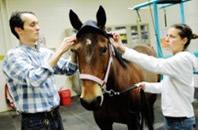
Photo by Joshua A. Bickel
Research assistants Marco Lopes and Juliana Amorim strap a sensor to the head of Sissy before collecting data using a program that detects lameness in horses at the MU School of Veterinary Medicine’s Equine Clinic. Lopes and Amorim are two of Kevin Keegan’s assistants. Keegan developed the technology, and the pair run experiments to test and further develop the sensors and the software that processes the data.


