

By Nancy Brannon
Horses with hoof illness and injuries such as founder, laminitis, and navicular disease often suffer a lot of pain along with lameness. To alleviate that pain, acupuncture is a viable treatment, used in conjunction with other necessary medical treatments. Dr. Kathy Mitchener, DVM has found success in alleviating pain by using acupuncture for such hoof ailments.
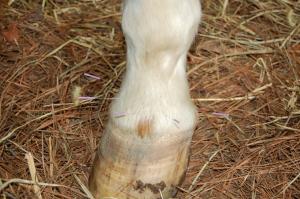
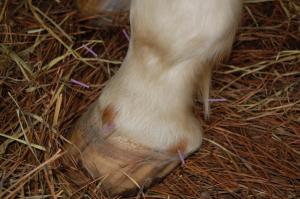
When treating horses for hoof-related pain, Mitchener strategically places the acupuncture needles above the coronary band at Ting Points. According to Equine Acupressure: a working manual(1999) by Nancy Zidonis, Amy Snow, and Marie Soderberg,each of the twelve major meridians has its own Ting Point, which are the beginning or ending of a meridian. Ting Points provide important information about the general health and well-being of a horse. They are very powerful points for treatment. Ting Points are located on the coronary band for the front and hind legs and are positioned roughly an equal distance around the circumference of the coronary band.
“These are very strong points,” she emphasized. “The blood supply, nerve tracks, and vascular beds are very concentrated there, so you can get some very potent treatment there in modulating the nervous system. In most horses it is a very tender and sensitive area. Some horses won’t let you treat with acupuncture there. But when you find a horse who will, that’s a real breakthrough!”
“I use Ting Points with foundered horses, as well as horses with navicular disease. Foundered horses have bulging Ting Points. Some practitioners can bleed those points, which releases some of the pressure and changes the vascular dynamics. It also has some neuro modulation effects. I’ve seen very dramatic (positive) effects when it works!
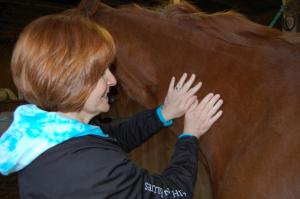
Mitchener uses a complimentary therapy, massage,to also help the horse relax muscles, which helps relieve pain. She massages particular areas of the horse with the palm of her hand for optimum effects. “When the horse likes it, the horse will move toward you to let you know. If not comfortable, the horse will move away. When you move the skin, you stimulate the superficial fascia and Pacinian corpuscles, which releases endorphins and serotonin to relax muscles.” She recommends daily massage. “You’re talking to the nervous system to quiet the pain and relax the muscles. This, in turn, facilitates movement and improves quality of life.”
With her quiet, soothing, and relaxing manner, Mitchener makes horses and people feel better already! For more information about equine acupuncture, visit Angel Care Cancer Clinic for Animals at: http://www.angelcarecca.org/acupuncture.html
Horses with hoof illness and injuries such as founder, laminitis, and navicular disease often suffer a lot of pain along with lameness. To alleviate that pain, acupuncture is a viable treatment, used in conjunction with other necessary medical treatments. Dr. Kathy Mitchener, DVM has found success in alleviating pain by using acupuncture for such hoof ailments.
When treating horses for hoof-related pain, Mitchener strategically places the acupuncture needles above the coronary band at Ting Points. According to Equine Acupressure: a working manual(1999) by Nancy Zidonis, Amy Snow, and Marie Soderberg,each of the twelve major meridians has its own Ting Point, which are the beginning or ending of a meridian. Ting Points provide important information about the general health and well-being of a horse. They are very powerful points for treatment. Ting Points are located on the coronary band for the front and hind legs and are positioned roughly an equal distance around the circumference of the coronary band.
“These are very strong points,” she emphasized. “The blood supply, nerve tracks, and vascular beds are very concentrated there, so you can get some very potent treatment there in modulating the nervous system. In most horses it is a very tender and sensitive area. Some horses won’t let you treat with acupuncture there. But when you find a horse who will, that’s a real breakthrough!”
“I use Ting Points with foundered horses, as well as horses with navicular disease. Foundered horses have bulging Ting Points. Some practitioners can bleed those points, which releases some of the pressure and changes the vascular dynamics. It also has some neuro modulation effects. I’ve seen very dramatic (positive) effects when it works!
Mitchener uses a complimentary therapy, massage,to also help the horse relax muscles, which helps relieve pain. She massages particular areas of the horse with the palm of her hand for optimum effects. “When the horse likes it, the horse will move toward you to let you know. If not comfortable, the horse will move away. When you move the skin, you stimulate the superficial fascia and Pacinian corpuscles, which releases endorphins and serotonin to relax muscles.” She recommends daily massage. “You’re talking to the nervous system to quiet the pain and relax the muscles. This, in turn, facilitates movement and improves quality of life.”
With her quiet, soothing, and relaxing manner, Mitchener makes horses and people feel better already! For more information about equine acupuncture, visit Angel Care Cancer Clinic for Animals at: http://www.angelcarecca.org/acupuncture.html


