

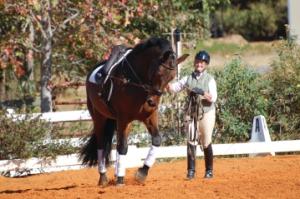
The first goal, for a horse that will be shown in dressage, is to establish a relaxed and confident rhythm in each of the working gaits. That sounds fairly simple, but we often see horses entering the show ring that are anything but confident and relaxed in their way of going.
All too often, horses starting to show in dressage, or in any other discipline, are tense, with quick hurried gaits, inverted toplines, and braced, unyielding necks and shoulders. To the observer on the ground, the horse may appear to be tearing around the ring, leaning precariously through corners, failing to respond promptly to changes of gait or halts. Alternatively, the horse may be so slow that it is barely moving, head held high, body often cranked sideways to the line of travel, the rider pushing more and more desperately with the leg and hauling on the rein for control. We have all seen these horses, and NO ONE watching says “What a wonderful picture. I want to ride that one!”
Every horse has a natural way of going when traveling freely in the pasture. When we fasten a girth tightly around its belly, we begin to interfere with that natural way of going. When we add the weight of a rider, we interfere even more. A horse that is mounted for the first time braces in its neck and shoulders, and drops and contracts the back muscles in reaction to the feel of that weight.
Therefore, our initial goal in training is to re-establish the natural balance and rhythm of the horse. We want the horse to be as free and confident under the rider as it would be without a rider. To do that, we have to have a common language between us, horse and human, before we climb on their backs.
I start by working with the horse on the ground, preferably in a round pen so that I work without the constraint of a lunge line. I want the horse to understand the basic voice commands – walk, trot, canter, halt and stand. I use a click of the tongue ahead of an up transition, and a quick whoa ahead of a down transition, so the horse can prepare a stride or two ahead for the next command. Later I add “turn” to change direction, “change” to change leads if the horse picks up the wrong one in the canter, and “stand” so I can adjust tack without holding on to the horse. I use the whip to teach the horse to stay out on the circle. I touch him with whip at the shoulder, girth and flank, and teach him to yield to pressure at each of those points.
At all times, I am careful that the horse understands when he is correct in his response; when he is not correct, I am careful not to accidentally reward incorrect response by reassuring him. If he incorrect I do not say anything ; I reward immediately by voice if he becomes more correct.
I prefer to start a horse with a cavesson and a surcingle, rather than with a bit. Western riders who are familiar with a side-pull hackamore are using the same principles of training as dressage trainers who use a cavesson. The cavesson puts pressure on the nose and teaches the horse to yield the poll to pressure in that way, much the same as a side-hackamore. Once the horse is working steadily with the surcingle, showing that it is accustomed to the feel of a girth around its belly, I begin to attach side reins to the cavesson. The side reins help the horse to find its balance both laterally and longitudinally. Properly used, side reins will encourage a horse to develop the muscle it will need to carry the rider’s weight easily.
When the horse has accepted the side reins, I add a simple snaffle bit. At the beginning, the horse just carries the bit and side reins are attached to the cavesson. Later, I attach the side reins to the bit, and still later, I will add long lines and begin to ground drive. When I am satisfied that the horse and I really understand each other on the ground, then I will think about getting on.
All too often, horses starting to show in dressage, or in any other discipline, are tense, with quick hurried gaits, inverted toplines, and braced, unyielding necks and shoulders. To the observer on the ground, the horse may appear to be tearing around the ring, leaning precariously through corners, failing to respond promptly to changes of gait or halts. Alternatively, the horse may be so slow that it is barely moving, head held high, body often cranked sideways to the line of travel, the rider pushing more and more desperately with the leg and hauling on the rein for control. We have all seen these horses, and NO ONE watching says “What a wonderful picture. I want to ride that one!”
Every horse has a natural way of going when traveling freely in the pasture. When we fasten a girth tightly around its belly, we begin to interfere with that natural way of going. When we add the weight of a rider, we interfere even more. A horse that is mounted for the first time braces in its neck and shoulders, and drops and contracts the back muscles in reaction to the feel of that weight.
Therefore, our initial goal in training is to re-establish the natural balance and rhythm of the horse. We want the horse to be as free and confident under the rider as it would be without a rider. To do that, we have to have a common language between us, horse and human, before we climb on their backs.
I start by working with the horse on the ground, preferably in a round pen so that I work without the constraint of a lunge line. I want the horse to understand the basic voice commands – walk, trot, canter, halt and stand. I use a click of the tongue ahead of an up transition, and a quick whoa ahead of a down transition, so the horse can prepare a stride or two ahead for the next command. Later I add “turn” to change direction, “change” to change leads if the horse picks up the wrong one in the canter, and “stand” so I can adjust tack without holding on to the horse. I use the whip to teach the horse to stay out on the circle. I touch him with whip at the shoulder, girth and flank, and teach him to yield to pressure at each of those points.
At all times, I am careful that the horse understands when he is correct in his response; when he is not correct, I am careful not to accidentally reward incorrect response by reassuring him. If he incorrect I do not say anything ; I reward immediately by voice if he becomes more correct.
I prefer to start a horse with a cavesson and a surcingle, rather than with a bit. Western riders who are familiar with a side-pull hackamore are using the same principles of training as dressage trainers who use a cavesson. The cavesson puts pressure on the nose and teaches the horse to yield the poll to pressure in that way, much the same as a side-hackamore. Once the horse is working steadily with the surcingle, showing that it is accustomed to the feel of a girth around its belly, I begin to attach side reins to the cavesson. The side reins help the horse to find its balance both laterally and longitudinally. Properly used, side reins will encourage a horse to develop the muscle it will need to carry the rider’s weight easily.
When the horse has accepted the side reins, I add a simple snaffle bit. At the beginning, the horse just carries the bit and side reins are attached to the cavesson. Later, I attach the side reins to the bit, and still later, I will add long lines and begin to ground drive. When I am satisfied that the horse and I really understand each other on the ground, then I will think about getting on.


