

By Mike Branch, Flying B Horsemanship
Let’s talk about longeing the horse. It is a good thing once we have assessed that the horse is “with us,” that we move it out online at the walk and trot. This will allow us to go further into what the horse is feeling and confirm that it is soft overall and willing go along with our requests. I need to point out that the longeing process is not a matter of sending the horse in “mindless” circles, but rather a time to develop a better communication with our horse. We do this by using our body energy to make transitions from walk to trot and trot to walk, and to insure that these transitions take place with a soft feel.
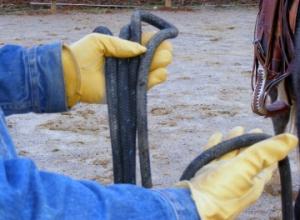
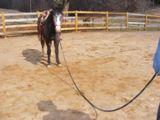
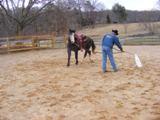
Make sure to hold the longe line in folds so that we can allow the line to fall out of our hand as needed (see photo). Caution: never hold a coiled line in your hand while working a horse; it’s a good way to lose fingers. Wear gloves if you are a novice at this; safety is and should be number one priority.
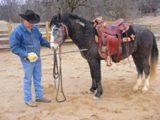
To begin we want our horse “facing up” to us. Once the horse is “facing up” we need to move it out on circle. But before we venture to that point, let me point out some things that will help you get your horse going correctly. You will notice that as the horse is faced up to me, my longe line is hanging loose on the ground. Imagine this line going straight through the horse dividing the horse into two separate halves, right side, and left side. I call this the “center line.” This will be to our advantage once we move the horse out.
Another factor that will help us train the horse is the “drive line.” The drive line is from the point of the withers to the ground in most cases, but can sometimes, depending on the horse, be from the point of the withers to the point of the shoulders or somewhere in between.
It is important to know that whatever drives the horse from behind, the “driveline” will cause either forward motion or lateral movement. Whatever happens in front of the “driveline” will cause either backward motion or lateral movement. The “drive line” information, along with the understanding of the “center line,” will help us give clear concise communication to our horse. So let’s begin the longeing.
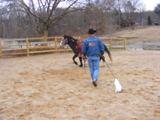
We begin with our horse “facing up” to us and take one step toward the horse with “energy” in our body to cause the horse to “set back” a little on its hocks (this allows the horse to keep its weight on the haunches, and step across with its forehand), while simultaneously offering a “feel” in the line for the direction you wish to go. As you do this, you may take your flag or training stick with your opposite hand and move in toward the point of the horse’s shoulder dividing the “centerline” and “driveline.” This will give the horse a “feel” of “set back,” along with “which way to go,” and the flag will offer a “send” into that direction, with the horse stepping over with its front feet.
We want our horse to feel comfortable on the longe so keep your energy low and just ask for a walk. Let me caution you: if you have never longed your horse, make sure the first time you do this, do it on a short line. Many times we do not know how to control the amount of energy we send to the horse and will inadvertently frighten our horse into bolting straightway. I have seen some horses feel the need to “defend” themselves; so until you know, please use caution and a short line so that you can maintain control of your horse.
You want the horse to begin with a nice walk; there can be slack in the line, which indicates the horse is not upset. I remind you that the longe is not “mindless circles.” What I am doing here is walking in a smaller circle toward the hindquarters of the horse, which is sending energy toward the hindquarters, which drives the horse; so we want our energy directed there. I am also maintaining just enough “life” in my body to keep the horse at a walk. Now let’s get ready for an upward transition.
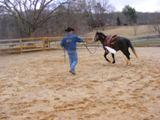
To ask the horse for an upward transition, I raise the life in my body language, thereby increasing the amount of “energy” being directed to the horse while simultaneously raising my shoulder and flag slightly. I then maintain just enough energy in my walk to keep the horse at a trot.
At the trot I am looking for a mind that is focused on me. I want ears to be alert, a bit of slack in the line, the head tilted slightly toward me, and the “flank” area to have a soft look. At this point the horse should be very soft overall.
The downward transitions are the hardest ones to make, but when we achieve overall softness in the horse, all we will have to do is simply exhale deeply, and lower the life in our body to what you had while you were asking your horse to walk. You should see your horse walking at a very relaxed state.
Practice making upward and downward transitions on the “longe line,” as it will help prepare you and your horse for making these transitions under saddle.
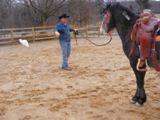
When I get ready to ask my horse to stop, I slide my hand down the rein (that is what your longe line or lead rope really is), slightly bend my body to look directly at the hindquarters, and the horse will then step across with its back feet utilizing its hindquarters even more. The horse needs to stop and “face up,” and stand with a relaxed look about its entire body.
When you longe your horse, be sure to do so with your horse moving clockwise and counterclockwise. If your horse has a “problem side,” you may need more patience and experience on that side.
Make sure to always use your body language and energy to make transitions. By doing this, you are not only preparing your horse to feel for you to make transitions while riding, but you are also learning to use your own energy to make transitions while riding, rather than pulling and tugging on the reins.
Mike Branch Horsemanship LLC, is a columnist for a few horse publications and has traveled from the south US to Canada to the United Kingdom, gentling wild horses, competing in “colt starting” clinics, demonstrating, lecturing, and holding symposiums.
Mike may be available for your next event; contact him by phone at 865-548-0112; by email at: flyingbhorsemanship@gmail.com; or visit his website:
www.flyingbhorsemanship.com


