

by Tommy Brannon
On a very rainy night March 8, 2011, approximately 125 people plus 2 horses attended a Purina Horse Owners Workshop (HOW) hosted by R&J Feed Supply in Jackson, TN. The workshop provided information about horse nutrition from Purina Mills and the featured speaker was Equine Acupuncturist Dr. Kathy Mitchener, DVM. R&J provided ample food and seating for everyone and several venders such as Tarter Gate had displays and donated door prizes.
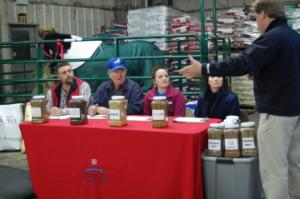
Rusty Bane, Equine Specialist with Purina Mills, educated the audience about feed, forage, and supplements in a clever and entertaining way: a game “The Feed Is Right,” a take-off of the TV game show “The Price is Right.” Four members from the audience were selected at random to sit on a panel; at their table several types of feed, forage, and supplements were displayed. Rusty asked the panel and audience questions about them, such as weight, ingredients, mineral content, nutritional qualities, and cost. The audience got thoroughly engaged in the game! Panel members were rewarded with coupons and horse-related prizes for correct answers.
The game taught the audience how to assess the nutritional needs of their horses by considering the horse’s lifestyle, use, age, history, and their body condition score. Rusty’s power point presentation showed pictures of horses as he explained the scoring system. The system scores horses’ body conditions on a scale of 1 to 10, with 1 being very emaciated to 10 being extremely obese. The ideal score is 5 to 6.5 depending on age. He also showed how to estimate a horse’s weight using a weight tape measure around the heart girth.
Weight is one of the most important considerations when choosing a feeding plan. Most people measure feed by the “scoop” and hay by the “flake,” but the amounts in each can vary widely. Feeds and hays have various densities and, therefore, various weight to nutrition ratios. So, investment in a simple scale for the feed room is one of the best tools to use to determine the proper amount of feed per seasonal nutritional need of a particular horse.
Purina Mills has done extensive research to determine feeding needs and has a wide variety of feeds for these needs. They make specific feeds for older horses, foals, pregnant and lactating mares, hard working athletes, pleasure horses, horses with digestive problems or Cushing’s disease, etc.
Cost is another factor in determining a feeding program. Rusty demonstrated that when determining cost, things are not as they seem. The cost per sack of a complete feed such as Purina Strategy may seem more expensive than other feeds, but may actually be less expensive to feed. He gave an example of the nutrition by weight of oats and hay alone as feeds, which may lack some essential nutrients. Supplements would be necessary to meet those needs. So, adding the cost of the oats, hay and supplements, the cost is higher than feeding Purina Strategy with hay.
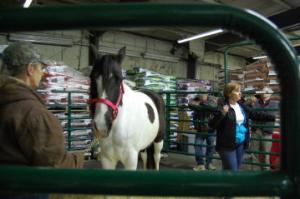
The featured speaker at the workshop was Dr. Kathy Mitchener, DVM. Dr. Mitchener is a veterinary oncologist for dogs and cats and an acupuncturist for horses. She demonstrated acupuncture techniques on two provided horses.
Dr. Mitchener explained why she was drawn to acupuncture. After completing her veterinary oncology residency at The University of Tennessee and going into private practice in Memphis, she became very frustrated and was often at a loss on how to manage the pain in some of her canine patients. She attended a seminar on acupuncture and was intrigued enough to get extensive training to become a certified Acupuncture Practitioner. Also an avid Dressage rider, Dr. Mitchener brings to the practice a perspective from both atop and beside the horse. She said that to perform acupuncture on humans in Tennessee one is not required to be an MD; but to practice on horses and dogs, one is required to be a DVM.
Dr. Mitchener explained how most medical people in the west are unaccepting of acupuncture because it is not understood in a scientific, measurable sense. Yet the practice has existed for over 2,000 years, and the results are definitely observable; plus it does no harm to the patent.
Acupuncture taps into the nervous system; inserting small needles at or near the nerve receptors generates a response in the brain. She asked the audience to shout out the names of maladies in horses and, in almost every case, she said acupuncture could be used, sometimes alone and sometimes in conjunction with other treatments to diminish or cure the problem. Some exceptions are blindness, because the optic nerves cannot be accessed with needles, and cribbing, because cribbing is mostly a behavioral problem. Her approach to treating cribbing is to increase the endorphins through acupuncture, because some behavioral problems are affected by endorphins. In the case of back problems, which are often caused by ill fitting saddles, Acupuncture is only a temporary fix.
There will be another Purina Horse Owners workshop with Dr. Kathy Mitchener and Rusty Bane on May 10, 2011, hosted by Hall’s Feed and Seed in Collierville, TN. For information call Hall’s at 901-854-5739.
On a very rainy night March 8, 2011, approximately 125 people plus 2 horses attended a Purina Horse Owners Workshop (HOW) hosted by R&J Feed Supply in Jackson, TN. The workshop provided information about horse nutrition from Purina Mills and the featured speaker was Equine Acupuncturist Dr. Kathy Mitchener, DVM. R&J provided ample food and seating for everyone and several venders such as Tarter Gate had displays and donated door prizes.
Rusty Bane, Equine Specialist with Purina Mills, educated the audience about feed, forage, and supplements in a clever and entertaining way: a game “The Feed Is Right,” a take-off of the TV game show “The Price is Right.” Four members from the audience were selected at random to sit on a panel; at their table several types of feed, forage, and supplements were displayed. Rusty asked the panel and audience questions about them, such as weight, ingredients, mineral content, nutritional qualities, and cost. The audience got thoroughly engaged in the game! Panel members were rewarded with coupons and horse-related prizes for correct answers.
The game taught the audience how to assess the nutritional needs of their horses by considering the horse’s lifestyle, use, age, history, and their body condition score. Rusty’s power point presentation showed pictures of horses as he explained the scoring system. The system scores horses’ body conditions on a scale of 1 to 10, with 1 being very emaciated to 10 being extremely obese. The ideal score is 5 to 6.5 depending on age. He also showed how to estimate a horse’s weight using a weight tape measure around the heart girth.
Weight is one of the most important considerations when choosing a feeding plan. Most people measure feed by the “scoop” and hay by the “flake,” but the amounts in each can vary widely. Feeds and hays have various densities and, therefore, various weight to nutrition ratios. So, investment in a simple scale for the feed room is one of the best tools to use to determine the proper amount of feed per seasonal nutritional need of a particular horse.
Purina Mills has done extensive research to determine feeding needs and has a wide variety of feeds for these needs. They make specific feeds for older horses, foals, pregnant and lactating mares, hard working athletes, pleasure horses, horses with digestive problems or Cushing’s disease, etc.
Cost is another factor in determining a feeding program. Rusty demonstrated that when determining cost, things are not as they seem. The cost per sack of a complete feed such as Purina Strategy may seem more expensive than other feeds, but may actually be less expensive to feed. He gave an example of the nutrition by weight of oats and hay alone as feeds, which may lack some essential nutrients. Supplements would be necessary to meet those needs. So, adding the cost of the oats, hay and supplements, the cost is higher than feeding Purina Strategy with hay.
The featured speaker at the workshop was Dr. Kathy Mitchener, DVM. Dr. Mitchener is a veterinary oncologist for dogs and cats and an acupuncturist for horses. She demonstrated acupuncture techniques on two provided horses.
Dr. Mitchener explained why she was drawn to acupuncture. After completing her veterinary oncology residency at The University of Tennessee and going into private practice in Memphis, she became very frustrated and was often at a loss on how to manage the pain in some of her canine patients. She attended a seminar on acupuncture and was intrigued enough to get extensive training to become a certified Acupuncture Practitioner. Also an avid Dressage rider, Dr. Mitchener brings to the practice a perspective from both atop and beside the horse. She said that to perform acupuncture on humans in Tennessee one is not required to be an MD; but to practice on horses and dogs, one is required to be a DVM.
Dr. Mitchener explained how most medical people in the west are unaccepting of acupuncture because it is not understood in a scientific, measurable sense. Yet the practice has existed for over 2,000 years, and the results are definitely observable; plus it does no harm to the patent.
Acupuncture taps into the nervous system; inserting small needles at or near the nerve receptors generates a response in the brain. She asked the audience to shout out the names of maladies in horses and, in almost every case, she said acupuncture could be used, sometimes alone and sometimes in conjunction with other treatments to diminish or cure the problem. Some exceptions are blindness, because the optic nerves cannot be accessed with needles, and cribbing, because cribbing is mostly a behavioral problem. Her approach to treating cribbing is to increase the endorphins through acupuncture, because some behavioral problems are affected by endorphins. In the case of back problems, which are often caused by ill fitting saddles, Acupuncture is only a temporary fix.
There will be another Purina Horse Owners workshop with Dr. Kathy Mitchener and Rusty Bane on May 10, 2011, hosted by Hall’s Feed and Seed in Collierville, TN. For information call Hall’s at 901-854-5739.


