

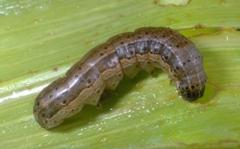
Fall Armyworms
Have made their way into some hayfields
By Becky Muller, Extension Agent
UT Extension Service
Fall Armyworms have made their way into some hayfields in Shelby County, and they are most numerous in late summer or early fall. Carried by air currents, fall armyworm moths make their way from Central and South America. The size and timing of the initial moth flights are two factors that influence the outbreak potential of this pest. Fall armyworms are unable to survive our winters because they are susceptible to cold.
Armyworm damage is most likely to occur from August- October when populations are at seasonal highs. In closely grazed fields, the grass may thin out and develop brown spots that look burned or browned out. This is the result of grass plants rapidly dehydrating after fall armyworm larvae have chewed off the tender foliage. Fall armyworm damage often resembles drought damage. In hayfields or in pastures virtually all tender green material may be removed, leaving only tough stems a few inches long. Established, healthy, Bermuda grass is rarely killed by fall armyworms, but complete defoliation caused by a severe infestation weakens plants and deprives livestock of pasture or a hay producer of a hay cutting.
Damage from armyworms seems to come in “waves” about a month apart. This is because moth activity and egg laying peak periodically, even though there is substantial overlap between generations.
Two weeks after damage has occurred, start checking for small caterpillars. Because moths prefer to lay eggs on light colored surfaces, check these first. In pastures and hayfields, fence rails, fence posts, and tree limbs are favored egg-laying sites.
Scouting pastures and hayfields can help detect fall armyworm infestations before they cause economic damage. An easily detectable sign of armyworms is the presence of flocks of birds feeding in established pastures or hay fields. Check in and around areas with dead grass or where birds are congregating. If no caterpillars are seen on the grass, look in the thatch at the base of the plants for larvae and green pellets of larval excrement about the size of bahia grass seeds. If available, use an insect net to sweep the grass in early morning or late afternoon to check for the presence of young fall armyworms. In fields wet with dew, you can find caterpillars stuck on tires of vehicles that have been driven through an infested field.
To check areas where fall armyworm populations are suspected, use soap flushes (about 2 tablespoons of lemon-scented dishwashing detergent in 1 gallon of water) to bring larvae to the top of the sod.
The decision to treat for fall armyworms depends on the stage of the armyworms and the intended use of the forage. A population of three or more fall armyworms per square foot is a reasonable treatment threshold. Timing is important. If infestations are detected too late, the damage may already have been done. If necessary, treat with insecticides at the right time. Small fall armyworms are much easier to kill than larger ones. If you check an area properly, you can determine the extent of an infestation, and spot-treat. Frequently, mowing is the best option for salvaging a hay crop. When this approach is taken, it may be possible to avoid using an insecticide. Fields damaged by fall armyworms should be closely monitored for the rest of the season to determine whether further treatment is required.
If a hayfield has been heavily damaged, fertilize as recommended to allow for another hay crop. Badly damaged pastures may need to be rested. If possible, restrict grazing on badly damaged pastures until the grass has re-grown.
If insecticidal control is necessary on perennial grass pastures and hayfields, there are several options. Sevin XLR is available without a private applicator’s license and is user friendly. Tracer SC is also available without a private applicator’s license and is effective. Mustang Max is a restricted use pesticide, requiring a private applicator’s license to purchase and use it. Pay close attention to grazing and harvest restrictions, and follow all label recommendations.
Apply insecticides early or late in the day, because fall armyworm larvae are most active at these times. Apply sprays by ground, a minimum of 30 to 40 gallons of water per acre, or by air, a minimum of 3 to 5 gallons of water per acre. Control of larvae longer than 3 4 inch, or in tall or thick stands of grass, may be poor. If possible graze the affected area before treating.
Source of information for this article: “Management of Fall Armyworm in Pastures and Hayfields” by Kathy Flanders, Don Ball, and Patricia Cobb, Auburn University, ACES.
The UT Extension Service offers its programs to all eligible persons regardless of race, color, national origin, sex, age or disability. Please call Becky Muller at 752-1207 or email at beckymuller@utk.edu with any questions.
Editor’s note: Chemical pesticides can be harmful both to targeted pests and to other beneficial insects and animals. For example, Sevin is one of the U.S.’s most widely used insecticides. Sevin XLR is highly toxic to bees, which are essential for pollination of all kinds of plants including trees. Tracer SC, aka Spinosad 45 SC (Tracer) Insecticide by Dow Agro Sciences, is “Slightly toxic to birds on acute basis and toxic to bees.” [Dow Agro Sciences Material Safety Data Sheet.] Mustang Max, zeta-cypermethrin, is a pyrethroid insecticide labeled for restricted use due to its toxicity to fish and aquatic invertebrates. Warnings for zeta-cypermethrin say: “Do not graze or harvest treated forage, straw or hay for livestock feed. Do not exceed 0.15 lb a.i. per acre per season.” [information from Phillip Roberts, Extension Entomologist and Robert M. McPherson, Research Entomologist, University of Georgia College of Agricultural and Environmental Sciences, Pest Management Handbook]
If you do not wish to use toxic chemicals on your pastures and hayfields, there are organic alternatives to controlling armyworms. Here are several sources of information: Planet Natural, http://www.planetnatural.com/site/xdpy/kb/armyworm-control.html; Green Harvest, http://www.greenharvest.com.au/fact_sheets/fs_caterpillar.html. University of Wisconsin Madison Zoology Department offers indirect strategies for armyworm control: http://www.zoology.wisc.edu/faculty/Por/extras/SMPLthatchworms.html
While the below-linked article is oriented toward controlling armyworms in wheat, it has information about organic pesticides: http://www.organicgrains.ncsu.edu/pestmanagement/wheatinsects.htm.
Excerpt from Green Thumb: “Once they come to the surface, armyworms can be killed by dropping them in a bucket of boiling water or a pan of bleach. This is the easiest, organic way to control a minor infestation. If you have a serious outbreak, you may have to resort to commercial pesticides. Always keep in mind that pesticides are all inclusive. They kill good insects as well as pests. They also contaminate ground water and can be dangerous to children and pets. Use pesticides to kill armyworms only as a last resort. The armyworm life stage is only 14 n 40 days. If you can wait it out without resorting to chemicals, they will move on naturally.” http://www.greenthumbarticles.com/article/Armyworms-a2839.html


