

In a Man’ure of Speaking
Gardening with the Mid-South Horse Review
What do you do with your Mid-South Horse Review after you and your horses, friends and neighbors have read it? The usual options are to line the birdcage, to house-train your puppy, or take it to the recycle bin. Trashing it is not an option!
The Mid-South Horse Review (MSHR), printed with soy ink and no binding, is 100% recyclable, unlike glossy publications. There are significant costs and restrictions in the recycling process of products containing clay, dies, varnishes, foils, staples or glue. MSHR contains none of these.
Printing on newsprint vs. coated stock saves trees, even before adding back in the recycle content [see http://www.conservatree.org/learn/EnviroIssues/TreeStats.shtml] Papers coated with plastic or aluminum foil, and papers that are waxed, pasted, or gummed are usually not recycled because the process is too expensive.
The use of soy-based inks reduces the level of volatile organic compounds (VOCs) emitted during the printing processes. Soy based inks are recyclable after being printed on newsprint, and easily dissolve during the recycle process with no bleaching.
Our MSHR printer strives to be as environmentally benign as possible. Our printmaking inks and solvents are ECO-FRIENDLY! including plate-making solvents. That means that there are no recordable Pressroom VOCs! All this makes Mid-South Horse Review an environmentally safe, great gardening tool!
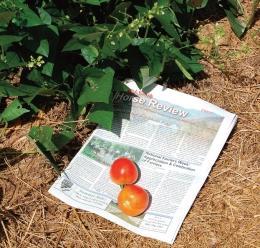
Mulch ado about gardening. Laid down underneath your oldy, moldy hay, MSHRs make wonderful mulch and a barrier to unwanted plants around your vegetables and herbs. This mulch holds in moisture so you don’t have to water as much during the summer drought. Another option is to overlay MSHRs with composted manure from your stable, which makes luscious, rich black soil teeming with nutrients for your plants! We don’t recommend fresh manure because it can be too “hot” for your plants.
Worm food. Did you know that newspapers are great earthworm food? And you want to encourage as many earthworms in your garden as possible to keep your soil loose and aerated.
Starting Seedlings. Our printer says that her family makes “newspaper cups” in which to start their seedlings. Once the plants are large enough to put in the ground, all she has to do is put the whole cup and seedling in the ground, reducing damage to the plant by removing it from the starter cup.
Resources for further reading::
http://www.naa.org/Sustainability/Newspapers-and-the-Environment/Newspapers-and-the-Environment.aspx and
http://www.naa.org/Sustainability/Environmental-Policy/Environmental-Policy.aspx
Read about “The Magic of Newspaper Mulch” in the Mother Earth News, the Chicago Tribune, at Veggie Gardening Tips, at ehow.com, and AllSands.com. Read about newspapers as worm food and worm compost systems at www.recycleworks.org/compost/wormfood.html, www.wormfarmingsecrets.com, and http://whatcom.wsu.edu/ag/compost/easywormbin.htm.


