

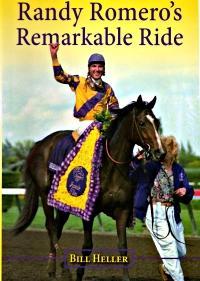
Randy Romero’s Remarkable Ride
Jockey's biography by Bill Heller
Born in Louisiana’s Cajun Country in 1957 into a family involved with horses, Randy Romero showed an early flair for riding and an uncompromising fearlessness that would follow him throughout his life. His father Lloyd J. Romero trained American Quarter Horses. This candid biography begins with the jockey’s unstable childhood in an abusive home and continues through the riding career that made him a legend.
In 1975 Randy began his professional riding career at Evangeline Downs in Lafayette, Louisiana. He was nicknamed the “Ragin’ Cajun.” His success led to his being chosen by owner Ogden Phipps and trainer Shug McGaughey to ride Personal Ensign, whom Randy would ride to an undefeated career, capped by a victory in the 1988 Breeder’s Cup Distaff. In 1989 he won his third straight Breeders’ Cup with Go For Wand. Unfortunately, in the 1990 Breeder’s Cup Distaff race, Go For Wand was in the lead when she broke down. Randy broke his pelvis and several ribs, and the filly had to be euthanized.
Despite missing six years of riding due to injuries, Romero remains one of the top jockeys in Thoroughbred racing history. He has suffered a punctured lung, broken bones, had more than twenty major surgeries, and survived a near-fatal fire from a sweatbox explosion. Through all that, Randy never gave up his passion for the sport. When he retired in 1999, he had ridden 4,285 winners.
Romero won races at such notable tracks as the Fair Grounds in New Orleans, Keeneland in Kentucky, Arlington Park in Chicago, and Gulfstream Park in Florida. He rode the distinguished fillies Go For Wand and Personal Ensign, who as a result of Romero’s perfect performance in the 1988 Breeders’ Cup Distaff, became the first undefeated major American Thoroughbred in 80 years.
Now retired from racing and undergoing dialysis, Romero exemplifies the power of the human spirit. Pictures from his past depict him as a young child already on horseback, while others show him triumphant after yet another victory. Interviews with colleagues and reflections from family members reveal a fiercely determined but soft-spoken man who overcame seemingly overwhelming obstacles both on and off the racetrack.
The Mid-South Horse Review had an opportunity to interview Randy by email.
Randy was one of eleven finalists for the National Museum of Racing Hall of Fame in 2009. We asked him about nominations for 2010. Is he still up for consideration? Randy replied, “Yes, I was nominated 8 times and am still up for consideration. I'm expecting to get in this year.”
As a retired jockey, what Randy is doing now? “I'm helping my son Randy II, who graduated from LSU with a degree in Equine dentistry. I travel with him on the days I don't have dialysis. I also work out to keep weight down and my body in good shape. Lately I've been traveling to promote my book and enjoying my two grandchildren,” he said.
Is there a particular aspect of being a jockey that the public should know about?
He replied, “Jockeys go through extreme measures to keep their weight down by maintaining strict diets and watching eating habits. This takes plenty of dedication. Gaining 2 pounds makes a difference and becomes too much weight. Also, you should focus on the commitment it takes to get to the top and stay on top, along with the challenge of the game!”
Romero was one of the stars of the HBO documentary Jockey. Every track sets weight requirements for each race, depending on the horse's age, sex and skill level and the race's distance. Yet the predominant weight scale remains largely unchanged from the original outline set in 1858, when humans were smaller. The weights horses carry generally range from 112 to 126 pounds. That figure includes the jockey plus about 7 pounds of gear.
A group of seven jockeys who screened Jockey estimated that 90 percent of all jockeys reduce their weight daily to ride. We asked Randy for his comments about the film Jockey. He said, “I thought it was done well. Many jockeys can learn from this movie and make the industry better for horses and riders. People will see what jockeys endure to keep their weight down and overcome injuries.”
This May was the 136th running of the Kentucky Derby, the one time a year when horse racing gets national media coverage. We asked if he had any comments about the health, care and well-being of jockeys? He replied, “It's a great honor to ride in these races. There is less concern on weight since there is an even weight requirement. The weight requirement is 126 pounds, while most jockeys are 115 pounds.”
As always, review copies of books reviewed by the Mid-South Horse Review are available at the Horse Review office in Somerville, TN.


