

Richard Winters Performance Horsemanship
Teaching Your Horse To Work Cows
By Nancy Brannon
Richard Winters has started many horses to working cows. But before he puts the horse in a pen with a cow, there are some basics the horse must develop. Most important is body control. “Working a cow is all about position and maneuverability in the horse’s head and neck, shoulders, rib cage, and hind quarters,” he said. “With these abilities, I can show a horse how to relate to the cow’s movements using proper body posture and movement. If you can move their body and keep them soft in the face, it makes cow work much easier.”
When the horse has developed these basic skills, the first introduction to the cow is kept simple. It is best to use quiet, slow cows for this training process. Step one is to play follow the leader. “Allow your horse’s curiosity to work and just let him follow the cow,” Winters explained. “Look for the natural cow sense that Quarter Horses are bred for” and let the horse track the cow wherever it goes. Soon “you will feel the cow begin to pull your colt along and he’ll begin to show some expression and interest on a cow. As you play this game, direct your horse as much as necessary but try to do as little as possible to keep your colt following.”
Step two is to be able to control your horse in relation to the cow. “You want to be able to stop the horse and let the cow go on,” he said.
Third step is to stop your horse parallel to the cow. “Just drift out along-side the cow until you are parallel with it and then stop when the cow stops. First and foremost the horse needs to stop every time the cow stops, turns, or moves directly away,” Winters explained.
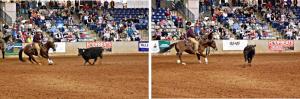
Winters used his son as “cow” to demonstrate how to walk your horse parallel to the cow. Winters would walk his horse along side his son, then when his son stopped, Winters stopped his horse. The pattern was stop, back up, turn and go the other direction. Working parallel to the “cow,” he stops, turns, and follows the “cow” the other direction. “You’re teaching the horse cadence and foot work,” Winters said. “Then you want to teach the horse to stop and turn without backing. If the horse starts to lean forward or get into the cow too much, back the horse. Then see if the horse will do this on his own: use fewer aids and see if the horse will pay attention to what the object is doing.”
The sequence is to teach the horse how to stop, back, and then turn with the cow. “By backing before the turn I ‘load up’ his hind end and help him prepare to roll over his hocks when he turns. This is when the foundation of body control really begins to pay off,” Winters said.
When you back up, you can put a hand on the horse’s neck to let him know he is done. Winters emphasized that the horse must stop before he turns. This is important cutting horse training.
Winters described the three different disciplines: ring cow horses, reining horses, and cutting horses. Working cow horses are “triathletes of the cutting horse world,” he said.
“The first few weeks of cattle work are all about confidence building, proper body position and generating interest in the horse’s mind toward cows.” In conclusion, Winters emphasized “giving a horse a job to do with the curiosity to follow. This makes the horse better and makes the rider better, too. The rider gets to looking further out and riding better when there is a job to do.”


