

Quest for the Pyramid
Adult Dressage Clinic
with Charlotte
Bredahl-Baker
By Nancy Brannon
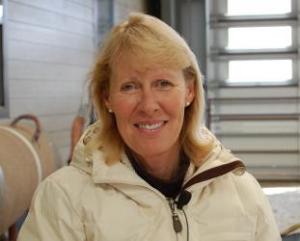
Olympian Charlotte Bredahl-Baker is the USDF 2009-2010 Platinum Performance/ USDF Adult Clinic Series clinician. From October 2009 to October 2010, she is conducting nine symposium style clinics, including a lecture, in each of USDF’s nine regions. She was in Hernando, MS on March 20-21 to give the Region 9 clinic at Mid-South Dressage Academy.
Bredahl-Baker has impressive credentials. She won a team bronze medal at the 1992 Barcelona Olympics; she rode Monsieur to USDF Grand Prix Horse of the Year in 1994 and 1997; she is a USEF “S” judge and an FEI “C” judge. At the 2009 Rolex FEI World Cup Finals in Las Vegas, NV, she competed in the Pas De Deux challenge and in the International Reining Celebrity Challenge.
Horses have been her most influential instructors. “Horses have taught me more than any person,” she said. “I think every horse gives you instant feedback, and they teach you more than a person could n if you listen.”
Born in Denmark, as a teenager, her first dressage instructor was military man Captain Nielson. When she moved to California at age nineteen, “Hilda Gurney was my early influence, then Guenter Seidel, Robert Dover, and the late Herbert Rehbein.” In recent years, she has worked with U.S. national dressage coach Klaus Balkenhol.
Bredahl-Baker defines “success in dressage” as having “a wonderful partnership with your horse at any level. You should feel at one with your horse, regardless of your riding level.” The most important aspects she looks for in a dressage horse are good temperament, trainability, and three decent gaits, in that order. “If you have three decent gaits and trainability and a good temperament, then you’re in good shape,” she said.
These Adult Clinics focus on the “pyramid of training.” The pyramid is a set of fundamental training steps, each the foundation for the next step, which forms the basis for all training of the horse. “Rhythm and regularity” are at the bottom of the pyramid and “collection” at the top. Rhythm is the first step. Rhythm is regular, even steady paces. Suppleness comes next. This means the ability to bend the body both laterally and longitudinally. The third step is contact. This is the acceptance of the bit and rider’s hands. The horse should go willingly forward into the bit. Impulsion means the pushing power. Impulsion comes from behind with push and power. Straightness will follow. The horse will remain straight on curved or straight lines. Last is collection. This means the horse has reached self carriage. The strides are more animated with more suspension. The hind legs show more bend.
For more details about the pyramid of training, see http://www.sporthorsenetwork.net/pyramid_of_training.htm and http://www.dressage-academy.com/dressage-training-pyramid.html for the interconnection between dressage skill level tests and the training pyramid.
In teaching the Platinum Performance clinics, Bredahl-Baker has several goals. “With each horse, it is all about making a better partnership with the horse. I’ve ridden and trained practically every day of my life. I’ve had experience with most breeds and can appreciate them all. I’ve judged for over 25 years, so I think I have the whole package. I have a positive approach and try to be as encouraging as possible.”
For the riders in the Region 9 clinic, Bredahl-Baker tailored her remarks and training advice to the levels at which they were riding and the goals they wish to reach. To one rider, she advised, “Work on suppleness and don’t over collect. Keep him soft in the neck.” She helped this rider with exercises in half pass and haunches in at canter. For a horse that is sluggish in the half pass, she had an exercise that alternates asking for half pass; then straightening a bit and leg yielding; then asking for half pass again. She described the sequences of movements in another exercise, “zig-zags:” shoulder fore, half pass, push the haunches out of the way, straighten, and then do shoulder-in toward the new direction. “You don’t want the haunches leading in the new direction,” she told the rider. To teach the horse trot lengthening, “introduce the medium trot in short spurts. Allow the horse’s neck to come out and down a bit. When coming back [making the transition back to regular trot] you want the horse to really 'sit down' when coming back instead of just slowing down.” So she recommended working on transitions back [from lengthening]. “If you get your horse to 'sit' in the downward transitions, rather than just slowing down, you will get higher scores. Otherwise, it’s just a 6.”
Key advice to any horse and rider at any level is to “set up the horse for success. Set the horse up to do the movement correctly. If you always do it that way, you will give the horse a lot of confidence. If you don’t have the horse set up, forget it” [asking for the movement].
Her advice for teaching the horse flying changes at canter across the diagonal. “Between changes, keep your leg on. If you leg is on, it gives the horse confidence and keeps the horse from anticipating. Make the horse wait for you.”
Champion Dressage Rider also succeeds at Reining. To watch video clips of Bredhal-Baker’s rides in the Dressage Pas De Deux and the International Reining Celebrity Challenge at 2009 Rolex FEI World Cup Finals in Las Vegas, NV, visit YouTube: http://www.youtube.com/user/windfallcb. Don’t miss her dazzling spins and slides on Reeboks Rerun with Gold medal winner Will Simpson and NRHA President Rick Weaver!
To read about her experiences at the World Cup in Las Vegas visit her blog: http://bredahldressage.com/blog/. She writes, “My instructor was David Hanson and he was an exceptional teacher. While we were spinning and sliding right outside the stabling for the World Cup horses, many of the riders came by and couldn’t believe what they were seeing. When Saturday came, we all got dressed in our finest western gear and for some of us, we had to do our very first reining pattern in front of thousands of people yelling and screaming. My horse Reeboks Rerun had been absolutely perfect in practice, but got a bit fired up in the Mack Arena. Not only was the audience very enthusiastic, but the announcer added serious sound effects like screeching brakes for our sliding stops. I can’t think of too many horses that wouldn’t be affected. When all was said and done our team won. So much fun to try another sport and I absolutely loved all the reining people. They were super nice and made it a great experience for all of us.”
The Platinum Performance/USDF Adult Clinic Series Clinic Schedule:
Region 3: October 17-18, 2009, Magnolia Farms at Live Oak, Live Oak, FL
Region 8: October 24-25, 2009, Carbery Fields Farm, Lebanon, CT
Region 5: November 14-15, 2009, Los Cedros, Scottsdale, AZ
Region 9: March 20-21, 2010 Clifton Farms/Midsouth Dressage Academy, Hernando, MS
Region 4: April 10-11-2010, Leatherdale Equine Center, St. Paul, MN
Region 1: May 8-9, 2010, Hassler Dressage at Riveredge, Chesapeake City, MD
Region 2: October 30-31, 2010, Rosebud Ranch Equestrian Center, Brookston, IN
To learn more about the Platinum Performance/USDF Adult Clinic Series and how to participate, visit www.usdf.org. To learn more about Charlotte, go to www.bredahldressage.com


