

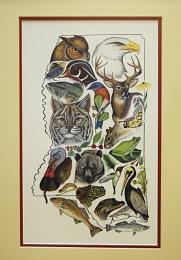
Wildlife’s Contribution to Human Quality of Life
From the Human-Animal Bond Lecture Series at Mississippi State University
By Dr. Jeanne Jones, MS State FWRC - Wildlife and Fisheries
There a strong connection between our life quality and wild nature. Often surrounded by man-made structures, many of us need activities in the outdoors, especially in places seemingly untouched by human development. “Like winds and sunsets, wildlife and nature are often taken for granted n until progress begins to do away with them” (from Aldo Leopold, A Sand County Almanac, 1949).
Cultural Views of Nature. We modern, urbanized people primarily see “nature” in terms of its commodity value, such as timber, water source/transportation, medicine, food, furs, skins. Aboriginal people had a different relationship with nature. They knew their subsistence depended on it, as their source of food and water for survival. They had cultural and spiritual links to it, which taught respect, conservation, and preservation of their basis for existence. Native Plains People, for example, had a special relationship with the Bison, taking only what they needed for food, clothing, and warm coverings, utilizing all parts of the Bison. Their spiritual, cultural, and socioeconomic health was inexorably tied to the Bison.
The South has cultural ties to wildlife and nature, too, in music, food, hunting and fishing traditions. Black Bears in Mississippi and the mountains of Tennessee, which are now listed as a threatened species, are the subject of lore. They are the origins of the Teddy Bear. President Teddy Roosevelt guided by Holt Collier hunted black bears in the Mississippi Delta.
Whole fields of academic study and professional careers are built around wildlife, such as fisheries and wildlife biologists.
Biophilia. Dr. Edward O. Wilson coined the term biophilia to describe an instinctive bond that exists between human beings and other species. Biophilia are “the connections that human beings subconsciously seek with the rest of life.” We are born curious about and are attracted to other living creatures. This innate desire drives us to explore, to pioneer, to forage, to survive. It is the key to childhood development. “We are healthier, mentally and physically, when outside exploring,” said Steven Kellert of Yale University n Socio-ecologist, Environmental Psychology.
Nature and children. The exposure to nature of modern urban children has been greatly reduced due to the loss of places to play outside, along with preoccupation with electronic gadgets. Richard Louv’s book Last Child in the Woods documents and explains “nature deficit disorder” and its impacts on children. Staying inside too much has negative consequences for children, beginning with vitamin D deficiency. There are increased risks of mental disorders, aggression, and attention deficit disorder; increased weight gain with accompanying increased risk of cardiovascular and diabetes diseases.
The answer? Direct interaction with nature reduces physical and mental health risks, contributes to weight loss, and higher self-esteem, especially in physically challenged youth. Learning first hand in nature, coupled with textbook learning, can improve math and science competencies. Nature helps children become better at conflict resolution and contributes to improved creativity (right brain function). Outdoor education has clear therapeutic value for troubled youth, resulting in less aggression, and reduction of ADHD symptoms.
What about adults? Surveys reveal that our preferred “habitat” is a camp on a hill overlooking a woodland savanna with visible water source and large herbivores. Nature stimulates intrigue and seeking of knowledge n brain health! Wildlife and wild places still offer mysteries in a “civilized” world.
Ecological Services. Nature provides abundant ecosystem services, that enable our ability to survive on Planet Earth. Clean water, oxygen, and uptake of carbon dioxide are all contributions of healthy, functioning ecosystems. Wetlands, floodplain forests, and coastal marshes can create effective barriers that ameliorate the effects of flooding and hurricane storm surges. Indicator species act as predictors of potential harm to human survival and health quality. Some species are extra sensitive to toxins and nature changes so that they give us an “early warning” to environmental problems, for example the effects of DDT on Bald Eagles that Rachel Carson revealed in Silent Spring.
The healthy functioning of the “web of life” in ecosystems includes plants, herbivores, carnivores, omnivores. The relationships between organisms create the living skin of the planet, called the biosphere. Diversity of life forms is very important to humans.
Pollinators. Account for $57 Billion/ year in beneficial plant pollination of forage and food crops; contribute to native plant beauty and diversity. More than 99% of insect species are valuable pollinators or recyclers, along with bacteria, fungi and worms. They convert complex plant and animal material and waste into fertile topsoil for plant productivity. They are food for birds and other insectivorous wildlife! Habitats that support pollinators are filled with beauty and aesthetic quality.
Fish and Wildlife Recreation. 87.5 million U.S. citizens pursued fish or wildlife recreation in 2006 and they spent $123 billion doing it, creating thousands of jobs, mainly for rural communities. The Hummingbird Festival at the Strawberry Plains Audubon Center attracted more than 8700 visitors. There are 12.5 million hunters who spend who spend $22.9 billion hunting; 30 million people went fishing, spending $42 billion. Wildlife watching and photographing is important to 71.1 million people, who spent $45.7 billion doing it. 26 million households in the U.S. feed birds because they enjoy seeing the beauty of the birds and studying them; it brings them relaxation and a sense of peace; and it is a function of humans’ biophilia n an innate desire to have wild creatures near us. “Humans would die of a loneliness of spirit without wild creatures.” (Chief Seattle)
Save a Place for Nature. “Now we face the question of whether a still higher standard of living is worth its cost on things natural, wild, and free” (Aldo Leopold 1949). Fish, wildlife and land conservation is vital for our Life Quality on the Blue Planet. We can conserve Green Belts in our yards, fields, and roadsides. Our Waters, wetlands, rivers, oceans, need less pollution and less habitat loss. “Man always kills the things he loves and so we the pioneers have killed our wilderness. I am glad I shall never be young without wild country to be young in. Of what avail are forty freedoms without a blank spot on the map?” (Aldo Leopold, 1949)
Dr. Jeanne Jones is TWS certified Wildlife Biologist and professor in the Department of Wildlife and Fisheries at Mississippi State University (MSU). She teaches courses in wildlife conservation and management, and habitat management and restoration. She is a professional illustrator and has completed illustrations for over 45 research and other publications. Her hobbies include riding horses, wilderness back- and horse packing, fly fishing, organic gardening, and playing mandolin and fiddle.
Dr. Jones’ PPT slides can be viewed at: http://msite.ext.msstate.edu/mediasite/Viewer/?peid=a1c8d425320a4bdcac7067249909af4c


