

The Healthy Horse
Blessed Broodmares
By Nancy Brannon
This month’s article on breeding issues covers broodmares, and information was compiled from several sources for a general overview of the care and breeding of mares. Sources include Dr. Carla Sommardahl, D.V.M., Assistant Professor-Equine Medicine in the Large Animal Clinical Sciences Department at UT Knoxville; Dr. John Henton, UT College of Veterinary Medicine Continuing Education; Dr. Frederick Harper, retired Extension Horse Specialist, Department of Animal Science, UT Knoxville; and Dr. Tulio M. Prado, DVM, UT College of Veterinary Medicine, Large Animal Clinical Sciences.
Following are excerpts from Dr. Harper’s article “The Broodmare in Spring.” Broodmare owners generally categorize mares as pregnant, barren, open or maiden. Pregnant mares will foal this spring; barren mares are ones bred last year but are currently not pregnant; open mares were not bred last year; maiden mares have never been bred.
Barren mares. Of these groups, barren mares are the ones who present the most problems for horse owners and veterinarians. Management of barren mares starts in the fall and includes a body condition scoring (BCS) for proper winter management and a reproductive veterinary examination. A veterinarian who specializes in broodmare reproduction should be consulted and a plan established to put the mare under optimum conditions to get her in foal. This can include placing under artificial lights in the winter and making sure she is in the proper body condition before breeding. Data show that thin mares are less likely to become pregnant and, if they do, have increased risk of bringing the foal to term. Data indicate that broodmares must have a BCS from 5.5 n 7.5 to get in foal and remain pregnant.
Open and maiden mares. If these mares were in the herd last fall, they should have been in a program to bring them to the required body condition before the beginning of breeding season. Mares starting the breeding season in the proper body condition come into estrus earlier in the season and tend to ovulate earlier. A veterinarian should check all open and maiden mares to determine that no problems exist. Some maiden mares will have been performance horses and may be 8 years old or older. Mares that have been shown at halter may be fatter than desired. While data have shown no breeding problems in mares with a BCS of 8-9, such broodmares tend to produce less milk and their foals do not grow as well. Once mares with a BCS of 8-9 are determined in foal at 40 days, owners have from 40 to 110 days of pregnancy to reduce their BCS and weight. These mares need to be exercised. They can be fed a protein-mineral-vitamin supplement designed for feeding with grass hay.
Pregnant mares. The primary issues with pregnant mares are the foaling date and their current body condition. Mares should be immunized against Western and Eastern Equine Encephalomyelitis, tetanus, and influenza, and possibly West Nile Virus. Thirty days prior to foaling, start housing mares where they will foal. These measures should insure that the mare’s colostrum (first milk) will provide immunoglobulin protection against diseases and microorganisms in the foaling area. Make sure mares are fed nutritionally balanced rations. Lack of vitamin A supplementation during pregnancy, especially in winter, may increase the risk of retained placentas and congenital contracted tendons. Feeding extra vitamin E in late pregnancy and early lactation may enhance the immunoglobulins in the colostrum that provide antibody immunity to the newborn foal.
A clean pasture should be provided for mares and their newborn foals. This will reduce the level of internal parasites in foals. Tall fescue is the major pasture problem for pregnant and lactating mares because it can be infected with an endophyte fungus (Neotyphodium coenophailum). Broodmare owners can test their tall fescue pastures for endophyte infection. The endophyte causes serious problems. Mares approach parturition without exhibiting the normal signs of foaling; stillbirths are possible; retained placentas are possible; and rebreeding problems exist. Remove pregnant mares from tall fescue pastures, and do not feed fescue hay, at 300 days of gestation.
[UT Agricultural Extension Service published a booklet “Tall Fescue: Endophyte-Infected or Endophyte-Free?” by Gary Bates, Assistant Professor, Plant and Soil Science.]
Dr. Sommardahl also advised avoiding fescue hay or pasture for pregnant mares. “It is hard to find fescue-free pasture or hay, so check with your extension agent or someone who is knowledgeable about grass content in hays so you know if the hay you are feeding contains fescue. If you do have hay or pasture containing fescue, the mare is probably going to be OK on that in the first 4-6 months of pregnancy. But the last part of her pregnancy, the mare should have fescue-free hay and pasture.”
“The problem is a fungus that infects fescue grass during growth and remains in the hay. It is hard to find fungus-free hay or pasture because the fungus travels by air and can infect a whole field that may have once been fungus-free. It is hard to control because the heat and humidity in our climate are ideal growth conditions for it. The fungus is Acremonium coenophialum,” an endophyte fungus present in tall fescue grass and seed.
“Even with all the information there is available about feeding fescue to pregnant mares, it is still a problem. Every year we see mares without milk or foals with dismaturity. Dismature foals are carried to term, but have immature characteristics. This is related to placentitis, which causes placental thickening. When this occurs, the foal does not get enough nutrients from the mare because the placenta is too thick.”
Dr. Henton focused on preparing mares for breeding. The physiologic breeding season is from April to September, during which time 95% of mares have normal cycles and ovulate. However, the operational breeding season for mares is different. In 1833 the Jockey Club decided January 1 as the universal birth date for Thoroughbreds. This led to most breeding operations starting February 15 and extending through June. But this breeding season begins when only 25% to 30% of mares are having normal cycles and ovulating. To achieve fertility in an earlier breeding season, use photoperiod management, since both mares and stallions respond to increases in length of daylight. Breeders can put mares under artificial light at the end of the day, starting mid-November or early December, increasing light gradually to 16 hours a day using a 200 watt light bulb.
Dr. Prado discussed identifying and managing “at risk” pregnancies. A high-risk pregnancy increases the potential for death or disability of the mare or fetus or both, but identifying them can be difficult. Some conditions causing high-risk pregnancies include colic, uterine torsion, uterine rupture, ruptured prepubic tendon, uterine artery rupture, systemic illnesses or injury, and pelvic fracture. They can also be brought about by placental problems, such as infection or hydrops; consumption of fescue grass or hay during pregnancy; twins; and dystocia.
To evaluate the potential for these problems, get a thorough reproductive history of the mare. Then have a complete physical examination and reproductive evaluation that include: rectal palpation and ultrasound of the reproductive tract, transabdominal ultrasound, vaginal speculum examination, and culture of any vaginal discharge. The laboratory analysis can include a complete blood count, serum chemistry analysis, hormone profiles, and serum antibody titers for infectious diseases.
Dr. Sommardahl discussed breeding lines and some concerns about in-line breeding: “Inbreeding in any species is not healthy; it can be very detrimental to the animal. But in horses, it is not uncommon to breed dams to fathers, cousins to cousins. People are trying to breed for good traits, but along with these they get bad traits. There are not many known genetic diseases in horses and only a few can be tested for in the parents prior to breeding.”
In Quarter Horses, the main genetic disease is “HYPP n hyperkalemic periodic paralysis. There is a test for it in stallions, mares and foals to determine if they are carriers.” Dr. Sommardahl said. “The disease is caused by a defect in a muscle sodium channel so that the muscles are hyperexcitable and then become weak. Some horses have tremors; some fall over depending on the severity of the condition. It can affect the heart muscle, resulting in death.”
“In Arabs,” she said, “the most well known genetic disease is an immunodeficiency in foals called SCID.” Severe combined immunodeficiency (SCID) is a genetic condition that results in the death of a significant number of Arabian foals. The condition is inherited as an autosomal recessive trait and was first identified in 1973. In 1997 it was estimated that 2.5% of Arabian foals died from this condition. Clinical signs show in the development of opportunistic infections, usually of the respiratory tract. Foals with this immunodeficiency inevitably die before five months of age.
“There are other undesirable traits that are inherited, e.g., conformation defects, but there is no way to test for them. The foals inherit 50% of their genes from each parent, therefore the good traits and the bad traits of each parent may be passed on.” she said.
Dr. Sommardahl discussed the important facets of general care for broodmares.
Reproductive exams. “I recommend a good general physical examination and a general reproductive health check for mares whether they are young or old. This includes rectal palpation and ultrasound of the internal structures of the reproductive tract. It is important to assess the pelvic and vulva conformation of the mare. The mare’s conformation can affect her risk of contamination of the vulva which can lead to infections in the uterus. Any trained veterinarian can do this general reproductive examination along with a general physical examination. If the mare is in good health, then her chances of getting pregnant and carrying the foal to term are good.”
“The natural breeding season for mares is late April to August, when they start having fertile heat cycles. Mares go through a spring transitional period which is associated with increasing daylight length. Many mares will show normal signs of a heat cycle or estrus during this spring transitional period and may even be receptive to a stallion; therefore you cannot rely on the behavior of the mare to determine if the heat cycle is fertile. Many people want to breed earlier because they want the foal to be born as close to January first as possible. Most mares will not have fertile heat cycles until late March unless they have been put under lights in the fall or early winter. Horse owners should consult their veterinarians regarding when would be the best time to breed their mares. The veterinarian will be able to determine where she is in her cycle at that point in time. If owners are not concerned about the birth date of the foal, then they should wait until late spring.”
After being bred the mare will need regular care from the owner and veterinarian. “Have the veterinarian do a pregnancy exam on the mare 15-18 days after she has been bred. That is the earliest time that the fetus can be detected. It is also important to check for twins and this is the safest time to do something about that situation if she does have twins. Mares are not made to carry twins and usually both will be aborted later in the pregnancy. The sooner twins are detected, the easier it is on the mare.”
“After the first pregnancy check at 15-18 days, then another should be done at 30 days. The first trimester is very important, just as it is in humans. It is during this first trimester that the mare is most likely to abort or reabsorb the fetus. This is usually a result of something wrong with the fetus or just one of those things that occurs. If a mare continually loses foals during the first trimester, then the veterinarian should examine the mare for hormonal problems or an infection in the uterus.”
“After this point, we usually don’t need to check the mares again until fall unless the mare has a history of problems during pregnancy. If this is the case, then she will need regular pregnancy checks, especially with middle-aged or older mares who are more at risk of carrying the foal to term. We will also check mares if the develop a vaginal discharge or have any other health problems that may affect the pregnancy. Mares don’t require regular pregnancy checks or fetal examinations like humans. Although it would be nice to evaluate the foal’s development, the ultrasound machines available today are not designed for this type of examination and do not allow deep enough visualization of the entire fetus in most mares.”
Feeding and nutrition: “For general care, the mare does not need anything special regarding her feed, nutrition, or environment in the first 5-6 months. In the last five months (pregnancies last 11 months), she may need more nutrition-wise, more calories and protein. But don’t over feed the mare; the feeding regimen depends on the condition of the mare. In the first 5-6 months, feed what she needs for her body type and work load. Keep her in good condition, but, again I emphasize, don’t over feed her. The owner’s veterinarian can help with guidelines on feed and nutrition.”
“Good quality pastures and grass hay should be the basis of the diet. Choose a reputable feed and feeds that are made for horses. Many companies do a lot of research to improve their feeds and the quality of nutrition for horses. If the feed is safe for a cow, it may not necessarily be safe for a horse.” Cattle and horses have vastly different digestive systems. “Look for consistency in feed, that every bag of feed has the same nutrient content. There are a lot of herbal supplements and 'remedies’ on the market that can be problematic. If you use them, make sure they are tested and safe for pregnant mares.”
Vaccinations: “Prior to breeding the mare should be up-to-date on all her vaccinations. Then during pregnancy, the vaccine recommended is equine herpes virus, which causes abortions if contracted during pregnancy. This should be given as a killed vaccine starting at 3 months and then repeated at 5, 7, and 9 months of pregnancy. Then, 4-6 weeks prior to foaling, we recommend a booster of all vaccines that are safe for pregnant mares. There is a 4-way shot which includes tetanus, influenza, eastern and western equine encephalitis. Other combination vaccines may include the West Nile virus and herpes virus. It is important to make sure that the vaccines used are safe for pregnant mares. Vaccinating at this time will help insure that adequate levels of antibodies against these diseases will be present in the colostrum or first milk of the mare.”
Environment: “Mares should have access to good shelter and good quality drinking water at all times. There should be no new stresses in their environment. There is no right or wrong way to keep mares, either in stalls or out in the pasture. Maintain the environment that she’s used to, while making sure she has access to shelter and shade in the hot summer months and/or colder months. Observe her regularly, and check her daily during the last trimester for any visible problems. Check her general attitude and appetite, looking for normality. As time gets closer to her due date, gestation is an average 340 days, observe her more regularly and begin preparing a place for her to foal.”
Foaling: “Two weeks prior to foaling, prepare a place for the mare to foal. It can be a stall, a small paddock, or any place away from other animals. Watch her more closely, especially if this is her first time or you don’t know her patterns. Mares are usually consistent in their foaling patterns. Mares deliver rather quickly, too. Once you see labor has begun, the foal should be out within 30-45 minutes. The onset of labor is usually the time their water breaks or you notice contractions. Once the water breaks, the clock starts ticking. Most mares don’t have problems foaling, but if you don’t see active progress, call your veterinarian immediately.”
“If you see something coming out besides the foal, call the veterinarian. The foal should come first, not the placenta. If the opposite happens, this is abnormal. If this is your first time, then you may want to have an agreement with your veterinarian to call him/her once you see foaling has started. That way, when the veterinarian arrives, he/she can help with any problems in the mare and give the newborn foal a check-up.”
“We recommend a routine foal check-up at 24 hours after birth to make sure the foal is healthy and has ingested adequate colostrums by measuring its antibody levels in the blood. Owners may put chlorahexadine solution (Nolvasan®) or 2% betadine solution on the navel or umbilical stump to disinfect the area. Be sure not to use tincture of iodine; this will burn the area. Don’t cut the umbilical cord once the foal is born; it will break on its own. However, if it is wrapped around the neck or causing an immediate problem, then it should be torn rather than cut to prevent excess bleeding. The foal should stand and nurse within 2-4 hours after birth. If the foal is not standing within this time, and seems weak or sick, call the veterinarian.”
“Mares should pass the placenta within 2-3 hours after foaling. If it doesn’t pass, it can cause serious problems in mares. Save it in a plastic bag for the veterinarian to check to be sure that the entire placenta was passed when he comes to check the foal.”
Horse owners can avoid a lot of problems if they have a good relationship with their veterinarian during the whole process. The veterinarian can check the mare at various points during the pregnancy and at foaling.
Additional sources of information are: the American Association of Equine Practitioners, website http://www.aaep.org/index.php the January 10 “ask the vet” discussion with Dr. Ben Espy is about reproduction.
The UT College of Veterinary Medicine Continuing Education program offers educational seminars for horse owners. Dr. Prado’s and Dr. Henton’s presentations can be viewed at: http://www.vet.utk.edu/continuing_ed/06Equine/index.shtml.
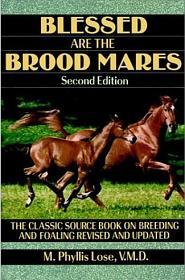
Blessed Are The Broodmares was first published in 1978 as the seminal source with a wide range of information on the care of the breeding mare from mating, through gestation, to foaling and nursing, and on the care of the young horse. A second edition (1991) is also available, and remains the mainstay of the nonprofessional breeder's library. It is a valuable, comprehensive resource for breeders and broodmare owners.


