

The Vital Importance Of Horse Hoof Care
They (hooves) help the horse perform better what the rider desires the horse to do
By Nancy Brannon
July 12-18, 2009 is National Farriers Week, so we asked Lim Couch to offer his expert advice about the care of horses’ feet. Lim is a long-time educator of farriers in the Mid-South area and a member of the International Horseshoeing Hall of Fame.
“A horse’s hoof is like hair n it grows constantly,” Lim said. “It grows faster in hot weather than in cold. In cold weather, the horse utilizes proteins to grow body hair and for body heat. In the summer, proteins go to the hoof.
“Horses that run in the wild live in areas that are more sandy, and nature self-trims their feet. Nature protects n and weak, lame horses become food for other animals. When humans put horses in our care, shoeing becomes a necessary task. Trimming properly on a regular basis prevents many problems. Regular, routine trimming prevents 'hangnails,’ for lack of a better term,” Lim explained. “Trimming is important to prevent lameness, to keep the horse in balance, and to keep the horse comfortable. It is preventive maintenance, so to speak.”
Shoeing is important and necessary for several reasons. First, shoes protect the horse’s feet on surfaces like rocks that are uncomfortable to the horse. Second, shoeing is used to enhance the horse’s performance, much like a human athlete uses special shoes for his/her sport. “A horse is shod differently for different disciplines,” Lim said. “Tennessee Walking Horses, Quarter Horses, Halter horses (which Lim describes as a “beauty contest”), Saddlebreds, hunters and jumpers, barrel racers, race horses n all have different types and weights of shoes for their varied purposes. They help the horse perform better what the rider desires the horse to do.” However, “regardless of the type of shoe used, trimming is the most important part; it is the foundation,” Lim emphasized. “How the horse is trimmed determines how the horse will travel.”
Moisture in hooves is another topic for which there are many rumors, some accurate, some inaccurate. Lim clarified: “A lot of people think you have to get the hooves wet. This works temporarily to soften the hooves, but when they dry out, you get a phenomenon like 'dishpan hands.’ When the hooves are wet, they expand; when they dry out, they contract and get hard. This wetting and drying cycle takes away the natural oil, the moisture in the hooves. Also in the summer when horses stand around and stomp their feet a lot to fight the flies, that constant pounding is hard on their feet.”
“There are a number of products out there to help keep the moisture in. One that is used frequently by local farriers is Hawthorne’s Sole Pack. When you look at hoof products, you have to be careful and ask, what is the opposite [of what they claim to do]? For example, when looking at hoof sealing products, sealing may prevent undue evaporation, but the horse already has a natural sheen covering the hoof. The key is to consider products carefully. Some products work; some are just to sell.”
“If you have a horse, take care of it: feed it regularly and trim the feet regularly!” Lim summarized. “You must keep the angles correct.” One feed supplement to grow better feet that Lim has found effective is Hoof Power.
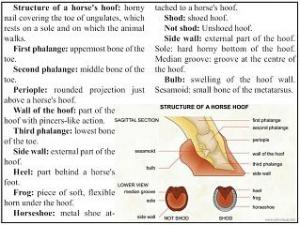
To see diagrams and examples of the horse’s hoof and leg structure, check out the images at Horse Science, http://www.horsescience.com/ There you can view anatomy charts of a normal hoof, a foundered foot, and a variety of freeze-dried models that Couch uses in his school and many other educators use in their programs. The “Educator Hinged Hoof” is excellent for understanding anatomy and the mechanics of hoof trimming, especially in the heel area. Another hinged hoof model is made from specimens with excess hoof growth and one half the hoof is trimmed. This model shows clearly the consequences of proper and improper trimming on the horse’s bones and internal hoof structures, as relates to the ability to move correctly and perform well.
On September 26, Mid-South Farrier Supplies will host an all day, FREE clinic for horse shoers and horse owners. Bob Schantz, a former student of Lim’s, will be the guest clinician. The clinic will be held at 568 Laughter Rd. S. in Hernando, MS. For more information, call 662-429-0802.
The Mid-South area’s oldest, most renowned horse shoeing school is taught by Lim Couch. The Horseshoeing Hall of Fame inducted Lim in January 2005. Lim has been a member of the American Farriers Association since 1976, served on its many committees, and was President for a few years. The American Farriers Association conducts a lot of research, which helps farriers learn the whys and hows to keep horses’ hooves healthy. You can even find Lim on YouTube! http://www.youtube.com/watch?v=Lhqk4RQCR9E&feature=channel_page


