

Celebrating 100 Years
Gates & Gates Veterinary Hospital
By Sharon Terry
April 10, 2009 marked the 100th year anniversary of Gates and Gates Veterinary Hospital in Clarksdale, MS, celebrated by an overwhelming number of clients and friends at Open House. As rich in history as the Delta is in blues, or the soil is in crop growing, this hospital has seen its share of patients from pre-antibiotic days to modern times.
Dr. William Lake Gates attended Ontario Veterinary College in Toronto, Canada, the best at that time, and returned to the South in 1908 to set up a practice. His first office was on the site where the Peabody Hotel now stands, and there was a livery stable behind the hospital.
On April 10, 1909, Dr. Gates opened Gates Animal Hospital in Clarksdale on Delta Avenue. He bought a block of land extending from the railroad to Fourth Street Bridge, where he built the practice on Sunflower that evolved over time. Behind the hospital he built a livery stable, where gypsy mule traders did a lot of mule trading there.
Gates was a prominent member of the community, active in many organizations such as the Masons and Shriners, and served on the City Commission. He was president of the North Mississippi Kennel Club and organized AKC dog shows in Clarksdale. He served as president of the Isaac Walton League in the 1920s; was president of both the Beulah Island Hunting Club and Donelson Point Hunting Club.
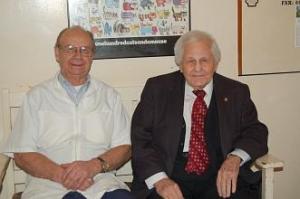
Dr. Glenn D. Gates, one of four children born to Dr. Gates and his wife Cornelia Davis Gates, followed in his father’s footsteps and became a veterinarian. He attended the University of Pennsylvania, where he won the J.B. Lippincott Award for the highest four year average. He joined his father’s practice in 1941, which then became Gates and Gates. Father and son practiced together until his father’s death in 1962. Dr. Glenn Gates is now 95 years young. Although his eyesight prevents him from doing as much in the practice, he still has a “hands on” approach.
When Dr. Gates started practicing, the work was all large animals. Treating a dog was practically unheard of and there were no antibiotics. Dr. Gates spent many a day vaccinating horses and cattle. One of the most common ailments he treated was fistulous withers (caused by collars and harnesses) on work horses and mules. Treatment consisted of surgery, followed by antiseptic cleansing and drainage. Colic was also a big problem then, often caused by too much corn and alfalfa in a hot horse or mule. Colic meant that most likely the doctor worked all night. Modern drugs such as Banamine didn’t exist. Treatment consisted of passing a tube into the animal’s stomach, pumping warm water into the stomach, then siphoning out all the fermentation. Anthrax, a bacterial disease that has residual spores in the ground, was another problem. Dr. Gates noted that by the time an animal contracted anthrax, it died so fast that there was little they could do. Anaplasmosis, caused by protozoa, was another problem, along with internal and external parasites.
One of Dr. Glenn’s favorite patients was a renowned Tennessee Walking Horse, Merry Boy, owned by Mrs. Margaret Yandell of Vance, Mississippi. The story of Merry Boy is one of going from “a perfect example of neglect” to a fat, healthy horse with a proud light in his eyes. One of the most impressive characteristics of Merry Boy was his gentle disposition. Another famous Walking Horse Dr. Gates worked on was Sir Mau Gray, whom Dr. Gates described as being of a “mean” disposition from his first encounter with the horse. However, when he saw him again years later, his disposition had improved. Dr. Gates noted that he was being treated much better and Mau Gray responded to the kindness.
One of the most unusual animals Dr. Gates ever worked on was a bear. A circus came through town and their performing bear was getting mean. They had cut off all four of his tusks with bolt cutters and left an exposed nerve. The only thing left to do was to extract the four teeth. Dr. Gates gave him two shots of anesthesia, but neither fazed him. The trainer started the truck and the bear jumped in. Dr. Gates blocked all the holes in the back except one, through which he shot chloroform. The bear slept through the tooth extraction. A year later the same trainer and bear came back through town, making a special stop to show Dr. Gates how well the bear was doing.
In 1965 Dr. Elmer Landess came to work at Gates and Gates. Dr. Landess works on both large and small animals and does surgery. After 44 years at the practice, Dr. Landess said they see more pets and small animals, in addition to large animals. Dr. Landess graduated from Auburn University and is married to the former Bessie Cullum; they have two sons.
Dr. Gates always wore a suit and tie to work. He took coveralls and boots and there was no task too dirty for him to tackle. But he always left as clean as he arrived.
Dr. Gates has been active in community activities. He was “Citizen of the Year” in 2000 and 2001. He is a member of the Mississippi Veterinary Association, was its President in 1951 and elected to the Hall of Fame in 2002. Gates and Gates Animal Hospital is located at 385 Sunflower, whereits corridors reflect medicine of a bygone era, while continuing to adapt to changing times.


