

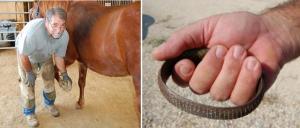
Mark Taylor, Natural Hoof Care Practitioner
“The model for natural hoof care is the wild horse”
By Nancy Brannon
Mark Taylor is a certified natural horse care practitioner, “a ‘barefoot trimmer’ some people call us,” Mark said. “I’m not a blacksmith because I don’t forge metal and don’t do metal shoes, but I am a farrier.” Mark does use other types of shoes, ones that don’t require nails, for horses that need them. Mark is certified by the Association for the Advancement of Natural Horse Care Practices (AANHCP), the founding organization promoting natural hoof care. He is also the Strategic Planning Director with AANHCP.
“The model for natural hoof care is the wild horse,” Mark explained. “The trimming is designed to copy the horse’s hoof in the wild. There are wild horses that are 20 to 30 years old and when they round up the wild horses, they usually find nothing wrong with their feet. Why is that? They spend a lot of their time moving, traveling, foraging for food. That contrasts with our pasture kept horses, who are stuck in a small area. The wild horses eat a little, then travel 3 to 5 miles; eat a little, then travel 3 to 5 miles over varied terrain. They might travel up to 20 or 30 miles a day. It’s the traveling over varied terrain, some grass, some rock, some sand, that keeps their hooves trimmed and cleaned,” Mark explained. “Horses are amazing adaptors.”
Mark told how Jaime Jackson, President and Executive Director of AANHCP, had studied approximately 2,000 wild horses over a number of years to learn about the common hoof problems that our “pasture pets” have, such as thrush, founder, and navicular disease. He said Jackson’s research found that the mustangs had none of these problems and he wanted to find out why. Some of his key explanatory factors were feed and terrain.
Jaime Jackson believes that “shoeing causes harm to horses’ feet and that going barefoot is the superior and humane way to go.” This belief and his experiences with wild horses of the west led him to become a “natural hoof care practitioner.” His first book about those wild horse experiences and natural hoof care is The Natural Horse: Lessons From The Wild (Northland Publishing, 1992).
Mark got into natural hoof care about three years ago. He has several horses of his own, but was unable to find a farrier to trim his horses’ feet as he wished. He discovered natural hoof trimmer Steve Johnson in Kentucky, who would periodically come to his area to trim all his horses. Steve got Mark interested in learning how to do it, so Mark contacted the AANHCP and entered their training program - mainly to be able to trim his own horses. As part of the learning and certification process, Mark had over 30 books to read, as well as other materials; then had to work with eight mentors in various parts of the country. To complete the program, he had to pass exams to become certified. Eventually his skills with his own horses turned into a full time job.
A main part of natural hoof care is understanding the design and function of the horse’s hoof. “A horse’s hoof designed to be self-cleaning,” Mark said. “You want to make the horse’s hoof as self-sufficient as possible. When the horse’s hoof hits the ground, it is designed to absorb the compression. It’s a pump and it loads with blood to absorb the shock of hitting the ground. With a metal shoe on the hoof, it cannot absorb all the vibration, so it travels upward and is absorbed by the knees, shoulder, all the way up. You want maximum blood flow through the hoof. ”
In the process Mark follows with each horse he trims, “The first step is to evaluate the horse’s hoof,” he said. “You want to find live sole, so you don’t invade, don’t sore a horse. Then evaluate the hoof needs. You want to nip out the sole and bowl it; smooth the sole around the frog. Start at the toe and work to the edges.”
“The horse is not really supposed to walk on the hoof wall. The horse walks on the water line,” Mark said. He pointed out the sections of the horse’s hoof: the hoof wall, water line, and white line. “The water line follows the hoof wall all the way around. The quarters are the true thickness of the hoof wall, so you want to make the hoof wall the same thickness all the way around. When you get finished, you should have a hoof wall with no flares.”
Mark cuts at a 45-degree angle with his nippers. He also rolls or bevels the edge of the hoof wall. One of his finishing touches is to use sandpaper on the bottom outside of the hoof wall to remove any frayed horn and to stimulate the periople in the hoof wall. “You want the hoof wall edge to be thoroughly rounded with no sharp edges anywhere.” Mark likened it to a human having “no hangnails.” All the tools Mark uses are basically the same as other farriers use. There is an additional rasp that he uses to smooth the sole and make sure it is concave.
Mark is not opposed to shoeing horses nor does he want to try to change traditional horse shoeing. He does use three kinds of shoes, according to his clients’ needs. The one he uses most often is like a tennis shoe for horses, the Cavallo Simple Boot. He also uses Renegade Hoof Boots, and Easyboots, as the horses’ feet and uses require. He has found that “Easyboots have been improved over the years, especially with the addition of the gaiter so it comes around the bulbs of the heel. I’ve found a trick to getting them on, too. Just spray the inside with a little Pam and they slip on much easier,” he said.
Mark talked about the success he has had with foundered horses. “The pain is in the toe, so I drop the heels a little further [than usual]; it doesn’t take much to get the pressure off the toe. The flexor tendon in the back will stretch.” But along with proper foot trimming, Mark says changes in feeding are most important. “Take them off the sweet feed. Many require a dry lot and just water and hay. Keep them trimmed, keep them in a dry lot for a period of time and solve the problem mainly through diet.
Katherine Lynn of Williston, Tennessee is caring for a horse, JIMBO, who has chronic founder. Following Mark’s trimmings and his feeding recommendations for the horse, JIMBO’S recovery is quite a success story. Mark was recommended to Katherine, and when she called him to come to assess JIMBO’s problems and needs, the horse “would get down and not get up. We thought we might not ever be able to ride him and might have to put him down,” Katherine said. “But Mark recommended we put a grazing muzzle on him and we did. Mark worked on him every four weeks for eight months. And after that time, he was actually running in the field, which he hadn’t done in three years. Then later on I was able to ride him.” Since he’s foundered so many times in the past, he is much more susceptible to founder. Katherine believes, “Mark is an awesome farrier and the price for what he does is excellent. He’s always reliable and punctual. He’s taken a lot of time with the horse. I am so glad to have found him” and she is very pleased with the marked improvement in the horse. ”He’s really good and I’m impressed with his work.”
Mark displayed a copy of Jaime Jackson’s latest book: Paddock Paradise: A Guide to Natural Horse Boarding. In the book Jackson explains his feeding program and diagrams his “Paddock Paradise.” The area where the horses are kept is double fenced around the edge like a Hitchcock pen, and there are a variety of places for horses to gather, such a dust rolling place, a foaling place, several shady areas, and a variety of places to water and eat. Mark follows this model in the care of his own horses. “I don’t feed them at the same place at the same time, which bothers a lot of people. I feed them at a variety of times and vary the places where they eat. I make them work for their food.”
Mark also has knowledge of horse nutrition and can assess a horse’s nutritional needs, in addition to trimming their hooves. “I first evaluate what the horse is taking in, and then plan from there.” He recommends finding feeds with less sugar, less cane molasses. “Feeds need some molasses to hold the grains and pellets together, and feeds with 6% molasses or less are okay.” It is also important to trim the horse every 4 to 5 weeks to keep them in balance. “Keeping the horse in balance is very important.” This, with proper diet, “keeps the horse at peak performance,” Mark said.
Based in Ashland, Mississippi, Mark said he has over 450 customers and travels to West Memphis, Arkansas, to Dyersburg, Tennessee, to Jackson and Henderson, Tennessee areas to Florence, Alabama, and to north and east Mississippi.
For more information about Natural Hoof Care and theAANHCP, see http://www.aanhcp.net/. To contact Mark Taylor, call (662) 224-3043 or e-mail talloakhorsefarm@yahoo.com.
Cutlines for photos:
DSC_0742:
DSC_0748: Mark Taylor shows the rasp that he uses to smooth the sole and make sure it is concave.
Hoof-diagram.jpg (self explanatory)


