

The Roads To, In, And From Afghanistan
Personal Journal by Guy Buck
For those of you whom I have not had the pleasure to meet, my name is Guy Buck and I have been a farrier in West Tennessee for about 20 years. I have specialized in Endurance horses for the last 10 years and spend most weekends covering an Endurance ride somewhere in the Southeast. Now if you’re wondering what any of this has to do with Afghanistan, let me explain. In January 2006 I was just like many of you: having worked the same job for years, I was ready for a new adventure. Looking back, many times I have asked myself why? I had a good business, great customers, mostly good horses, and very few problems in my professional life.
Actually I had wanted to see Afghanistan since the early 1980s. I had always been amazed at how rugged the people and country appeared on the nightly news. I was drawn to that beauty and saw an opportunity to maybe make a change in a war-torn, recovering country. A few phone calls and an unbelievable amount of paperwork later, I was on my way to Afghanistan to help train the Afghanistan National Police. A qualifying matter that I failed to mention is that I am also an ex-Law Enforcement Officer and the US State Department contracts with civilians to train and mentor police officers in recovering countries.
To skip many of the details, after letting most of my customers know that I would be missing for awhile (I say ‘most’ because I found out later that some had been missed - big mistake), I arrived in Kabul, the capitol of Afghanistan in March 2006. I could not believe the state of things! Third world does not begin to describe this country. None of the things that we take for granted were present; the roads were unimproved even in the capitol and nonexistent when you ventured beyond the city limits; no public utilities; no infrastructure; and the security situation left a lot to be desired.
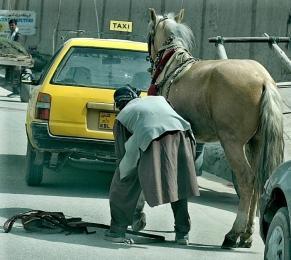
I was amazed that during my initial ride from the airport, there was a large amount of equine traffic on the roadway. The horses of Afghanistan were earning their keep: they carry extremely large loads on small carts that are being pulled mostly by horses that resemble small Arabians. I was immediately struck by how small and malnourished most of the animals seemed. After I was in-processed and settled in, I had the opportunity to ask some of the locals in camp about the horses I had seen. The overwhelming opinion was that they looked good considering that it was the end of the winter, most of the winter stores of forage had been used, and it would be a while before the new grass would be in. They were right; within the first few months summer came and the horses of Afghanistan began to transform before my eyes. I wouldn’t say they ever fattened up, but they definitely started looking better. There is a very short period of time in the late spring and early summer when the landscape transforms into a beautiful green that contrasts with the rugged mountains in the background. As fast as the landscape turns green, it becomes brown and dry by mid summer. I found that most of the population spends every extra moment gathering any type of forage to store for the dry summer and winter to follow.
Being a farrier I set out to check out their feet, which sounds easy, but considering the security situation, you can’t just walk around and mingle in the community. I began sitting at the front gate and waiting for horses to come by. Again, that sounds easy but considering there is a language barrier, getting them to stop and to allow a crazy American to look at their feet became a challenge. Not one to give up easily, I eventually did have the opportunity to check out a lot of horses in Afghanistan. These are my impressions of the horses of Afghanistan.
In spite of everything I saw, and most of it wasn’t pretty, most of the horses were extremely sound. How can that be? Surprisingly, the majority of horses are shod; even more surprising, they are shod with machine made shoes and stamped nails (although clinches are long and ugly). The tools used for shoeing are similar to the ones used around the turn of the century in the United States. Wooden rasps are used and most tools are showing their wear. Most of the work was functional if not pretty. They don’t spend a lot of time removing flares; they just seem to nail it where the foot should be and forget it. The result is an ugly but functional arrangement. I also learned the hard way that most horses are shod in stocks and don’t like to have their feet messed with. I looked like an idiot trying to pick up a horse’s feet to take a picture until the owner told me the horse had never had this done before. And I thought I was losing my touch.
Horses in Afghanistan are used for work; no pasture ornaments here! If an animal isn’t up to the task, he is more valuable as food. That sounds harsh, but the result is an equine population that is rugged, hardy and sound. I did see some very blatant abuse, but nothing worse than I have seen in the U.S. I did see a few animals dead in the harness; again that sounds tough, but the animal did not go to waste and the equine population was strengthened because of it.
I observed very little pleasure use of horses in Afghanistan; they are primarily a beast of burden. The one exception is the sport of Buzkashi, the Afghanistan national sport. If you are not familiar with the term, the sport is a cross between polo and soccer played on horseback using a headless goat or lamb as the ball. It is an amazing action-filled sport that is not for the weak or weak-hearted. This is a sport of the wealthy and the horses involved are well taken care of and extremely valuable. However, I did not see an event farrier on stand-by at the stadium.
The best part of being away from home, horses and customers is coming home. I have an unusual customer base: I have been shoeing for some of my clients for approximately 17 years. Almost without exception they were understanding and have been excited to hear about my adventure, and more excited to get back on my schedule for their horses’ hoof care. I will never take for granted the value of my family or good customers and friends. I have spent the first month home taking it easy and getting back into the groove of things. My wife could not believe how soft my hands had become and she hates to see them get rough again. My back can’t believe that it used to do this every day all day, but I’m beginning to convince it that it did.
In closing, I feel that horse shoeing is a calling and I never really appreciated the value of the profession until I stepped back and took a good hard 18-month look. There is no doubt in my mind what I’m supposed to be doing it and if I ever start to doubt again, all I have to do is look back, remember why I do what I do, then bend over and get back to work.
For more information about Guy Buck’s shoeing services, call 731-439-0868, e-mail him at guybuck@hotmail.com or visit his website at http://www.buckfarrierservice.com.


