

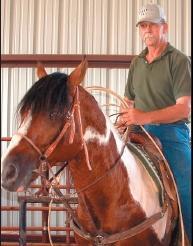
Training With A Sonny Disposition And A Heart Of Gould
by Nancy Brannon
Sonny Gould has been riding horses almost all his life and made a life-long career out of riding and training team roping horses.
He’s a soft-spoken, easygoing guy who tries to get the best out of the horses he’s working. His history of success with team roping is long.
On the day that I spoke with him, every horse he was riding wore a saddle with some kind of championship imprinting on it, like “USTRC 99 Eastern Finals,” “NIRA Ozark Region Champion Team Roper,” “L & M Productions Champion 2002.” Even a saddle pad was monogrammed “USTRC Southeast Regional Finals.” Sonny humbly admitted, “Yes, I’ve had a few successes.”
Interestingly, he has sold several of the saddles he’s won. “Some people would rather buy a used saddle than a new one,” so he has parted with a number of his prizes.
Sonny has spent a life time working and riding horses at ranches across the country. He started at age 15 in Pawhuska, Oklahoma, where he worked for Gene Herren in the summers breaking, training, and trading
horses. Gene was a PRCA bareback and bull rider, so he got Sonny started into rodeo, too. “I rode in amateur bareback and bulls for nine years, ” he recalled.
Then he got into team roping. “It was a lot easier on the body,” he said and he has been doing it since 1964, when he got out of the army. “I spent 12 years with John Oxley in Tulsa, Oklahoma,” a man who made his money in the oil business. Sonny worked on his registered Hereford ranch in Pawhuska, Oklahoma, and started 15 to 20 colts for him. “He used his horses for polo,” and had a lot of Thoroughbred horses at his ranch.
From there he moved to Donie, Texas and worked at M.B. Hunter Ranches for five years. Then he was transferred to AtokaRanch in Oklahoma, working for eight years there doing team roping, training, and trading horses across Texas and Oklahoma. After that he went to work at Buckner Hunt’s “Bluegrass Farms” Lexington, Kentucky. He ran the cattle operation and his friend Larry Richardson ran the Thoroughbred operation.
Most recently, he worked at Dogwood Farm in west Tennessee for fifteen years before moving a short distance down the road to build up his own farm and ride for himself. He just finished a 100 by 220 feet indoor arena in March, and is back to training team roping horses for customers whose horses come from all over. He’s currently working with horses from Indiana, Kentucky, and Mississippi.
His arena has everything a team roping trainer needs, complete with cattle pens and an automatic chute, which he operates by remote control so he can decide when the steer leaves the chute. The arena even provides shade and a cool breeze to help cope with west Tennessee’s sultry summers.
Asked about his secrets to good horse training, he could not think of anything special that he does, although he has a knack for finding out just what a horse needs. “Horses are like persons,” he said, “all with their own personalities and quirks. I just work with the horse until I figure him out” and find what it will take to make the horse a success. “Some horses won’t make it; they don’t like the box or there will be something about it [team
roping] that they don’t like. But most horses, if you give them a chance, they’ll come around. I can watch a horse, or ride him or feel him, and tell you what you need to do to fix him.” There are times when people start team roping on horses that are too green, that are not finished. So Sonny “finishes them so they can become competitive horses.”
There are some common problems that Sonny sees with team roping horses that are similar to problems in other riding disciplines. One problem is not liking the box, a problem eventing horses have, and race horses who are upset by the starting gate. Some horses anticipate and are too eager, a problem similar to hunters/jumpers who rush fences. Another is “being able to rate a cow,” he said. “You’ve got to teach the horse how to set himself up, and carry the weight, and then face the cow. You want the horse to handle well, to have him well-broke before the contest. You want him to stop, turn around, and log.” By log, Sonny means that the horses
literally pull a log, dragging it behind them, to simulate the weight of the cow pulling against them.
One horse that Sonny has in training now, he described as “too eager. He seems like he has never been tired.” His owner had made a pet of the horse and taught him tricks like bowing. “He needs to be fatigued; it will help him appreciate it [the work].” Sonny is training another horse who “has a lot of speed and ability, but doesn’t like the box.” So he worked with him “about 45 days. He’s now relaxing, although he still has a way to go.”
In team roping, the head horse has more stress on him than the heel horse. “The head horse has to gather himself, get to the cow, then slow down, and take the weight of the cow. He’s under more pressure. The heel horse can just kind of float out,” Sonny explained.
Over the years, “team roping has been good to me,” Sonny reminisced. “I’ve made a lot horses and sold some good horses. Today, good prospects are hard to find. More and more ranches are using pick-up trucks and 4-wheelers to work cattle. Horses are not really used as much.” When people do bring their horses to Sonny for training, “some might want a 30-day run through. Others want me to keep the horse until he is made, or until we know the horse won’t make it.” If your horse is not going to make it, Sonny will tell you so he doesn’t waste your time and money. “Some customers appreciate it,” his honest approach, ‘some don’t.”
To contact Sonny Gould, call (901) 491-1678. His arena and farm are located at 1995 Poole Road in Moscow, Tennessee.
For more information about team roping, see the United States Team Roping Championships web site: http://www.ustrc.com/Home/ or Team Roping.com at http://www.teamroping.com/.


