

Acclaimed Author Extols Virtues Of Horses, Hounds, And Hunt
At Davis Kidd Booksellers in Memphis
Fans of foxhunting and fiction alike enjoyed an evening of real “infotainment” when accomplished author Rita Mae Brown appeared at Davis Kidd Booksellers in Memphis, Tennessee on Monday, October 23.
Although the event was primarily touted as a book signing for her latest work, “The Hounds and The Fury,” Brown spent just over an hour talking mainly about the sport of foxhunting itself. “The Hounds and The Fury” is the fifth in a series of mystery novels by Brown that take place in a world where the hunt, the horses, and the hounds are central to the story. Brown said she began the series after wondering if people would “...like to enter into our world (foxhunting), and it turned out they did.”
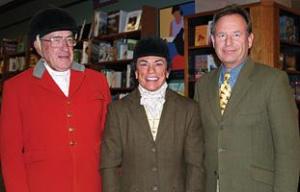
The author, herself a Master of Foxhounds at the Oak Ridge Hunt Club in Virginia, happily shared the spotlight with a trio of Mid-South foxhunters: Oak Grove Hunt Club Masters of Fox Hounds Dickie Watson and Jack Bowman, and an affable Penn-Marydel hound named Garfield. An avid foxhunter herself, Brown graciously afforded Watson and Bowman ample opportunity to promote both their club and Memphis-area foxhunting in general.
During his remarks later in the program, Bowman made it clear to the audience that American foxhunting is not like the English version, where the fox population is so abundant and destructive it is considered a serious nuisance by some.
Mid-South clubs chase both foxes and coyotes, but the goal is never to harm the animal. On hunts where the hounds actually find quarry, the event ends when the animal “goes to ground,” finding a place to hide.
“Generally, in American foxhunting, we’re not out to kill a fox or a coyote,” said Bowman. “That’s not the object of American foxhunting...Our object is to follow the hounds, be out in the sunshine, have companionship with our friends. I’ve been hunting for almost 40 years, and I have never been in on a kill because we do not kill foxes or coyotes or anything else when we hunt.”
Brown began by introducing Watson, who also serves as Oak Grove’s Huntsman (the person who directs the hounds in the course of the hunt), quipping that he “...has a whip, and when a man has a whip you do what he says.”
Watson did have an ornately-crafted hunt whip, but quickly explained that its primary use is “...to keep the tree branches out of my face or to reach out and close the gates” while on horseback. “It can be used for punishment,” he said, “But it’s just a good tool.”
Despite the generally quiet atmosphere of the book store, Watson was finally coaxed into giving the attendees a short sample blast on his hunt horn, which he uses to communicate with the hounds during a hunt. He explained the types of commands he makes with the horn, which Brown later described as “...a very, very nice banded Goodall.”
Watson welcomed Brown, and said Mid-South foxhunting is “...alive and well, and has been...” since he began riding with the hounds in the mid-1960’s. While he remarked that the sport is “...all about the hounds,” he also acknowledged it was his initial love of horses that brought him into foxhunting.
He gave a brief history of the Oak Grove organization, saying that 2006 marks its 60th anniversary and noting that his colleague, Jack Bowman, has been a Master for half the club’s existence.
Watson announced the club’s official opening meet on the second Saturday of November, and invited anyone who might be interested in participating or watching to contact the club for scheduling and location, noting that hay wagons will be available in which spectators can ride as they follow the “field” of riders.
He then introduced Bowman, who related his introduction to foxhunting while trying to rent a horse in Germantown, Tennessee, in the mid-1960’s. When he arrived at the facility, he was told, “This isn’t that kind of stable. We teach you to ride and jump and follow the hounds...On the way home, I said, ‘He thinks I’m going to get on a horse and jump over a fence with it? He’s out of his mind!’” Nevertheless, he went back the next weekend and began taking lessons and “...haven’t been off a horse since. It’s really been great.” That comment prompted a fellow foxhunter in the audience to respond, “We’ve seen you off a horse a couple of times,” which brought a round of laughter from everyone, including Bowman. “Well, maybe involuntarily,” he replied.
Bowman went on describe some of the conditions under which hunts are held, or called off, talked about some of the progress members of the club have made since they started, and gave the listeners a vivid picture of what they would experience if they attend a hunt.
Brown, Bowman, and his wife, Joan, were all dressed in variations of the official garb of foxhunting, and Brown and Bowman gave the audience a detailed explanation of the significance of each item, and the guidelines within and between hunt clubs.
Bowman, clad in the familiar long-tailed scarlet jacket, white breeches, and boots, explained his outfit is worn only by those who “...have been around a while, know how to hunt, and look after everybody else.” Brown, clad in a subdued olive-toned tweed jacket, said the sport’s protocols dictate that Masters from other clubs not wear their red coats unless explicit arrangements have been made with the local club. Both she and Joan Bowman were wearing what Jack Bowman called “ratcatcher” outfits, or clothing worn on hunts which take place before the official season begins. He said those coats are exchanged for black ones when the official hunts begin.
Brown also remarked that it has only been in the last 15 year or so that women were allowed to wear the scarlet jackets, commenting that the garments make it easier to track riders while they’re in the woods.
She touched on the inter-club protocol, adding it would help readers get more out of “The Hounds and The Fury,” by drawing attention to the small ribbons on the backs of the black-velvet covered helmets the riders wear, explaining that “loose” ends on the bows indicate “staff members” of the local club. “If I were to be hunting with Oak Grove, I would die before I would do that, it would be so rude. I would wear (a) hat with the ‘tails’ up.”
Brown then spent half an hour or so extolling the virtues of foxhunting, remarking that it is “...the only sport that cannot be commercialized and corrupted...You are not going see the hounds at a hunt with (dog food) advertisements on their loins. You are not going to see a Master with big ad on his back (for equine products.). That will never happen...We all do this because we love it.”
She spoke about how foxhunting touches on a number issues: weather science, mankind’s connection with nature and animals, the impact of development on the environment, the fact that people on all socio-economic levels can participate in the hunt, and comparisons of the physiology and natural abilities of both hunter and quarry.
“That whole idea about foxhunters being snobby, it’s not American,” said Brown. “In America, slaves hunted. If you had the ability, out you went, with the horses or the hounds...We have people that hunt (on) mules. I assume ya’ll do, too. You don’t need a lot of money, but you have to have good manners.”
“If you’re working with horses, the first thing you have to learn is that fundamental instinct (for survival),” she said. “The horse isn’t stupid. Those instincts are what has kept it alive...You figure out what’s going to make them “shy,” and you get them through it You get the animal to trust you. A horse will die for you, a horse will die under you, it has such a big heart.”
Questions from the group prompted Brown and Bowman to talk about horse breeds suitable for foxhunting,
Brown responded to a query about the “best” horse for hunting by saying participants should ride “...the one you love...The horse that you connect with and work with.”
Bowman said his first “really good” hunt horse was a cross between a thoroughbred and an Appaloosa, and that he’d ridden a Hanoverian, a cross between a Percheron and a thoroughbred, and a cross between a Clydesdale and a thoroughbred.
Toward the end of the session, Watson brought in Garfield, member of a breed he said is known for large ears and “deep, melodious voices, which Brown described as sounding “...like Bach.” While Garfield made friends with members of the audience, the three speakers described the various breeds favored by foxhunters, and the talents that make each breed uniquely suited to the sport. Before turning to signing books, Brown briefly entertained the crowd with some history and stories about various types of hounds.
For more information on Oak Grove Hunt Club, visit their web site at http://www.geocities.com/oakgrovehuntclub.
You can find out more about Rita Mae Brown at her web site, http://www.ritamaebrown.com.


