

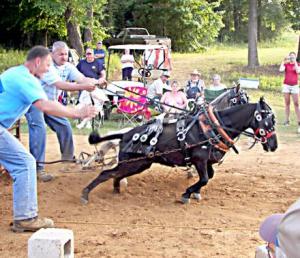
Pony Pulling—A "Little" Horsepower Can Go A Long Way
by Michael Osburn
There's an enormous variety of horse-related sport out there, but every once in a while something pops up on the radar screen that many equine enthusiasts may never have heard of, or hadn't thought about for a long time. Pony Pulling is one such activity, and rest assured it's alive and thriving all over the country, especially in the Mid-South.
Eddie Stroupe, President of the North Mississippi Pony Pullers Club, recalls attending pony pulls with his uncle when he knee-high to a Shetland, and he says the family-oriented sport has been around much longer than that. And it's been around in Kentucky, Missouri, Tennessee, Kansas, Oklahoma, and a whole lot of other places, as well.
Stroupe has been the club's president for a couple of years and, except for missing some time during his military career, has been a member “...at least since I was twelve,” but he was involved a good six years before that.
He says most of the human teams involved in training pony teams often includes the whole family and that the competitions his club organizes are great entertainment for families; the pony teams usually consist of a pair of Shetland or Welsh athletes. Participation is high; the added money events draw about 50 teams, and club secretary Crystal says as many as 70 teams have competed in one event.
The training for a pony pulling team begins early in life, and the ponies develop the strength, stamina, and discipline that will eventually help them pull a flat-bottomed sled that weighs in at 600 pounds, before any additional ballast is added. “It takes a lot of effort,” says Stroupe. “You have to work with your horses almost daily, training and preparing them, making sure they get the right feed and vitamins. It takes a lot of work to make it pay off.” More about that “payoff” later.
Each team is weighed before a competition, and assigned to one of three divisions based on how they tip the scale: light, medium, and heavy.
The lightest team kicks off the event, starting with a loaded sled that's twice their weight. The goal is to pull the load six feet in one shot, with 3 attempts available for each run. Stroupe says most teams accomplish the first couple of runs fairly easily, and the competition obviously heats up as the load increases.
After all teams have finished the first run, the weight increases to two and a half times, then three times, and so on until it just can't be done. When teams that can't make a complete pull in a weight class, their efforts start being measured in inches, which figures into their final standing.
The North Mississippi Pony Pullers “season” usually starts at the beginning of March and runs through the end November, with meets held nearly every weekend. If the competitions aren't taking place at one of Mississippi's numerous county fairs, the group will rent one of the region's agricultural arenas for a meet. Stroupe said the organization has booked the facility at Pontotoc, Mississippi for five events this year.
“They've got really good dirt for pulling,” says Stroupe, and that's an important component of a pony pull. “The ground is very important,” he says. “You want to avoid sandy dirt. The pulling may not be fair, because the sled cuts into the sand. A lot depends on where you hook up in pulling, but the ground preparation is really important. If it's not right, the teams can't get the traction they need.” He gives a lot of credit for site preparation to Alfred Burton of Burton's Sugar Farm in Michigan City, Mississippi, and says the conditions there are prime for a pony pulling.
“He (Burton) really does a good job getting the ground ready,” says Stroupe. Word gets around about conditions, and Stroupe says the events draw more teams at the better-prepared sites. Burton's Sugar Farm is hosting several of the competitions this pulling season.
Although no breed dominates the sport, Stroupe says most of the pony teams averaging between 35” and 51” are the most commonly used in his area. “There aren't many true miniatures...The last few years, there have been a lot smaller ponies. There are a lot of them that size in Missouri, and a lot have been coming from there. There's been a surge of 35” to 38” ponies. That seems to be what people are going for.”
So, if breed and size aren't particularly important in a winning pony team, what does it take to pull in a prize? “You've got to have good ponies,” says Stroupe. “They have to be alert, they can't be deadheads. A good pony has to have some 'action' about him, to be one of the better pullers. He's got to get up in the bridle good.”
Now about that “payoff.” Stroupe says it's not expensive to get into, and repeats that it's a great thing to get the kids involved in, provided everyone is up to the commitment it takes. Once you're ready to compete, figure on an entry fee of about $12.50 per team. Some contests are strictly jackpot events; teams compete for prized based on the entry fees. Other events pack a little more punch, with host sites and sponsors kicking in some added money and others offering feed and other necessities as prizes. Stroupe says for the non-jackpot pulls, he estimates contributors bump the average total purse by some $500 in added money.
On September 7, the club will be hosting a competition at the Benton County Fair in Ashland, Mississippi, at the end of the month they head to the Muhlenburg Fairgrounds in Central City, KY for the Kentucky Championship Pulling, and in early October they're back at Burton's Sugar Farm in Michigan City. For the rest of the pony pulling dates this season, check the Calendar in this month's Mid-South Horse Review.
If you want to know more about Pony Pulling in north Mississippi, call Eddie Stroupe at 662-587-9494, or phone the club's Vice-president, Jim Graves, at 662-837-4867.
Even if you're just interested in watching the mighty mites show off their strength, the North Mississippi Pony Pullers would be more than happy to see you. “If they want to come watch, we sure invite them,” says Stroupe.


